
Designing Social Firewalls: A Strategic Framework for Influence Containment
On social network firewall selection
The paper introduces the weighted Segregating Vertex Set (wSVS) problem, a novel graph-theoretic approach to competitive influence containment in social networks. It proposes a Mixed Integer Linear Programming (MILP) model for optimal solutions and an LP-relaxed rounding heuristic to find a minimum-weight "firewall" that restricts a competitor's influence to less than half of the network's total weight.
Executive Summary
In the hyper-competitive landscape of Online Social Networks (OSNs), the battle for market share is often a zero-sum game. This paper by Mazumder and Sen introduces the weighted Segregating Vertex Set (wSVS) problem—a strategic framework for defensive influence management. Unlike traditional blocking methods that try to stop as much influence as possible under a budget, wSVS focuses on guaranteed containment: finding the cheapest way to ensure a competitor never captures more than 50% of the network. This work bridges the gap between graph theory, competitive marketing, and epidemic control.
The Core Challenge: Containment vs. Mitigation
Modern influence research typically focuses on Maximization (growing your own reach) or Blocking (minimizing the reach of others). However, from a business or public health perspective, there is often a critical "tipping point."
The authors identify a major gap in prior work: they don't guarantee a majority save. In scenarios like political campaigning or standard wars, letting the "opponent" reach 51% of the population is a total failure, even if you successfully blocked 49% of their potential. The wSVS problem treats the network as a battlefield where a "firewall" (a set of nodes to be neutralized or incentivized) must be strategically placed to physically partition the graph.
Methodology: From MILP to Heuristic Logic
The authors prove that wSVS is NP-complete by showing it is at least as hard as the Set Partition Problem. To solve it, they provide two paths:
1. The Optimal Approach (MILP)
They define a Mixed Integer Linear Program where nodes are assigned to three possible states:
- P: Reachable by the competitor (Player A).
- Q: Protected and unreachable.
- C: The Firewall (The nodes we pay to stay neutral).
The objective is to minimize the weight of set C while ensuring weight(P) < weight(Q) + weight(C).
2. The Heuristic: Iterative Rounding
Since MILP is computationally expensive for large networks, the authors propose a heuristic based on LP relaxation. By allowing nodes to be "partially" in the firewall, they obtain fractional values that indicate which nodes are most critical to the partition.
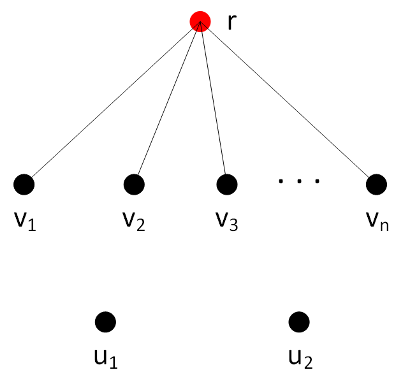
The heuristic selects nodes with the highest "fractional separator" potential until the reach of Player A is successfully contained. This leverages the mathematical intuition that nodes bridge-forming components are the most valuable tactical assets.
Experimental Insights
The researchers tested their approach on several graph topologies that mimic real-world interactions:
- Barabasi-Albert: Modeling scale-free social structures where a few "hubs" dominate.
- Watts-Strogatz: Modeling "small-world" phenomena with high clustering.
- Facebook Dataset: Testing on 4,039 nodes and over 88,000 edges.
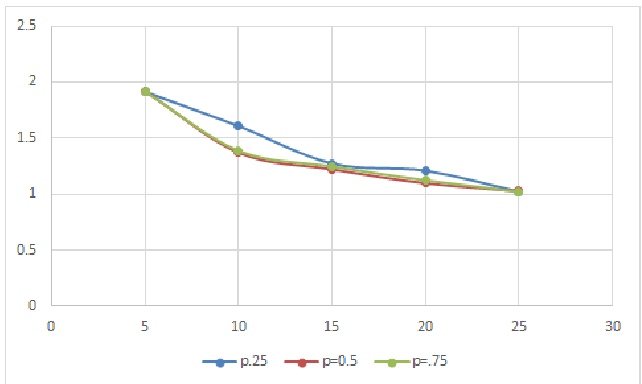 (a) Results for Barabasi-Albert Network showing the ratio of Heuristic weight vs. Optimal weight.
Key findings include:
- Efficiency: The heuristic's solution is consistently within 2x of the mathematical optimum.
- Topological Robustness: The method works effectively whether the network is highly clustered or sparse.
- Seedset Sensitivity: As the competitor's initial "seedset" increases, the cost of the firewall naturally rises, but the heuristic remains stable.
Critical Insight & Future Outlook
The beauty of the wSVS formulation lies in its abstraction. While framed as a social network problem, it is fundamentally about Resource Allocation under Constraints.
Limitations: Currently, the model assumes an undirected and static graph. However, real social influence is often directed and time-dependent.
Takeaway: For CTOs and researchers, this paper provides a robust mathematical foundation for "defensive AI." Whether you are protecting a cloud network from a cascading failure or a brand from a PR crisis, the logic of the Segregating Vertex Set allows for targeted, cost-effective containment that prioritizes the safety of the majority.