
Linking Shadows: Fingerprinting Smartphones for Social Network Forensics
Social Network Forensics through Smartphones and Shared Images
This paper presents a forensic framework for Smartphone Identification (SI) and User Profile Linking (UPL) across social networks using camera Sensor Pattern Noise (SPN). By leveraging Photo-Response Non-Uniformity (PRNU) and a combination of k-medoids clustering and Neural Network classification, the authors successfully link profiles on platforms like Facebook and WhatsApp with an average sensitivity of 98.5%.
TL;DR
Researchers have developed a forensic method to link anonymous social media profiles by analyzing the unique "noise" (SPN) produced by smartphone camera sensors. By combining PRNU extraction with k-medoids clustering and Multi-Layer Perceptrons (MLP), the system achieves over 98% accuracy in identifying the specific device used to take an image, even after aggressive compression by apps like WhatsApp and Telegram.
Background: The Forensic Gap in Social Networks
In modern digital investigations, a suspect may operate multiple accounts across different Social Networks (SNs) using different aliases, making it nearly impossible to link them via traditional metadata. While user behavior and profile attributes have been explored, they are easily spoofed.
The "physical" link—the hardware itself—remains the most reliable evidence. Every smartphone camera sensor has microscopic physical imperfections called Photo-Response Non-Uniformity (PRNU). These imperfections act as a "bullet casing" for digital images, allowing investigators to trace an image back to a specific sensor. However, the catch is Social Network Compression. Apps like Facebook or WhatsApp compress images to save bandwidth, often stripping away the high-frequency noise that contains the device's fingerprint.
Methodology: From Sensor Noise to Profile Linking
The authors propose a robust workflow to overcome compression artifacts and link users across the digital divide.
1. Extracting the Fingerprint (PRNU)
The core of the method is extracting the Residual Noise (RN). Using the Block Matching and 3D (BM3D) filtering algorithm, the "content" of the image is separated from the "noise." The noise from multiple images is then averaged to create a Pattern Noise (PN)—essentially a high-resolution fingerprint of the sensor.
2. Smartphone Identification (SI) via Clustering
When an investigator has a set of images from a suspect's device and social media, they use k-medoids clustering. Unlike k-means, k-medoids is more robust to the outliers and noise common in compressed SN images. This step groups images by the specific physical device that captured them.
3. User Profile Linking (UPL) via Neural Networks
The most innovative part of the paper is using identified clusters from one network (the "ground truth," often from a platform like Google+ that preserves resolution) to train an Artificial Neural Network (ANN).
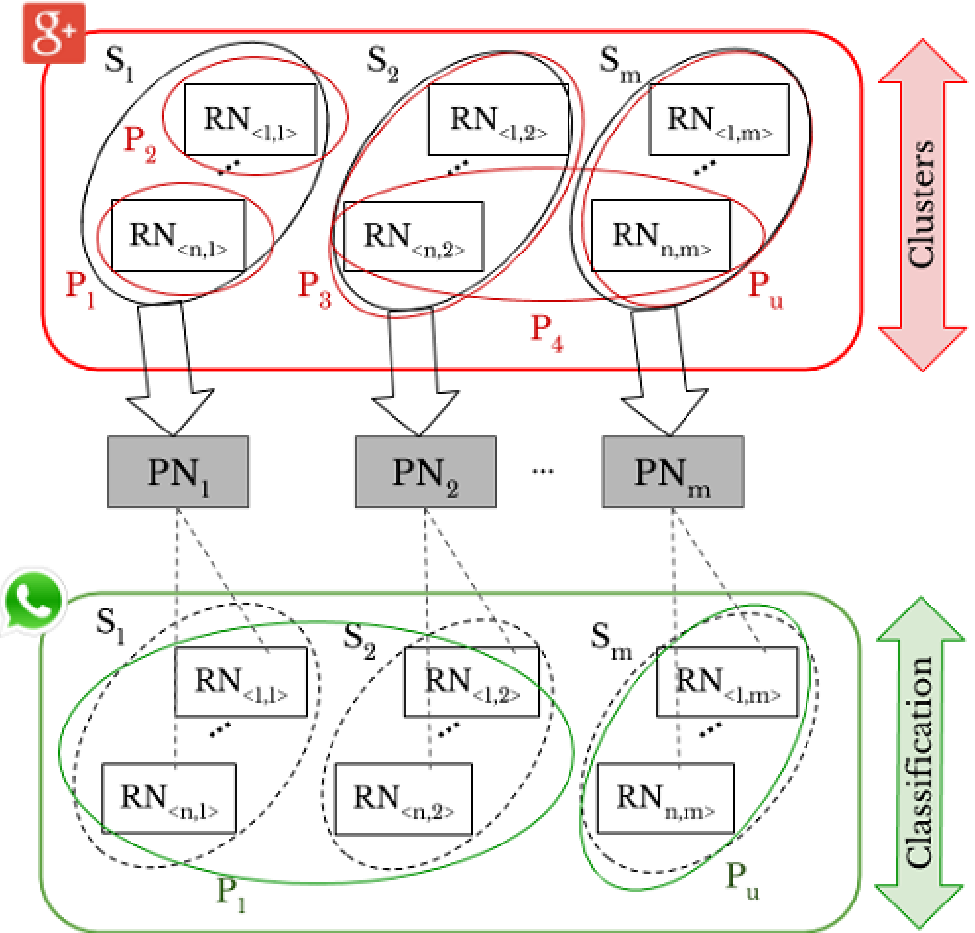
As shown in the architecture above, once the ANN is trained on images from SN "A", it can classify images from SN "B". If images from profile P1 on WhatsApp and P2 on Facebook are both classified to the same smartphone S1, the profiles are linked to the same user.
Experimental Battleground
The team tested their approach on a dataset of 2,000 images across four major platforms: Google+, Facebook, WhatsApp, and Telegram.
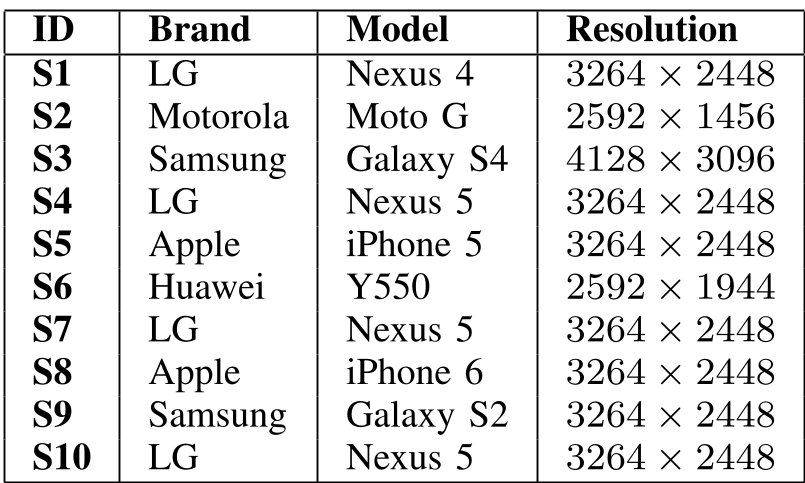
- The Hardware Challenge: They used 10 smartphones, significantly including three identical LG Nexus 5 models. Distinguishing between identical models is the "gold standard" of SI, as they share the same manufacturing specs but differ only in microscopic sensor noise.
- The Data: Even with the varying resolutions and compression ratios (WhatsApp at 1600x1200 vs. Google+ at original resolution), the system stayed resilient.
Deep Insights & Results
The results were remarkably high for a cross-platform task:
- Average Sensitivity (SE): 98.5%
- Average Specificity (SP): 99.5%
The study found that while Google+ provided the best results (due to lack of compression), the ANN-based classification was extremely effectively at "bridge-building" between platforms. For example, even images degraded by Telegram's compression could be successfully mapped back to the fingerprints established from high-quality images.
Critical Perspective: What's Next?
While the results are impressive, the study has a few limitations that define the next frontier of forensic research:
- The "Known Device" Constraint: Currently, the method assumes the number of smartphones under investigation is known. Future work needs to handle cases where an unknown number of devices are involved.
- Beyond Metadata: This method is purely image-based. Combining this sensor-level biometric with GPS EXIF data or behavioral logs would create an almost "un-escapable" forensic web.
Conclusion
This research moves social network forensics from the realm of "soft" data (usernames and logs) to "hard" physical evidence. By treating every shared image as a sensor-stamped document, investigators can now link identities across the web with nearly 99% certainty, proving that even in the anonymous world of social media, your hardware leaves a permanent footprint.