
SNGs: Beyond Cow Clicking — Harnessing Social Graphs for Deep Learning
Social Network Games
This paper provides a comprehensive academic overview of Social Network Games (SNGs), defining their unique characteristics such as asynchronous play and coopetition. It focuses on the transition of SNGs from purely commercial entertainment to powerful "Serious Games" for education and collaborative problem-solving, exemplified by cases like Foldit and QuizUp.
TL;DR
Social Network Games (SNGs) are often dismissed as mindless "Skinner Boxes." However, this study reclaims their value for the academic community, positioning SNGs as an essential tool for Serious Games. By integrating asynchronous play, "coopetition," and existing social ties, SNGs can solve complex real-world problems (like protein folding) and facilitate peer education at a scale traditional classroom settings cannot reach.
Background: The Social Infrastructure of Play
The rise of SNGs (representing 31% of frequent gamers) isn't just a market trend—it's a shift in human interaction. Unlike traditional games that require high-end hardware or simultaneous presence, SNGs piggyback on Online Social Networks (OSNs). This allows for Connectivism: a learning model where knowledge is an unstructured, networked resource evolved collaboratively.
The "Why": Solving the Engagement Gap
Why do SNGs succeed where traditional educational software fails?
- Low Entry Barriers: No "long-winded installation"—if you have a browser/Facebook, you’re in.
- Asynchronous Play: Learning happens at the user's pace, eliminating the pressure of "real-time" performance which often discourages non-gamers.
- Coopetition: A blend of competition (leaderboards) and cooperation (exchanging items) that drives retention without the "zero-sum" toxicity of hardcore PvP.
Methodology: The Core Framework of SNGs
The authors define a true SNG through four pillars:
- Asynchronous Play: Interactions occur over time (gifts, turns), supporting an "infinite" gameplay loop.
- Casual Multiplayer: Awareness of others' progress without strict dependency.
- Beneficial Social Media Interaction: Using the social graph (networking, sharing, discussing) as a game mechanic.
- Coopetition: Collaborating to achieve team goals while competing for individual prestige.
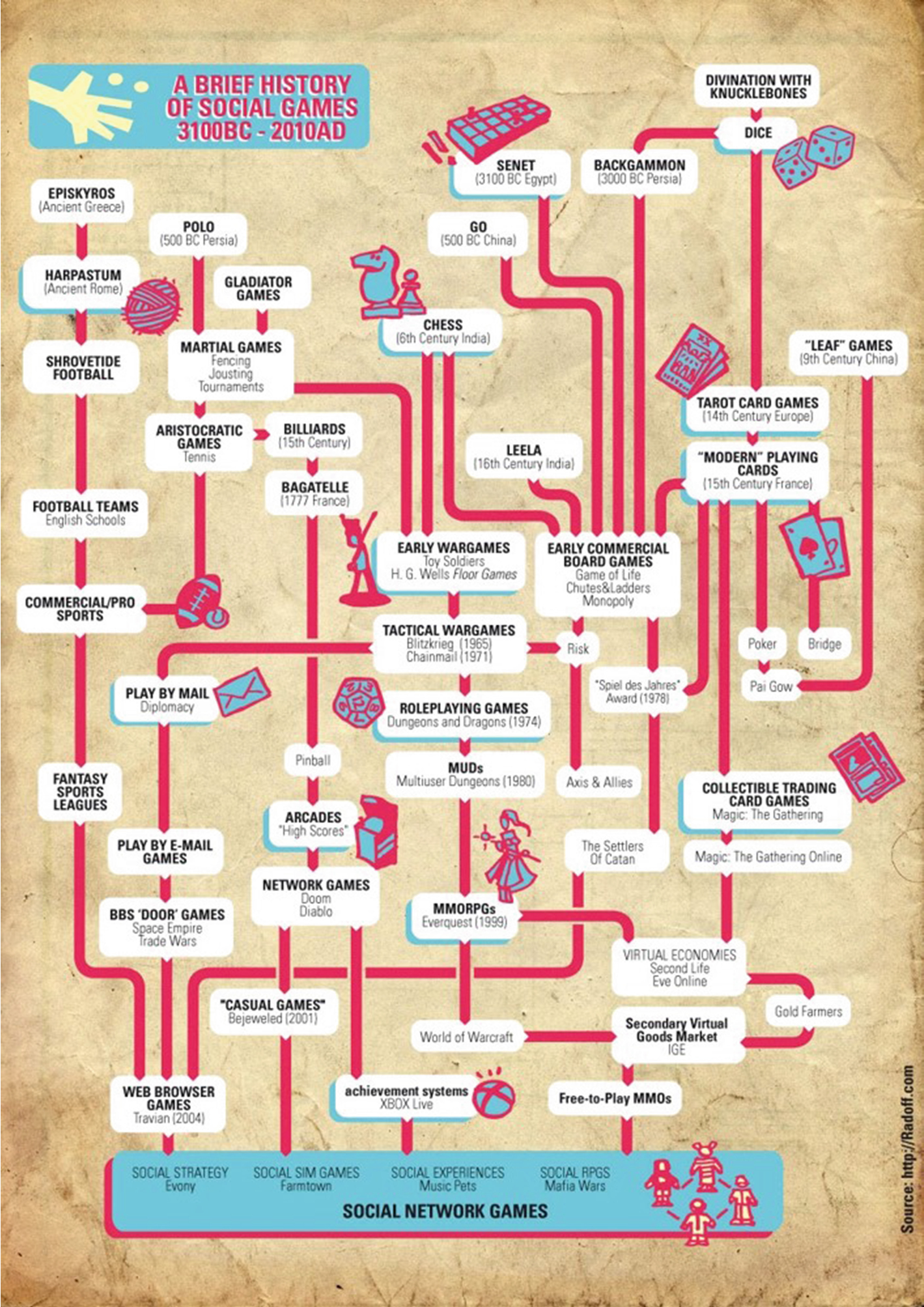 Figure 1: The evolution of social games from ancient Senet to modern MMOs.
Case Studies: The Power of the Crowd
1. Foldit (The Scientific SNG)
Foldit exemplifies the "Social Serious Game." By turning protein folding into a 3D puzzle, it allows laypeople to contribute to biochemistry.
- Insight: Players can share "recipe scripts" (strategies). These are User-Generated Content (UGC) that other players can adopt and improve, creating a collaborative intelligence loop.
2. QuizUp (Interest-Based OSNs)
Unlike Facebook games, QuizUp builds its own OSN around topics. This reinforces the idea that common interests (Knowledge Hubs) are a stronger basis for matchmaking than just "being friends."
The Dark Side: Toxicity and Monetization
Professional academic scrutiny requires looking at the flaws. The paper highlights:
- The "Skinner Box" Critique: Many SNGs use simple click-and-reward mechanics to exploit human psychology.
- Toxic Behavior: In multiplayer environments, "Griefing" or "Scamming" can destroy the learning atmosphere.
- F2P Ethics: The "Free-to-Play" model can lead to "Pay-to-Win," where financial resources replace skill, undermining educational integrity.
 Figure 2: Problematic monetization in commercial SNGs (e.g., $100 in-app purchases).
Critical Insight: The Challenge of "Open-Format" Problems
The most profound takeaway is the need for Open-Format Problems. Traditional AI can grade a multiple-choice quiz, but it cannot easily grade a "self-painted picture" or an "elegant math proof." The authors suggest that the future of Serious SNGs lies in Peer Assessment—where the community itself becomes the "grading algorithm."
Conclusion & Future Outlook
SNGs are a "remarkable instrument" for education. The next frontier involves:
- Social Matchmaking: Moving beyond "Skill Levels" (Elo) to match players based on "Mutual Benefit" (High Equality/High Mutuality).
- Automated Toxicity Detection: Using Machine Learning to identify negative patterns before they scale.
- UGC-Driven Quests: Games that generate their own content based on what the community creates.
Takeaway for Researchers: Don't build just a game; build a community framework where play and learning are secondary effects of social interaction.