
Understanding the SNG Crowd: Why "Simple" Games Create Deep Habits
Social network games: exploring audience traits
This research paper explores the audience traits of Social Network Games (SNGs) on Facebook, investigating how personality factors, demographics, and self-efficacy influence gameplay habits. Utilizing a snowball sampling method, the study identifies that "coping" is the strongest predictor of habit strength and reveals a counter-intuitive negative correlation between self-efficacy and daily playing time.
TL;DR
In this seminal 2010 study, researchers from Michigan State University peel back the curtain on the early Facebook gaming craze (think FarmVille and Pet Society). They discovered that social network games (SNGs) aren't just for everyone—they specifically attract people looking for "coping" mechanisms and, interestingly, those who feel less confident in their gaming abilities.
The "Simple Game" Paradox
Why would millions of people spend hours clicking on virtual cabbages or feeding digital pets? Traditional gaming research suggests that players enjoy challenges and the "flow" of mastering difficult tasks. However, SNGs are famously—or infamously—repetitive and simple.
The authors hypothesized that the "Audience Traits" of SNG players differ significantly from traditional "hardcore" gamers. They set out to map the Big Five personality traits, habit strength, and self-efficacy (one's belief in their ability to succeed) against actual gaming behavior.
Methodology: High-Touch Social Discovery
To reach a diverse network of players, the team used snowball sampling on Facebook.
- Demographics: 162 active players, predominantly female (60%), highly educated (75% with a bachelor's or higher), and with an average age of 32.
- Measures: Ten-Item Personality Inventory (TIPI) for the Big Five, alongside scales for self-efficacy and "Expected Outcomes" (Coping, Reciprocity, Common Ground, and Passing Time).
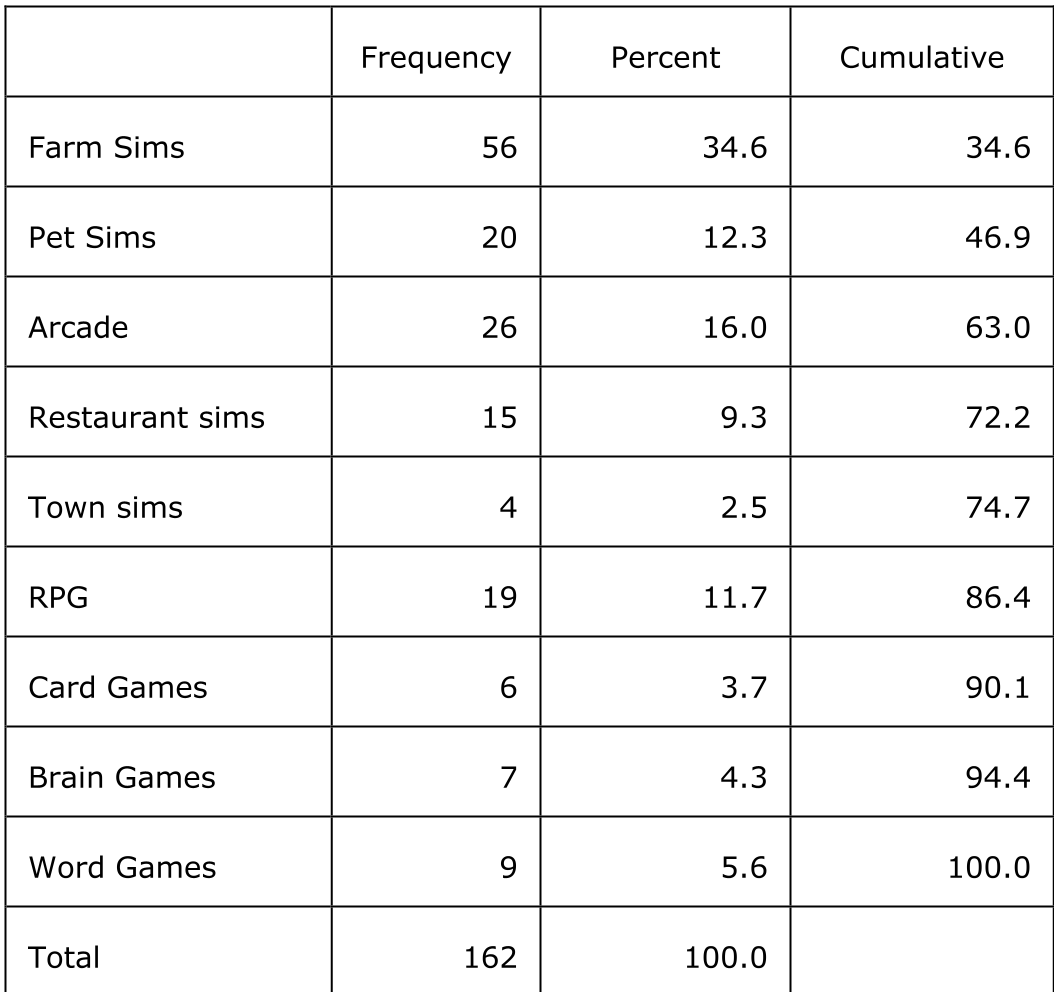 Table 1: The dominance of "Farm Sims" (34.6%) and "Arcade" games (16.0%) in the early SNG landscape.
Key Insights: Why We Play
1. The Inverse Self-Efficacy Trap
In a striking finding, the study revealed that self-efficacy was negatively correlated with daily playing time (r = -.16). Usually, high self-efficacy leads to better performance and more engagement. But in the world of SNGs:
- Players with low self-efficacy spend more time playing.
- Why? Since SNGs like FarmVille require zero strategy or complex skill, they offer a "safe" environment where even those who feel incompetent at "real" games can succeed effortlessly.
2. "Coping" as the Habit Engine
While many play to "pass time," the study found that Coping—using the game as a distraction or escape—was the only significant predictor of Habit Strength (β = .30). This creates a reinforcement loop: players feel stressed, they play to feel better, and the behavior becomes habitual.
3. The Gendered Social Loop
The study confirmed that females were significantly more attracted to the social interaction features of SNGs.
- Gifting: Females (M=4.41) engaged in gifting significantly more than males (M=3.85).
- The researchers argue that while SNGs are "single-player" in mechanics, the asynchronous interaction (leaving a gift for a friend to find later) yields a powerful impression of being in a social space, fulfilling a need for meaningful character-based interaction that traditional games lacked at the time.
Personality Traits & Behavior
- Neuroticism: Higher scores correlated with lower habit strength and less daily play. Negative emotions might discourage players from engaging in these perceived "happy" social spaces.
- Extraversion: Strongly correlated with the number of Facebook friends and "space customization" (e.g., decorating your virtual farm), suggesting that extroverts use the game as a digital stage.
- Agreeableness: Linked to higher self-efficacy in SNGs, potentially because these players are more predisposed to the cooperative, non-combative nature of social play.
Critical Analysis & Future Outlook
This paper was one of the first to identify that repetitive simplicity is a feature, not a bug. By lowering the "barrier to success," SNGs captured an audience that traditional gaming ignored.
Limitations: The study relied on self-reported data and a relatively small sample size via snowball sampling, which may contain bias. Furthermore, it was conducted at the "early stage" of the SNG lifecycle.
The Legacy: Today’s hyper-casual mobile games and "cozy games" (like Animal Crossing or Stardew Valley) owe their design philosophy to these findings. The "Coping" loop and the "Low-Barrier Social Interaction" remain the gold standard for mass-market engagement.
Conclusion
Social Network Games aren't about the game itself; they are about social coping. By understanding that players often use these platforms to manage their moods and social connections—rather than to be "challenged"—designers can build more inclusive and engaging digital tools for the future.