
From Call Logs to Social Circles: Ranking Friendship with Sports Logic
Social Network Generation and Friend Ranking Based on Mobile Phone Data
This paper introduces an automated framework for generating and organizing personal social networks using mobile phone interaction data (calls, texts, proximity). By applying the Colley sports ranking algorithm to prioritize contacts, the authors successfully map behavioral data into discrete "friendship circles."
TL;DR
Building a digital social network shouldn't be manual work. This paper presents a method to automatically rank your friends and categorize them into "intimacy circles" by analyzing mobile phone data. By treating social interactions like a sports league and applying the Colley Ranking Method, the system creates a stable, hierarchical view of your social life that isn't easily fooled by a single week of heavy texting.
Background: The Maintenance Tax of Social Media
We spend hours adding, labeling, and organizing friends on platforms like Facebook or LinkedIn. Yet, our most vital social sensor—the smartphone—already knows who we care about based on call duration, text frequency, and physical proximity. The challenge is that raw data is noisy. If you spend one weekend planning a trip with a casual acquaintance, a simple algorithm might rank them as your "best friend," which is socially inaccurate. This paper seeks to solve this sensitivity problem.
Problem & Motivation: The Flaws of Frequency
Most existing "friend ranking" systems rely on Winning Percentage—essentially, whoever you talk to most this month is #1. However, social sciences (notably the work of Robin Dunbar) suggest that human social networks have a specific, stable structure:
- The Inner Circle: ~5 intimate friends.
- The Sympathy Group: ~15 close friends.
- The Social Network: Expanding tiers (~50, ~150).
To replicate this, an algorithm needs mathematical inertia. It should require sustained effort for a new person to break into the inner circle.
Methodology: Social Life as a Sports Season
The authors propose a two-step process:
1. Weighted Interaction Evaluation
Not all communications are equal. The system calculates an interaction value () using weighted variables:
- Face-to-face/Proximity: Heaviest weight ().
- Voice Calls: High weight (assigned 1.25 in simulations).
- SMS/Texts: Baseline weight (assigned 1.0).
2. The Colley Ranking System
Instead of just counting wins, the authors adapt the Colley Matrix, a method used to rank college football teams. In this "Social League," if Friend A has more interaction points than Friend B in a month, Friend A gets a "win."
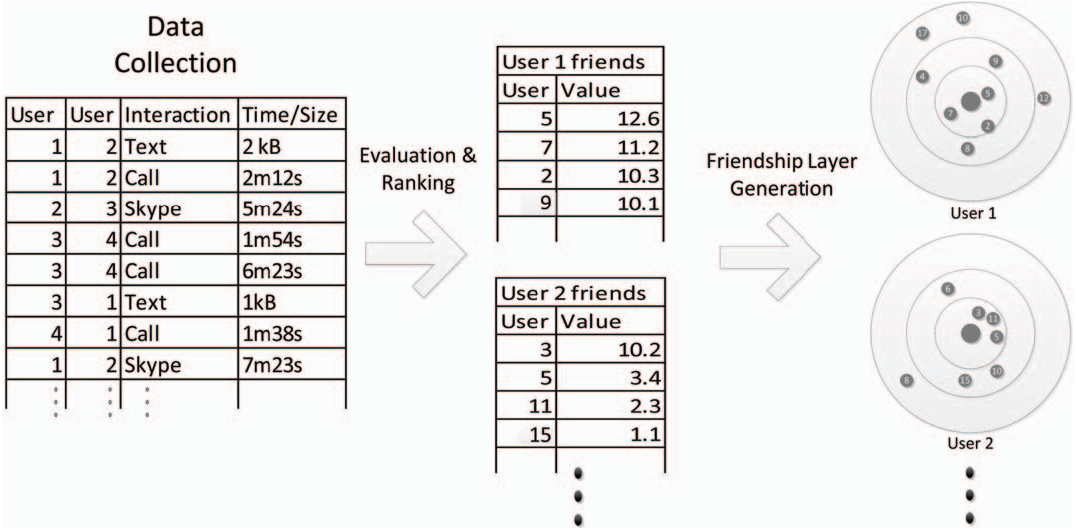
The beauty of the Colley method is its Iterative Dependency. Your rank isn't just about your wins; it’s about who you won against. Winning against a highly-ranked "Best Friend" carries more weight than winning against a "Casual Acquaintance."
Mathematically, it solves a linear system , ensuring that the median rating stays at 0.5 and changes occur gradually.
Experiments & Results: Finding the "Circles"
The study used the Nodobo dataset (high school students' mobile data over 4 months).
The "Discrete Group" Discovery
The results were striking. When using the Colley method, the friend ratings didn't just fade away linearly. Instead, they formed concave patterns with clear gaps.
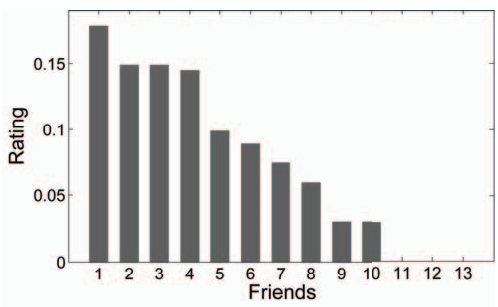
As shown in Figure 2, for 74% of users, the algorithm naturally sorted friends into three discrete groups. This confirms the Dunbar's Circle theory: we don't have a spectrum of friends; we have distinct "buckets" of intimacy.
Stability Over Time
When comparing the Colley method to the Winning Percentage (Figure 3), the latter was far too volatile. The Colley method provided a consistent ranking even as new contacts were added, reflecting the high "entry barrier" of real-world close friendships.
Critical Insight & Conclusion
This paper proves that Sports Analytics and Social Physics are two sides of the same coin. Both systems deal with relative performance in a network of actors.
Key Takeaways:
- Context Matters: A friend’s importance is relative to the "strength" of your other friends.
- Dampening is Feature: By using an "insensitive" algorithm, the authors actually made the system more accurate to human psychology, where trust and intimacy are built over months, not days.
Limitations: The study relies on metadata. It doesn't know what you are talking about (sentiment analysis). Future iterations could integrate the content of messages to refine the weighting of interactions even further.
Journal Reference: Akbaş et al., University of Central Florida.