
Engineering Human Societies: A Time-Budget Model for Ego Networks
A model for the generation of social network graphs
The paper presents a novel generative model for synthetic social network graphs based on anthropology-driven "ego networks." By leveraging Dunbar’s Number and hierarchical social layer theories, the authors developed a constructive algorithm that simulates how individuals allocate a limited time budget to maintain relationships of varying emotional closeness.
TL;DR
Why do we have only a handful of best friends but hundreds of acquaintances? This paper translates sociological observations—specifically Dunbar’s Number—into a mathematical framework. By treating "socializing time" as a finite resource, the authors propose an algorithm that generates synthetic social networks that look and behave like real human communities.
Background: The Limits of Socializing
In the era of cyber-physical convergence, understanding how humans circulate information is critical. However, humans are biologically capped. Anthropological research suggests our "ego networks" (the circle of people we actually interact with) are structured in layers:
- Support Clique (~5 people): Deep emotional ties.
- Sympathy Group (~15 people): Regular contact.
- Active Network (~150 people): The functional limit of stable relationships.
Existing graph generators often miss this "human" touch. This paper fills the gap by asking: If time is money, how do we spend it on our friends?
Methodology: Time as the Universal Constraint
The core insight is that Emotional Closeness () is a function of Time Invested ().
1. The Cost of Kinship
A fascinating aspect of the model is the distinction between Kin (Family) and Non-Kin (Friends). The authors observe that family relationships are "cheaper" to maintain at low levels of closeness but equally expensive at high levels.
2. The Generative Algorithm
The algorithm functions like a budget manager:
- Assign a Time Budget (): Based on the observation that humans spend roughly 20% of their time socializing.
- Iterative Layering: It starts from the inner circle (closest friends) and moves outward.
- Relationship Creation: For each "alter," it samples emotional closeness and calculates the required time cost ().
- Termination: The process stops when the time budget is exhausted.
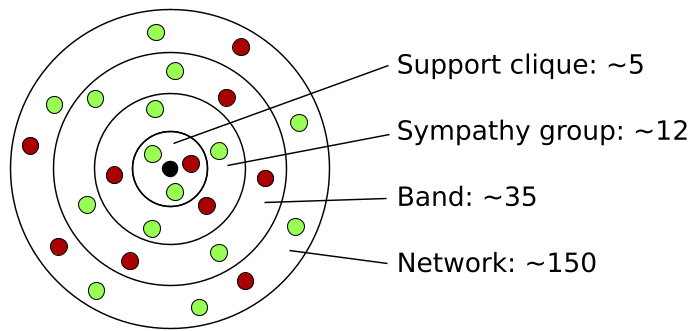 Figure 1: The hierarchical structure of an ego network, showing the ego at the center and concentric layers of relationships.
Mathematical Depth: The Function
The authors define a "Time-Closeness" function, . This exponential trend captures the reality that moving someone from an acquaintance to a "best friend" requires a non-linear increase in time commitment.
Specifically, they derived:
- Kin:
- Non-Kin:
This ensures that family ties () have a lower "base cost" () than non-family ties ().
Experimental Results
The model was validated using 100,000 runs. The results were remarkably consistent with empirical data:
- Network Size (): Averaged 132.84, hugging the theoretical goal of 132.5.
- Gender Dynamics: Female egos tended to have slightly larger networks because they typically have more kin relationships, which are "time-efficient" within the model's logic.
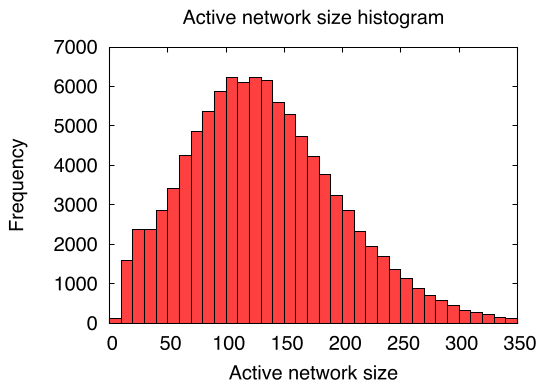 Figure 2: The distribution of network sizes generated by the simulation, matching the expected spread of human social groups.
Critical Insight: Why This Matters
This isn't just about simulating friendships. In technical fields like Pervasive Computing and Mobile Ad-hoc Networks (MANETs), data is often passed from person to person. If we know that a person only has 5 "high-trust" nodes (their Support Clique), we can design far more efficient and secure routing protocols than if we assumed a flat, random network.
Conclusion & Future Work
The paper successfully bridges the gap between social anthropology and graph theory. While the current model is static, it provides the blueprint for "Socially-Aware" algorithms. The next frontier? Modeling how these networks evolve over time—how friends become strangers and how we reallocate our precious time budget when "new" people enter our lives.
Key Takeaway: Our social circles are not just products of our personality, but of our biological time management.