
From Words to Wisdom: Morphing Social Graphs into Causal Bayes Nets via Lexical Analysis
From Social Network Graphs to Causal Bayes Nets
This paper introduces a lexical-based method to transform undirected Social Network Graphs (SNG) into Causal Bayes Nets. By analyzing the temporal diffusion of unique vocabularies between nodes, it identifies "influencer-disciple" relationships and establishes conditional probabilities for predictive modeling.
TL;DR
Researchers have developed a way to turn simple "who-knows-whom" social graphs into "who-influences-whom" Causal Bayes Nets. By ignoring the meaning of words (semantics) and focusing solely on the movement of words (lexicon), the method identifies influencers and disciples, providing a roadmap for predictive social analysis without the heavy computational lift of NLP.
Problem & Motivation: The "Static Graph" Trap
Most Social Network Graphs (SNG) are snapshots—nodes connected by edges representing interactions. While useful, they are often "dumb" in a predictive sense. To make them "smart," researchers typically turn to:
- Graph Partitioning: Finding clusters based on structure.
- Semantic Analysis: Using NLP to understand what is being said.
The former lacks directionality (influence), and the latter is a privacy nightmare and computationally sluggish. The authors of this paper suggest a third path: Lexical Analysis. Their intuition is that if Person A starts using technical jargon that previously only Person B used, Person B is likely an influencer for Person A within that specific Domain of Knowledge (DoK).
Methodology: The Mechanics of Influence
The core of the paper lies in the distinction between a Lexicon (the set of words belonging to a topic) and a Vocabulary (the words an individual actually uses).
1. Identifying Domains of Knowledge (DoK)
By taking the set intersection of vocabularies across multiple nodes, the system identifies clusters of words that define a specific interest (e.g., "mouse" and "monitor" defining the 'Computing' DoK vs. "mouse" and "corn" defining 'Biology').
2. The Influence Measure
The transition from an undirected graph to a directed Bayes Net is achieved through temporal tracking. The authors define an Influence Measure based on the rate of word transfer:
If node adopts words from node 's specialized vocabulary over time, the sign of indicates the direction of the causal link ().
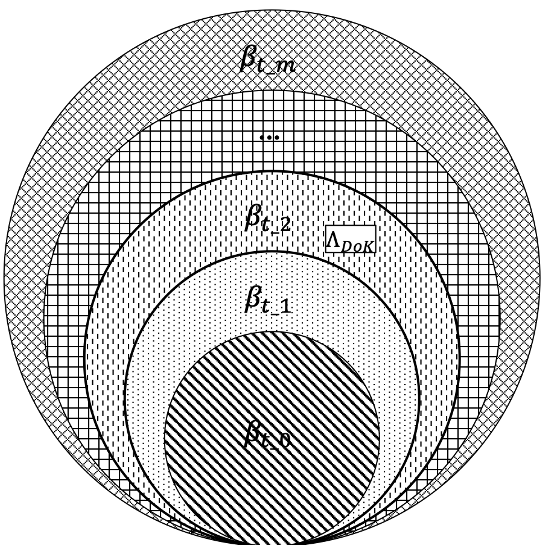 Figure 1: Evolution of an individual's vocabulary as new Domains of Knowledge (DoK) are introduced over time.
Experiments: Validating with the Chromium-Dev Archive
To test the theory, the authors analyzed 1.66 GB of data from the Chromium-dev archive.
- Data Reduction: They filtered the noise into a "usable English word lexicon" of 12,114 distinct words.
- Social Structure: Out of 6,387 email originators, only about 500 possessed significant specialized vocabularies (greater than 1% of the largest user).
- Tracking Growth: As shown in the table below, the "influencer" relationship becomes visible as specific technical terms (like 'bug', 'link', 'void') propagate from one user's vocabulary to another during a discussion topic.
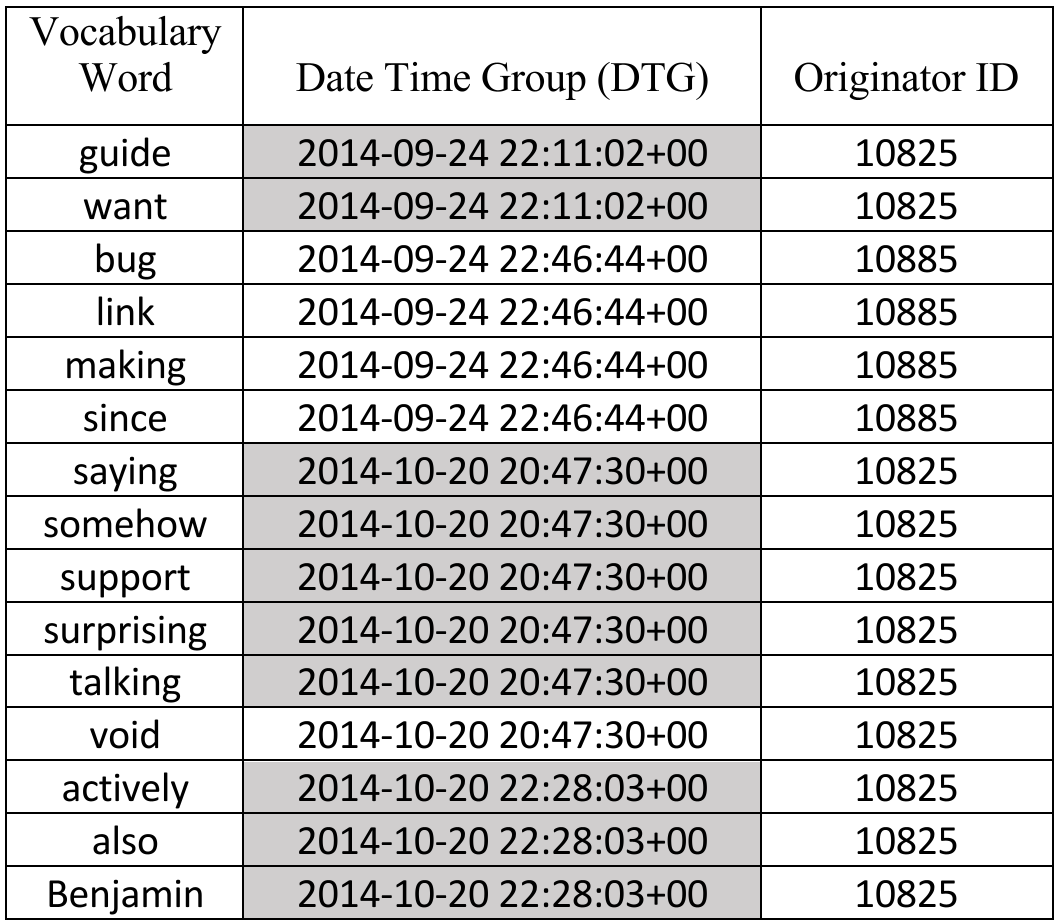 Table 1: Example of vocabulary growth during an email thread between two originators.
Critical Analysis & Conclusion
Takeaway
The genius of this approach is its efficiency. By treating text as a "bag of words" and focusing on the timing of word adoption, we can infer causal relationships (Bayes Nets) that would otherwise require massive transformer-based models to detect.
Limitations
- Linguistic Nuance: The model assumes that "using a word" equates to "being influenced." It might struggle with sarcasm, dissent, or cases where two people independently discover a term.
- Data Scarcity: As mentioned by the authors, finding unclassified SNG datasets with high-volume text for every node remains a challenge for benchmarking.
Future Outlook
This technique holds massive potential for Sensor Management. In a world of infinite data, you cannot monitor everyone. By using lexical analysis as a "prescreener," intelligence systems can identifies the "influencers" in a network and focus expensive semantic resources only on those high-value nodes.