
Social Dominoes: How Your Friends' Churn Increases Your Phone Bill
Social-Network Influence on Telecommunication Customer Attrition
This paper presents a multi-agent simulation study investigating "induced churn" in the telecommunications industry, where one customer's departure triggers others to leave due to increased calling costs. By modeling the market as a Small World Network, the authors identify Weighted Prestige as the most consistent SOTA predictor for identifying influential customers whose attrition poses the highest risk to the network.
TL;DR
When a friend switches their mobile provider, your own bills might go up due to "off-net" calling charges. This paper uses multi-agent simulations to prove that this "induced churn" is a major hidden threat for telcos. The researchers found that Weighted Prestige—how much a person is called by others—is the single best metric for identifying these high-risk "influencers."
The Network Motivation: Why Churn is Contagious
In the telecommunications world, losing a customer is 5-8 times more expensive than keeping one. Most operators try to predict who will leave by looking at individual complaints or bad signals. However, this paper argues that even a happy customer might leave if their social circle migrates to a competitor.
Under a "calling party pays" regime, calls to people on the same network (on-net) are cheaper than calls to other networks (off-net). When your "neighbor" in the social graph churns, your cost to call them spikes, potentially triggering your own exit.
Methodology: Simulating the Market
The authors built a multi-agent system where 1,500 agents act as subscribers. These agents are rational: they constantly calculate their total calling costs across different operators and switch to the cheapest one.
1. Network Topology
The study uses a Small World Network model, which mimics real-world human connections (high clustering but short paths between people).
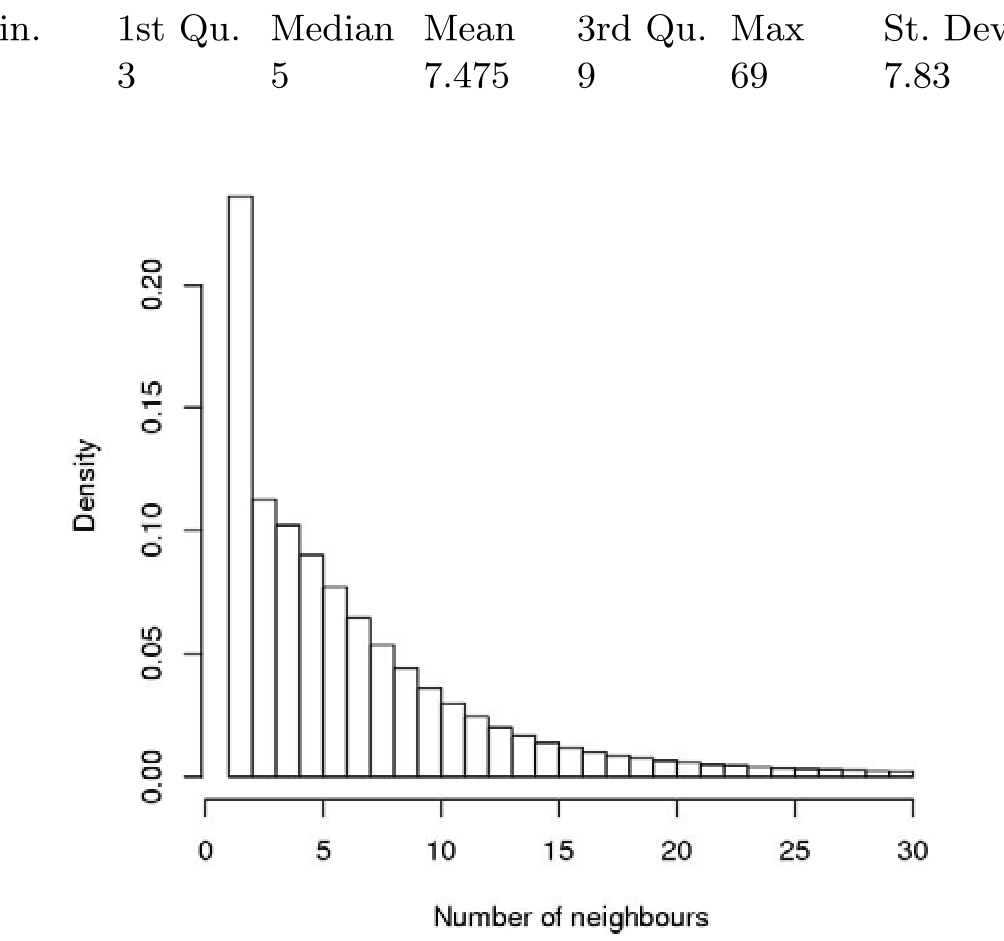 Fig 1: Real-world neighborhood size distribution used to calibrate the simulation radius (r) and rewiring probability (μ).
2. The Forced Churn Experiment
To measure influence, the researchers performed "forced churn":
- A stable state is reached where everyone has the best operator.
- One agent is forced to switch (representing non-price churn, like a bad handset experience).
- The simulation tracks how many others follow that person to the new operator.
Key Quantitative Findings
The study tested 54 different scenarios, varying the number of operators, price differences, and network tightness.
| Factor | Impact on Induced Churn |
|---|---|
| Radius (r) | Lower radius = Higher Churn. In smaller, tighter groups, one person's switch has a larger relative impact on friends. |
| Number of Operators | More operators = Higher Churn. Increased competition makes it easier for groups to find a "cheaper" common ground. |
| Rewiring Probability (μ) | Lower μ = Higher Churn. High clustering (cliques) fosters a "domino effect" within social circles. |
Predicting the "Influencers"
The core of the study compared different social network metrics to see which one identifies people who trigger the most churn.
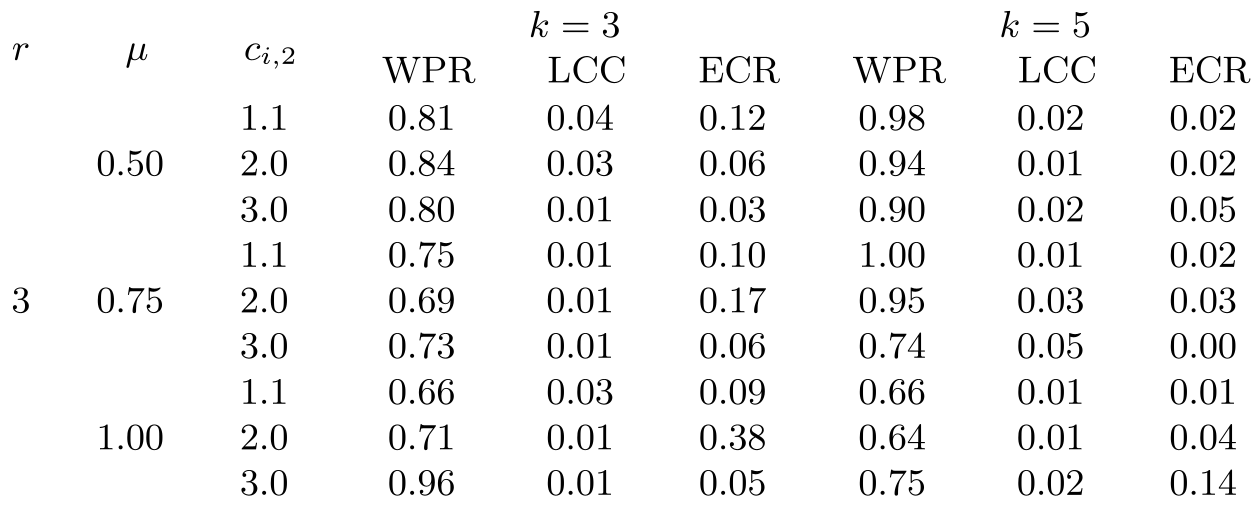 Table 5: Logistic regression coefficients showing Weighted Prestige (WPR) as the dominant predictor across various market setups.
Weighted Prestige (WPR)—the total volume of incoming calls—was the standout winner. Unlike standard "Degree" (how many friends you have), WPR accounts for the intensity of those relationships.
Critical Insight & Practical Application
The paper confirms that telcos are often looking at the wrong data. While many focus on "who makes the most calls," the real danger lies with "who is called the most."
Strategic Takeaways:
- Targeted Retention: If a customer with high Weighted Prestige complains, give them the best retention offer immediately. Their departure isn't just one loss; it's a potential exodus of their entire calling circle.
- Market Dynamics: Regulators should note that increasing the number of operators naturally destabilizes customer bases by lowering the "cost of coordination" for groups to move together.
Conclusion & Future Outlook
While this simulation provides a robust theoretical framework, it assumes customers have perfect knowledge of their friends' operators. In a modern "flat rate" world, the price incentive might be weakening, but the social network topology remains a critical factor in how behaviors spread. Future research moving into the world of Graph Neural Networks could further refine these prestige measures to prevent the next great churn wave.