
From Viruses to Viral Posts: Understanding Social Network Transmission via the URSIR Model
Research of Social Network Information Transmission Based on User Influence
2018-01-01
Summary
Problem
Method
Results
Takeaways
Abstract
This paper introduces the URSIR model, a specialized information transmission framework for social networks that builds upon the traditional SIR epidemic model by integrating user node influence. By defining mutual influence functions and relative weights between nodes, the model achieves superior accuracy in predicting propagation paths across various network topologies, including real-world datasets from Twitter and Sina MicroBlog.
## TL;DR
Researchers have developed the **URSIR model**, an evolution of the classic SIR (Susceptible-Infectious-Recovered) virus model tailored for the social media age. By injecting "User Influence" into the mathematical framework, the model significantly outperforms traditional methods in predicting how information saturates networks like Twitter and Sina MicroBlog.
## Background: The Shift in Information Topology
In the early days of the web, users were passive consumers. Today, they are active makers. Traditional epidemic models, which treat every "contact" between individuals as equal, fail to capture the reality of social influence. In a network, a retweet from a verified "Authority" node has a vastly different impact than a tweet from an isolated "Ordinary" node. This paper addresses the gap by asking: *How does the relative status of a user change the physics of information flow?*
## The Problem with Traditional SIR
The classic SIR model was designed for biological pathogens. In that context, a virus doesn't care if its host is a celebrity or a recluse—infection is a matter of biological probability. However, in social networks:
- **Inhomogeneity**: Nodes have vastly different "degrees" (connections).
- **Directionality**: Relationships (following/followers) are often one-way.
- **Receptivity**: Some users are more likely to pass on information based on who they received it from.
## Methodology: The URSIR Framework
The authors propose the **URSIR (User-influence Relative SIR)** model. The core innovation lies in defining the transmission probability as a function of the **Relative Weight** between the source node and the target node.
### Key Transmission Paths
The model categorizes interactions into four distinct pathways:
1. **Pa (Auth → Ord)**: High-authority nodes broadcasting to the masses.
2. **Pb (Ord → Auth)**: Organic discovery by influencers.
3. **Pc (Auth ↔ Auth)**: Elite-level echo chambers and high-level dissemination.
4. **Pd (Ord ↔ Ord)**: Peer-to-peer viral growth.

*Note: The model maps these paths to determine the ultimate "Infection Rate" of a piece of content.*
---
## Experimental Results: SOTA Comparison
The researchers tested URSIR against the standard SIR model across six network types, including real-world crawls of **Twitter**, **Sina MicroBlog**, and **Epinions**.
### 1. Maximum Infection Rate (MIR)
One of the most striking findings was in sparse, large-scale networks. In the Sina MicroBlog dataset, the standard SIR model failed to reach the majority of the network (MIR ~0.5). In contrast, the **URSIR model correctly predicted that information could cover nearly 100% of the network** by leveraging the high-out-degree of authoritative nodes.
### 2. Spreading Life Cycle (SLC)
The "life" of a post in URSIR follows a non-linear path. As the transmission probability (*k*) increases, the life cycle typically increases and then sharply decreases as the network becomes saturated more quickly.
| Dataset | Node Count | Max Degree | Network Type |
| :--- | :--- | :--- | :--- |
| Twitter | 145,942 | 7,079 | Scale-free |
| Sina Blog | 146,091 | 2,000 | Scale-free |
| ER | 5,000 | 14 | Random |
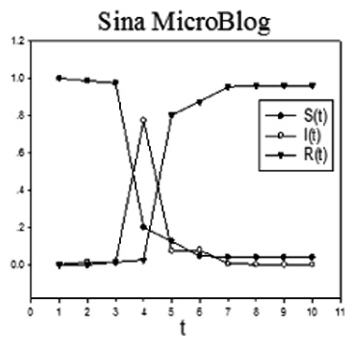
*Fig: The S(t), I(t), and R(t) curves showing the transition of users from susceptible to informed across different network topologies.*
---
## Critical Analysis & Takeaways
The URSIR model proves that **influence is the "gravity" of social networks**. It explains why some information goes "viral" despite having a low initial transmission probability—it simply needs to hit the right authoritative node to achieve escape velocity.
**Limitations**:
The current model operates on a **static network**. In reality, social networks are dynamic—links are formed and broken in real-time. Additionally, the model focuses on the "path" rather than the "content" (the theme of the information), which we know plays a massive role in receptivity.
**Conclusion**:
For developers of recommendation engines or public opinion monitoring tools, URSIR provides a more realistic blueprint. It moves us away from treating "reach" as a simple count of followers and toward a more sophisticated understanding of **weighted relative influence**.