
Fusing Social Wisdom: Solving Recommender Cold-Start with Dempster-Shafer Theory
Integrating with Social Network to Enhance Recommender System Based-on Dempster-Shafer Theory
The paper introduces a social-network-integrated collaborative filtering (CF) system that utilizes Dempster-Shafer (DS) theory to model user and community preferences. By fusing local rating data with "community preferences" extracted from social groups, the system achieves SOTA performance on the Flixster dataset, particularly in mitigating data imperfections.
TL;DR
Recommendation systems often fail when data is sparse—a "cold start." This paper proposes a novel framework that integrates Social Network Community Preferences with Collaborative Filtering using Dempster-Shafer (DS) Theory. By treating community opinions as "evidence" to fill individual gaps, the system effectively eliminates the cold-start bottleneck and improves accuracy (MAE) by over 10% compared to previous DS-based baselines.
Problem: The Fragility of Sparse Matrices
Most Collaborative Filtering (CF) systems are "people-to-people." They find neighbors who like what you like. However:
- Sparsity: Users only rate a tiny fraction of items.
- Cold-Start: New users/items have zero history, leaving the system "blind."
While social networks offer a potential "third dimension" of data, existing solutions often handle social trust as a simple scalar value, ignoring the imprecision and conflict inherent in human opinions.
Methodology: The Math of Uncertainty
The core innovation lies in using Dempster-Shafer (DS) Theory to model the recommendation process. Unlike standard probability, DS theory allows for a "mass function" that accounts for uncertainty and ignorance.
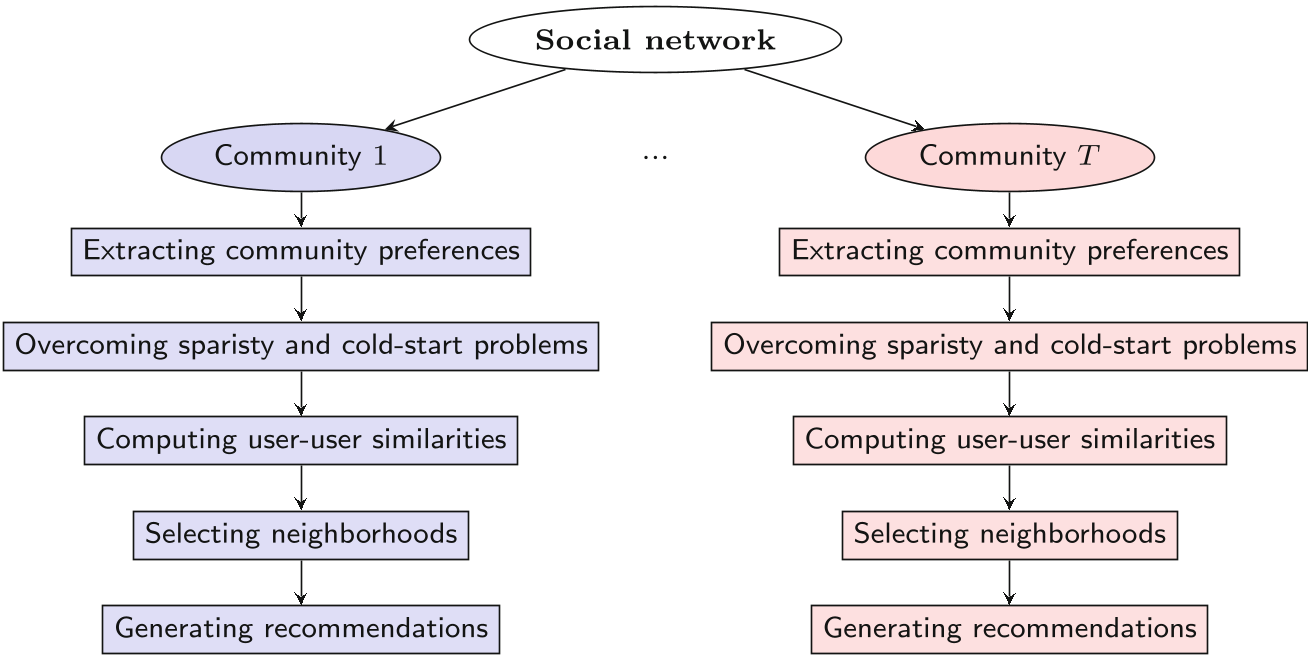
1. Extracting Community Preferences
The system partitions the social network into communities. For each item, it aggregates the ratings of members within the same community who share specific interests (Concepts/Groups). This creates a Community Preference profile.
2. Filling the Gaps (Mass Function Fusion)
If a user hasn't rated item , the system doesn't just leave it at zero. It propagates the community's mass function to the user level.
3. Dempster’s Rule of Combination
When generating a final recommendation, the system fuses two sources:
- The user's predicted individual preference.
- The neighborhood's collective opinion.
The fusion uses Dempster's Rule: where represents the technical "conflict" between different sources of evidence.
Experiments: Real-world Validation on Flixster
The researchers utilized the Flixster dataset (3,827 users, 535,013 ratings) to test the theory. They converted hard ratings (1-5 stars) into soft mass functions to handle the "fuzziness" of user tastes.
Key Performance Metrics
As shown in the table below, the "New System" consistently outperforms the baseline across all levels of (Neighborhood size).
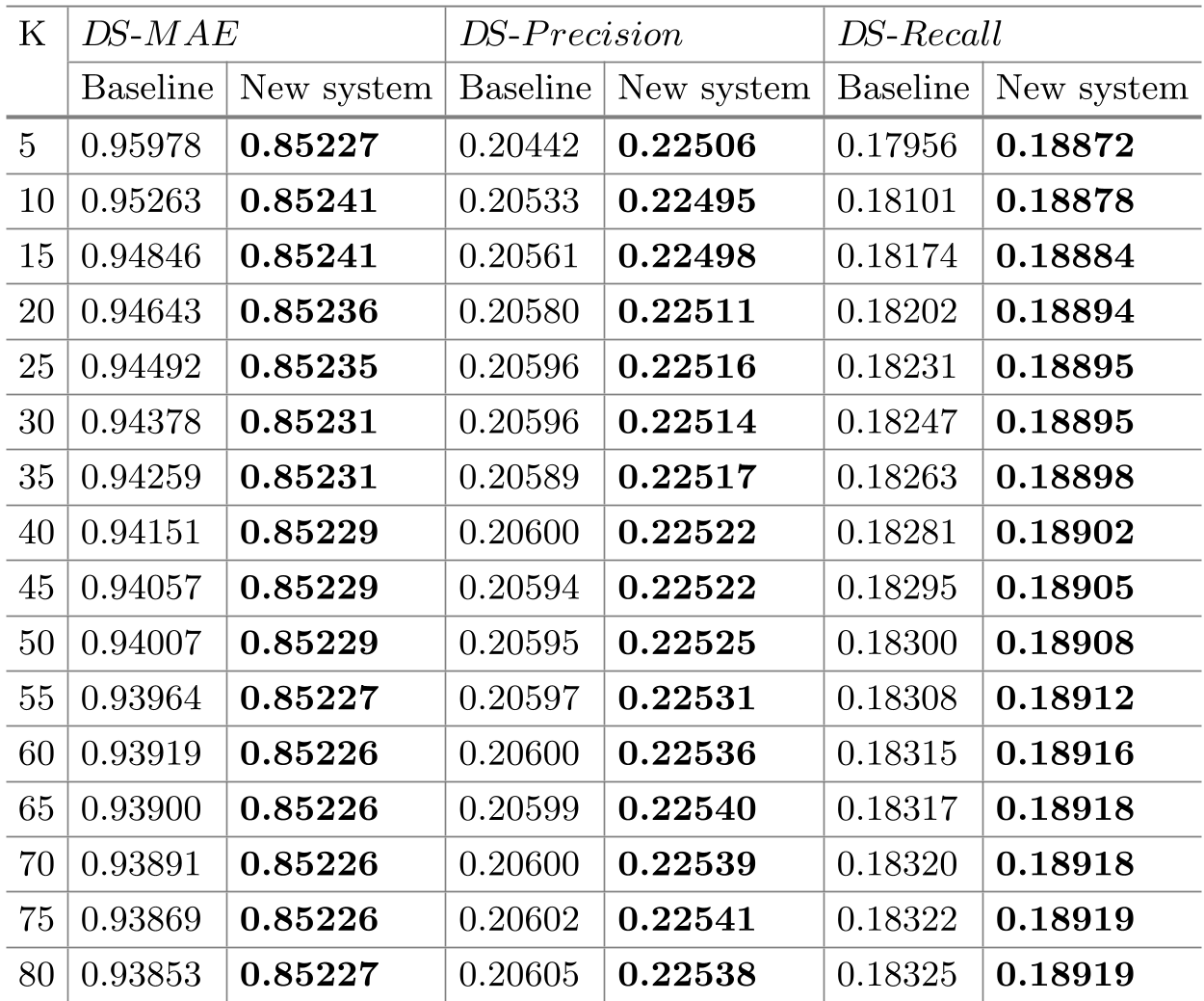
- MAE (Mean Absolute Error): Reduced from ~0.94 to ~0.85. A lower MAE indicates much higher prediction accuracy.
- Precision & Recall: Showed steady improvements, proving the system finds more relevant items even with limited data.
Critical Analysis & Conclusion
The true power of this work is its Inductive Bias: it assumes that individuals in a community share underlying latent preferences. By formalizing this intuition through DS Theory, the authors provide a rigorous way to integrate "noisy" social data without over-trusting it.
Limitations
- Computational Complexity: Dempster’s rule can be expensive as the frame of discernment grows.
- Community Dynamics: The paper treats communities as static segments; real social groups are dynamic and overlapping.
Takeaway
For developers and researchers, this paper highlights that Social Context is a first-class citizen. Don't just treat "friends" as a weight; treat the "community" as an evidence source that can fill the void of missing user data.