
ORCA: Weaponizing Social Network Intelligence to Disrupt Street Gangs
Social Network Intelligence Analysis to Combat Street Gang Violence
This paper introduces ORCA (Organization, Relationship, and Contact Analyzer), a specialized social network analysis toolkit designed to assist law enforcement in combating street gang violence. By integrating logic programming and community detection, ORCA successfully automates the identification of "unaffiliated" gang members and maps criminal "ecosystems" using real-world police arrest data.
TL;DR
The Organization, Relationship, and Contact Analyzer (ORCA) is a specialized AI-driven platform designed by researchers at West Point to map the invisible structures of violent street gangs. By applying advanced logic programming and network science to arrest records, ORCA can identify hidden gang members, pinpoint the most influential "radicalizers," and decompose complex gangs into their component "corner crews" with high precision.
Problem & Motivation: The "Shadow" Network
Law enforcement faces a persistent challenge: the "Silence is Golden" rule of the streets. Many active gang members never formally admit their affiliation, creating blind spots in police intelligence. Moreover, modern street gangs are rarely monolithic; they function as a fluid ecosystem of "factions" and "crews."
The authors recognized that gang violence mirrors an insurgency. Therefore, they adapted Counter-Insurgency (COIN) strategies to the urban landscape. The goal wasn't just to see who was arrested, but to understand the Inductive Bias of the network—how influence flows and how groups fragment.
Methodology: The Core Engine
ORCA's architecture is built on three pillars that transform raw arrest data into actionable intelligence.
1. Determining "Degree of Membership" (MANCaLog)
Instead of a binary "In/Out" classification, ORCA uses MANCaLog (Multi-Attribute Network Cascade Logic). If an individual is arrested with three known members of Group X, their "Degree of Membership" is calculated via an Influence Function. This function is learned from the dataset, recognizing that the probability of being a member increases non-linearly with the number of known associates.
2. Identifying Seed Sets (TIP DECOMP)
Who are the "inciters"? Using the Tipping Model, ORCA identifies a minimal "Seed Set" of individuals who, if they adopt a violent behavior, would cause the entire gang to follow suit (a social contagion).
 Figure 1: The TIP DECOMP algorithm iteratively strips away peripheral nodes to reveal the core influential "seeds" of a criminal network.
3. Mapping Ecosystems (Louvain Modularity)
To understand the internal friction and external alliances of gangs, ORCA uses the Louvain Algorithm to maximize modularity. This reveals "corner crews"—the highly connected clusters that actually run drug operations.
Experiments & Results: Quantifying the Streets
The system was tested on a dataset from a major American city involving 5,418 arrests. The efficiency was remarkable: the entire analysis for 18 gangs took only 34.3 seconds on a standard laptop.
Key Findings:
- Structure vs. Race: The tool provided quantitative proof for anecdotal police observations. "Racial Group A" gangs were found to be more hierarchical and centralized (lower modularity), while "Racial Group B" gangs operated as decentralized confederations of smaller factions (higher modularity by 11.2%).
- Hidden Members: All 180 individuals who did not admit gang membership were assigned a degree of affiliation based on their arrest proximity to known members, with the majority scoring above 0.5.
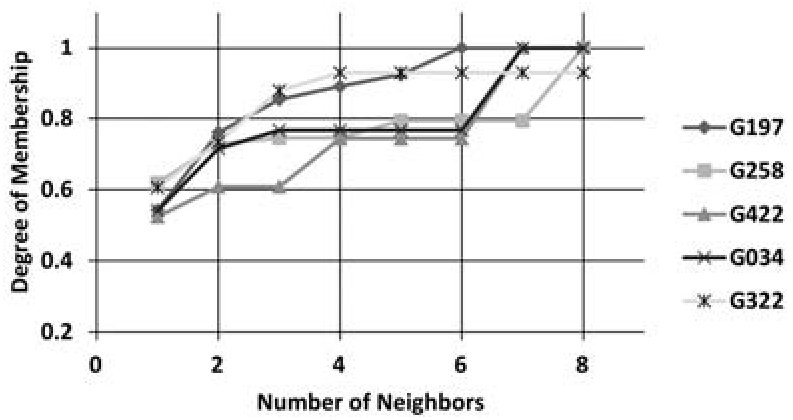 Figure 2: Influence functions for five separate gangs, showing the variation in how "contagious" membership becomes based on social ties.
Critical Analysis & Conclusion
ORCA marks a shift from reactive policing to Network-Informed Proactive Policing. By identifying "connectors"—individuals who link different gangs or sub-groups—police can target interventions that disrupt the entire criminal ecosystem rather than just making isolated arrests.
Takeaway
The success of ORCA confirms that the mathematical principles used to model viral marketing and epidemic spreads are equally potent in the socio-legal domain.
Limitations & Future Work
The current model relies on a "static" snapshot of data. However, gang alliances are notoriously volatile. The authors note that adding temporal and geospatial elements (tracking how boundaries move over time) is the next frontier. Furthermore, the reliance on arrest data introduces a potential "sampling bias"—the network only reflects those caught, not necessarily those most skilled at evading the law.
Despite this, ORCA stands as a SOTA implementation of intelligence software that bridges the gap between high-level network theory and the grit of law enforcement.