
Breaking the Silos: Hybridizing P2P and Social Networks for Expert Knowledge Sharing
A social network-based system for supporting interactive collaboration in knowledge sharing over peer-to-peer network
This paper introduces a social network-based system designed to facilitate interactive collaboration and knowledge sharing over Peer-to-Peer (P2P) networks. By integrating Instant Messaging (IM) and a three-layer social network architecture (K-net and S-net), the system successfully connects users with both relevant digital resources and knowledgeable collaborators.
TL;DR
In the age of information overload, finding a specific document is hard, but finding a human expert willing to explain it is harder. This paper presents a novel system that bridges this gap by layering a social relationship model on top of a Peer-to-Peer (P2P) network. By quantifying expertise through a digital Bloom Taxonomy and social ties via familiarity scores, the system enables users to not only find files but to form dynamic, real-time collaboration groups through Instant Messaging.
Problem & Motivation: The Anonymity of P2P
Most P2P networks (like Gnutella or early academic repositories) treat nodes as black boxes containing files. This leads to several failures in knowledge sharing:
- The Human Factor: Knowledge isn't just "explicit" (files); it's "tacit" (personal experience). You can't download experience.
- Reliability: How do you know if a peer's contribution is high-quality?
- Connectivity: Finding a peer with the right data doesn't mean they are willing to collaborate or effectively communicate.
The authors realized that Social Networks provide the missing link. By modeling the "strength of ties," they could predict which peers would most effectively help a requester.
Methodology: The Three-Layer Social Network
The core innovation is a hierarchical approach to filtering the network:
1. The P2P Knowledge Net (K-net)
When a user submits a query, the system identifies peers with the relevant expertise. To do this mathematically, the authors converted the Bloom Taxonomy (an educational framework measuring cognitive levels like "Remember," "Apply," "Create") into a 2D matrix.
- Knowledge Relationship Tie: Calculated by matching the requester's needs against a peer's proficiency matrix multiplied by their reputation.
2. The P2P Social Net (S-net)
Expertise isn't enough; you need a connection. The S-net calculates a Social Relationship Tie.
- Social Familiarity: A score from -1 to 1 (Friend, Teammate, Colleague, or Stranger).
- Social Reputation: A product of the peer's popularity and their average familiarity across the network.
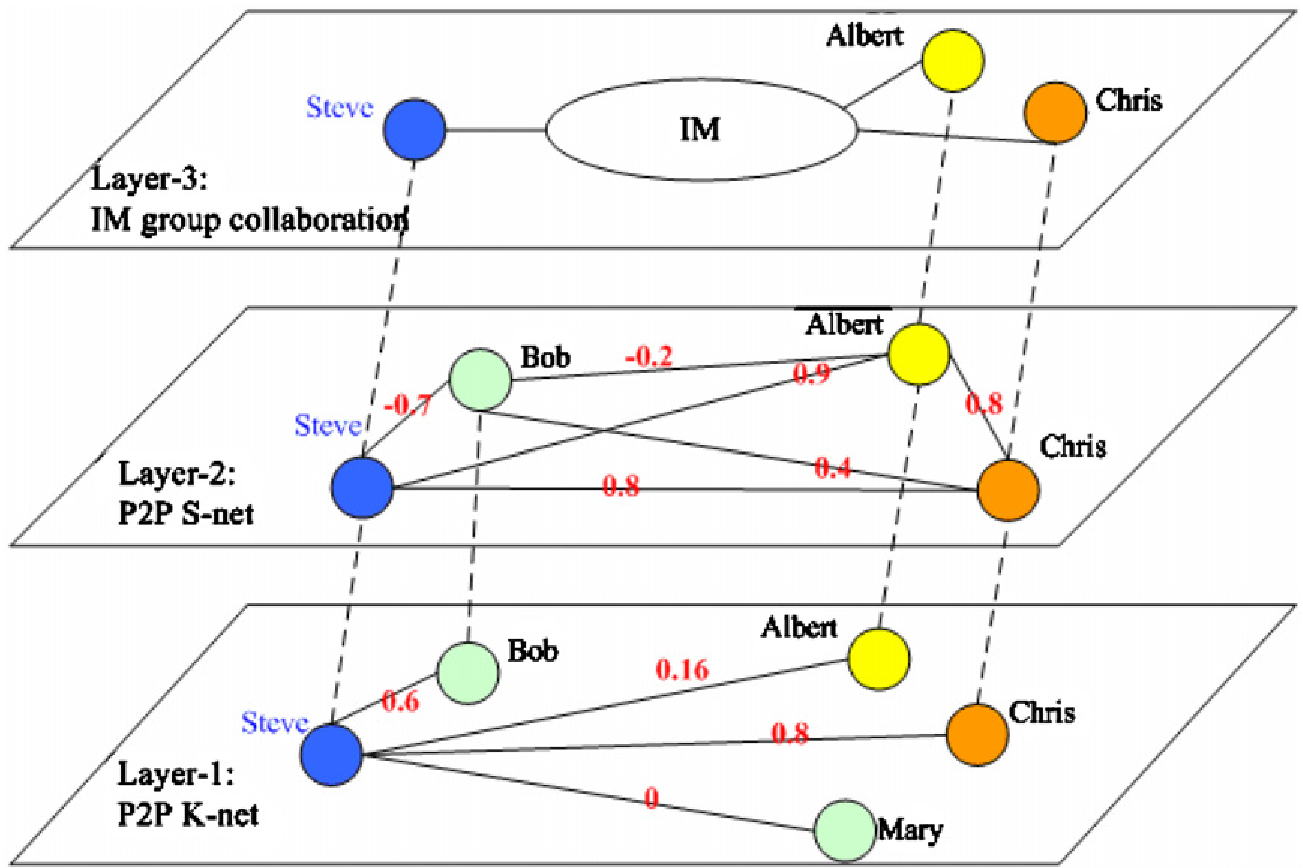
3. IM-Enabled Group Collaboration
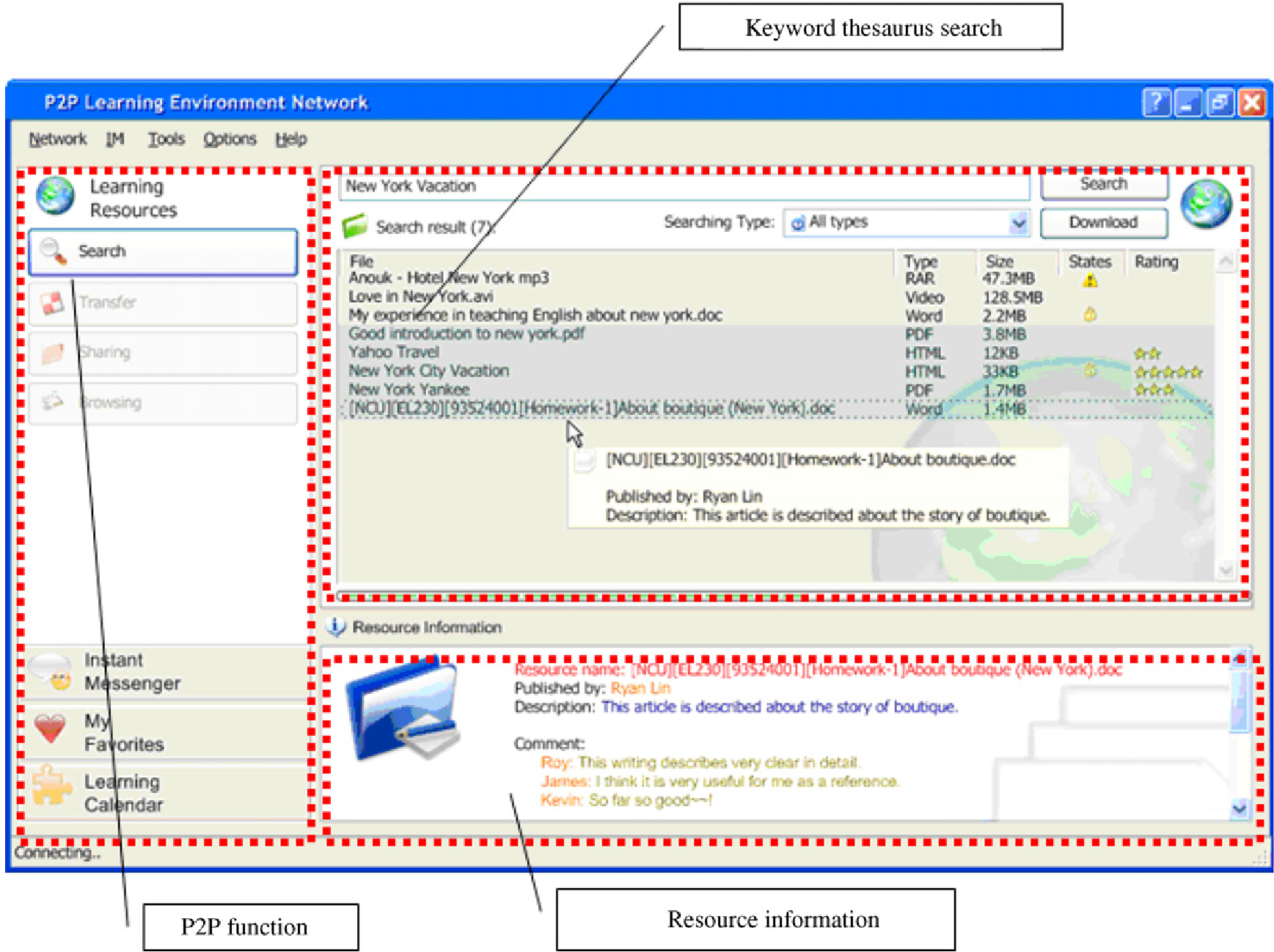
Once the best "Candidates" are found, the system invokes an Instant Messenger interface (SOtella) to facilitate real-time discussion, moving from searching for content to interacting with creators.
Experiments & SOTA Insights
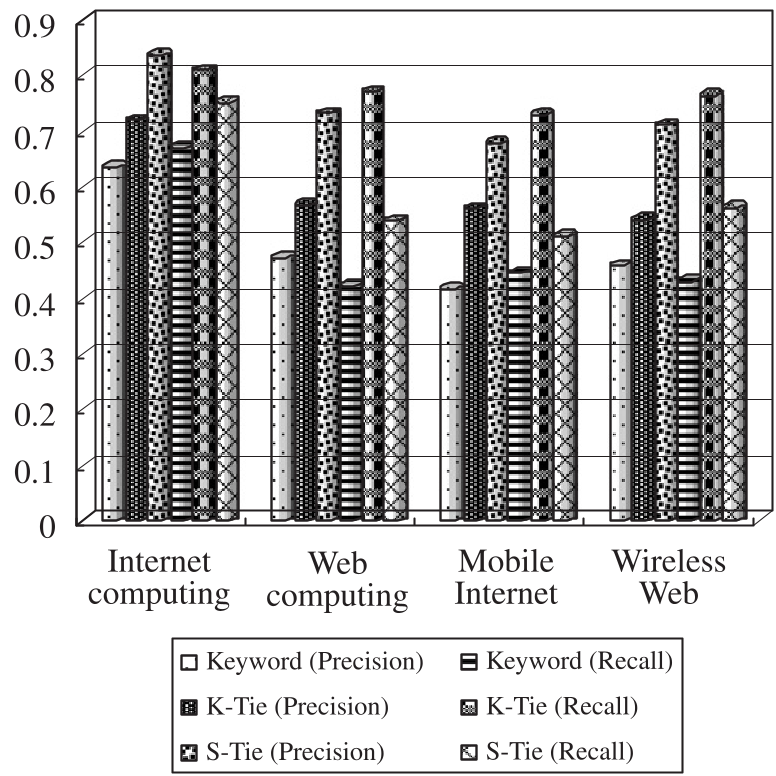
The authors conducted a study with 156 CS students. The key quantitative takeaway is the trade-off between Precision and Recall:
- Social Ties (S-Tie) yielded much higher Precision. If you know the person, you are more likely to find exactly what you need because they understand your context.
- Knowledge Ties (K-Tie) yielded higher Recall. This is better for "exploratory" searches where you want to see everything available in a domain, regardless of who owns it.
Critical Analysis & Future Outlook
While the system is robust for campus-sized networks (~150 nodes), it faces challenges in scaling. The authors purposefully limited the node count to avoid "message flooding"—a common P2P bottleneck where requests saturate the bandwidth.
Takeaways for the Industry:
- Reputation Matters: The use of a "95% confidence interval" for peer reputation is a sophisticated way to handle trust in decentralized systems.
- The Tacit Gap: Modern platforms (like Slack or Teams) often fail because they don't have the underlying K-net to tell you who actually knows the subject matter deeply enough to answer a "How-to" question.
Future Work: The authors aim to move from "Direct Relationships" to "Transitive Relationships" (a friend of a friend). This would allow the system to operate more like a "Small World" network, drastically expanding the reach without losing the social trust factor.
Conclusion
This paper serves as a foundational bridge between the "Cold" architecture of P2P file sharing and the "Warm" dynamics of social interaction. By digitizing cognitive taxonomies and social ties, it transforms a network of servers into a community of collaborators.