
NetworkING: Orchestrating Dramas via Social Connectivity
A Social Network Interface to an Interactive Narrative (Demonstration)
The paper presents NetworkING (social Network for Interactive Narrative Generation), an interactive storytelling system that uses a social network interface to control narrative generation. By manipulating character relationships (e.g., professional rivals or romance) and selecting narrative themes, users generate unique 3D-animated medical drama episodes driven by an AI planner.
TL;DR
NetworkING is an interactive storytelling system that allows users to act as a "social demiurge." Instead of choosing what a character does next, users define who characters are to each other via a graphical social network. Using an AI planner (Metric-FF), the system then translates these relationships—like "rivalry" or "romance"—into a fully voiced 3D medical drama episode.
Background Positioning
In the landscape of interactive narrative, we often see a tug-of-war between Emergence (letting things happen) and Authorial Control (ensuring a good story). NetworkING sits in the sweet spot of Structure-based Generation. It moves away from the "pick-a-path" gameplay of the past and focuses on the underlying engine of serial drama: the social friction between characters.
Problem & Motivation: The Logic of "Shenanigans"
Why do we watch medical dramas like Grey’s Anatomy or House? It is rarely for the medicine; it is for the interpersonal conflict.
Existing digital storytelling systems often focus on individual character goals or physical world state. However, the authors argue that the social relationship is the primary determinant of narrative events. The technical challenge was: How do we make these abstract social ties computable? How does a "rivalry" relationship mathematically increase the probability of a "confrontation" scene in a planning domain?
Methodology: The Social Planner
The core of NetworkING is the marriage of a Graph-based UI and an Automated Planner.
- The Interface: Users interact with a node-link diagram (powered by Graphviz4Net). By adding an arc between "Dr. Adams" and "Dr. Green" and labeling it "Rivals," the user sets a global constraint on the story.
- The Planner (Metric-FF): The social network state is mapped into a planning domain. If a relationship is "antagonistic," the cost of narrative actions involving "cooperation" increases, or the preconditions for "arguments" are met.
- Visualization & "Smithian" Cues: The output is not just text. The system uses the Unreal Engine to stage the scene, applying cinematic lighting and music—referred to as "Smithian" cues—to underscore the dramatic impact of the social changes.
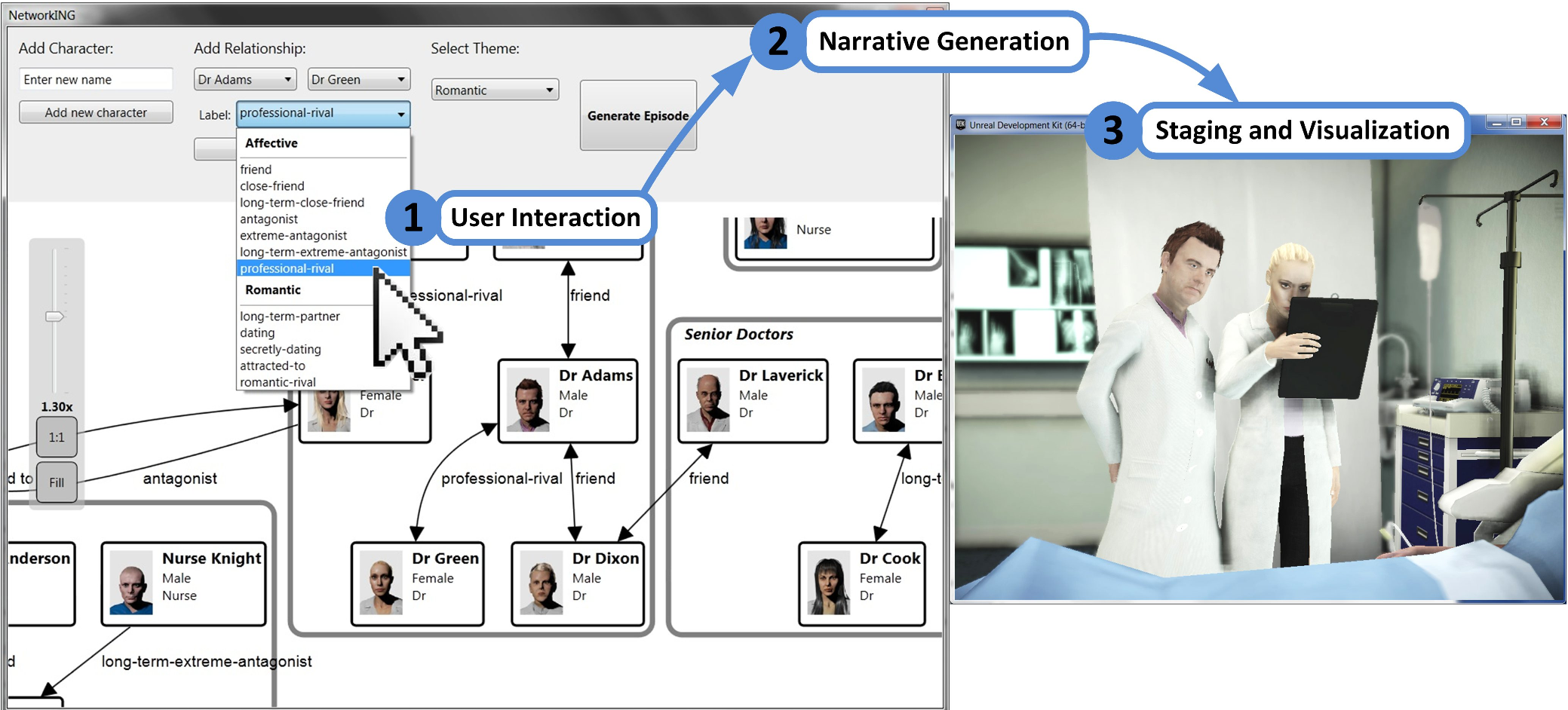 Figure 1: The user interaction cycle from social graph modification (1) to AI generation (2) and 3D visualization (3).
Experiments & Results
The system was tested using a robust domain consisting of:
- 18 Virtual Actors: Clustered by roles (Doctors, Nurses, Patients).
- 100+ Narrative Actions: Ranging from medical procedures to romantic advances and arguments.
The authors demonstrated that the system is highly sensitive to the social network's topology. A single relationship change can cascade through the planner’s logic, resulting in a completely different set of character interactions and dialogues (generated via text-to-speech).
Critical Analysis & Conclusion
Takeaway
NetworkING successfully demonstrates that Social Connectivity is a viable and highly intuitive "UI for Stories." It allows users to manipulate the DNA of the narrative rather than just its surface-level actions.
Limitations
- Symbolic Rigidity: Like most plan-based systems of its era, it relies on a hand-crafted domain model. Adding new types of drama requires defining new planning operators.
- Visual Fidelity: While 3D visualization is a plus, the emotional nuance of "rivalry" is often difficult to convey through the stiff animations of early-2010s game engines.
Future Outlook
In the age of LLMs, the "Social Network" approach remains highly relevant. While modern models excel at local dialogue, they often lose track of global relationship consistency across long contexts. The NetworkING approach—using a structured social graph as a core "world state"—could be the key to keeping modern AI storytellers coherent over multiple episodes.