
When Good Norms Go Bad: How Network Structure Drives Reciprocity-Driven Polarization
Social Network Interventions to Prevent Reciprocity-driven Polarization
This paper introduces an evolutionary game-theoretical model to investigate how social network topology and reputation systems interact to influence cooperation. Using the "stern-judging" social norm within modular networks, the authors demonstrate that community structures can lead to reciprocity-driven polarization, where cooperation flourishes locally but fails globally.
TL;DR
Even the most "moral" social norms—rules that reward helping the good and punishing the bad—can lead to extreme social polarization if the underlying social network is too modular. This paper from AAMAS '21 explores why "Stern-judging" leads to exclusionary group bias and how strategic "link-rewiring" can save global cooperation.
Background: The Double-Edged Sword of Reputation
In the digital age, our interactions are governed by two forces: who we know (Social Networks) and what we know about them (Reputation Systems). While both are designed to foster cooperation, their combination is a powder keg for polarization. The authors position this work as a bridge between Evolutionary Game Theory and Complex Network Science, asking a critical question: Can a system designed to promote "good" behavior actually tear a society apart?
The "Stern-Judging" Paradox
The core of the methodology lies in Indirect Reciprocity. The authors test several "social norms," with a focus on Stern-judging (SJ).
- The SJ Logic: You get a "Good" reputation if you help a "Good" person OR if you refuse to help a "Bad" person.
- The Flaw: In a divided network (modular/community structure), "Good" and "Bad" become relative terms. If my community decides your community is "Bad," my refusal to cooperate with you is seen as a "Good" act by my peers. This creates a self-reinforcing loop of out-group hostility.

Methodology: Simulating the Echo Chamber
The researchers generated synthetic networks based on "Caveman Graphs," where individuals are tightly clustered in modules. They then introduced a parameter , representing the number of "inter-community" bridges.
Using a Donation Game (a version of the Prisoner's Dilemma), agents chose to cooperate or defect based on their strategy:
- AllD: Always defect.
- AllC: Always cooperate.
- Disc (Discriminator): Cooperate only with those who have a "Good" reputation.
As strategies evolved through imitation (replicator-like dynamics), the modular structure forced the "Discriminator" strategy to adapt to local reputations, effectively "weaponizing" the stern-judging norm against other communities.
Results: The Geometry of Bias
The findings are stark. When is low (few connections between groups), Local Cooperation () is high, but Global Cooperation () is low. This is the definition of polarization.
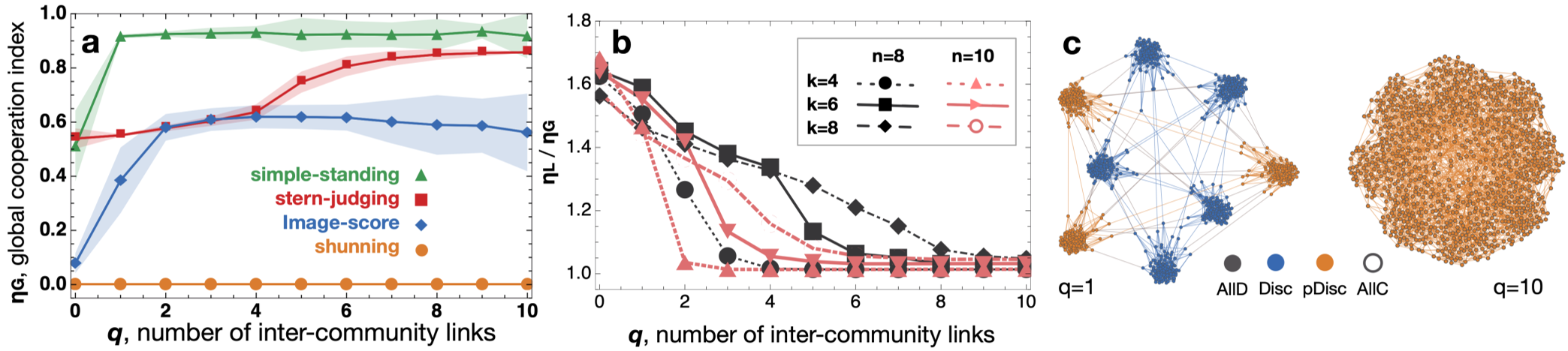
Key Insights from Figure 1:
- The Threshold Effect: As the ratio of inter-community links increases, the gap between local and global cooperation closes.
- Norm Comparison: While "Stern-judging" is the most effective at sustaining cooperation within a group, it is also the most prone to creating group bias. Other norms like "Image Score" produce less cooperation overall but are "fairer" to outsiders.
Critical Analysis: Interventions for the Future
The takeaway is profound for platform designers: Pro-sociality is not just about the rules (norms), but about the pipes (topology).
Limitations
The study assumes a single social norm governs the whole population. In reality, different "bubbles" might use different norms (e.g., one community values "Image Score" while another values "Shunning"). The authors acknowledge that studying the co-evolution of norms and strategies is the next frontier.
Future Outlook
This work provides a mathematical foundation for "link-rewiring" algorithms. Instead of just showing users content they like, platforms might need to "force-connect" disparate modules to prevent reciprocity-based reputation systems from hardening into permanent structural polarization.
Summary
In modular societies, being "good" to your neighbors often requires being "bad" to everyone else. To move from local tribalism to global cooperation, we must bridge the structural gaps in our social networks.