
From Devices to Friends: A Social Network Revolution for the Internet of Things
A Social Network Based Approach for IoT Device Management and Service Composition
This paper proposes a distributed IoT device management and service composition framework using Social Network (SIoT) theory. It leverages RESTful Web Services to encapsulate heterogeneous devices and organizes them into a 3-dimensional social subnetwork (Location, Type, and Correlation) to facilitate parallelized service discovery and automated workflow composition.
TL;DR
The Internet of Things (IoT) is suffering from "centralization fatigue." As billions of devices join the network, traditional management registries are hitting a performance wall. This paper introduces a Social Network-based Approach that treats smart devices like social entities. By organizing devices into localized, functional, and relational "social circles," the authors enable distributed, high-speed service discovery and automatic composition.
Background & Motivation: The Scalability Wall
Most current IoT architectures use a centralized Universal Description, Discovery, and Integration (UDDI) registry. While this worked for the early web, it fails for the IoT for two reasons:
- Heterogeneity: A smart toaster, a light bulb, and a heart rate monitor speak different languages.
- Scale: Managing 26 billion devices via a single "phonebook" is computationally impossible.
The authors' core insight is that IoT devices aren't isolated; they share Social Properties. Like people, devices often work in the same room (Location), perform similar roles (Type), or frequently collaborate (Correlation).
Methodology: The 3-Dimensional Social Mirror
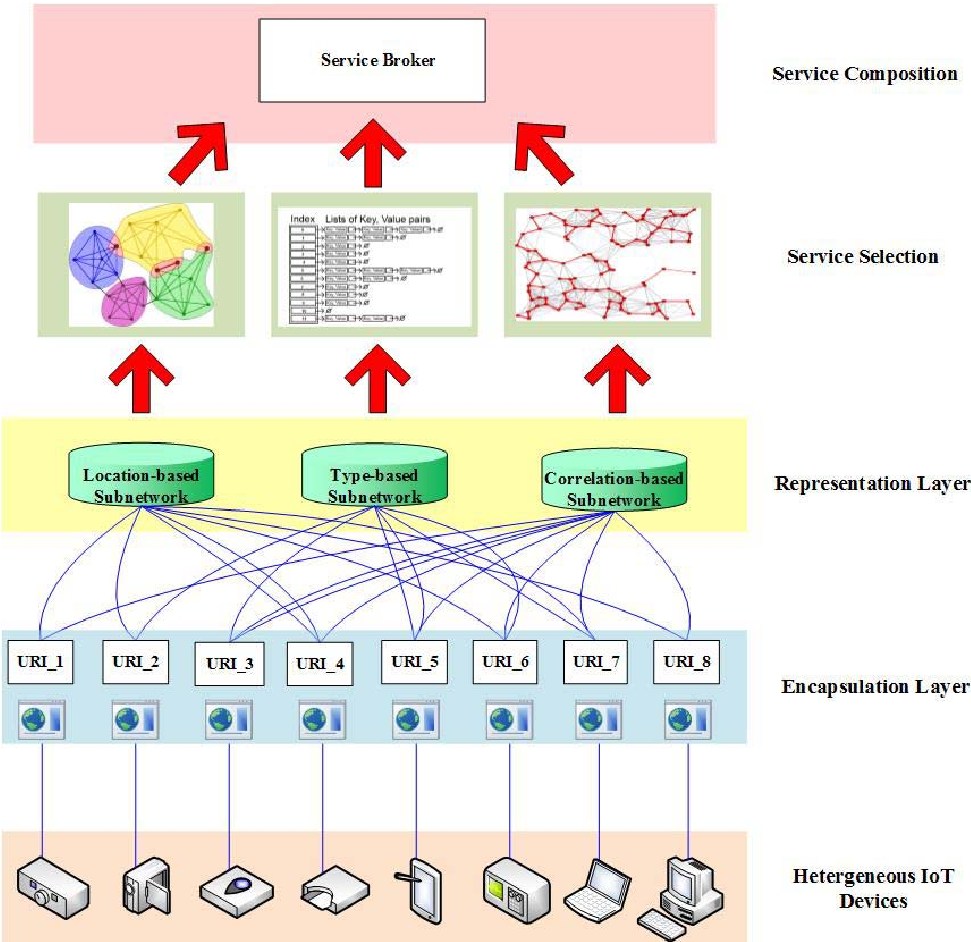
The proposed architecture (shown below) moves away from a giant list and toward a structured, multi-dimensional graph.
1. RESTful Encapsulation
To handle heterogeneity, every device is wrapped in a RESTful Web Service. Whether it's a proprietary industrial sensor or an off-the-shelf smart bulb, it becomes a URI accessible via standard HTTP. This transforms a hardware management problem into a software service orchestration problem.
2. Multi-Dimensional Search Algorithms
Instead of a one-size-fits-all search, the system splits the social network into three parallel dimensions:
- Location Dimension: Uses DBSCAN Clustering to automatically group devices by physical proximity without manual tagging.
- Type Dimension: Utilizes a Hash Table structure. Looking up "all thermometers" becomes an O(1) operation, meaning it takes the same amount of time whether you have 10 devices or 10,000.
- Correlation Dimension: This is the most innovative part. It tracks how often devices work together. If the garage door closing usually triggers the hallway light, they form a "strong social bond." The system uses a spanning-tree algorithm to find these "cooperative clusters."
Experimental Results: The Performance Edge
The authors validated their approach using a real-world smart home dataset. By simulating a "dinner preparation" scenario, they showed how the system could automatically select and compose services (e.g., turning on the kitchen light triggers the refrigerator to wake up and the microwave to pre-set).
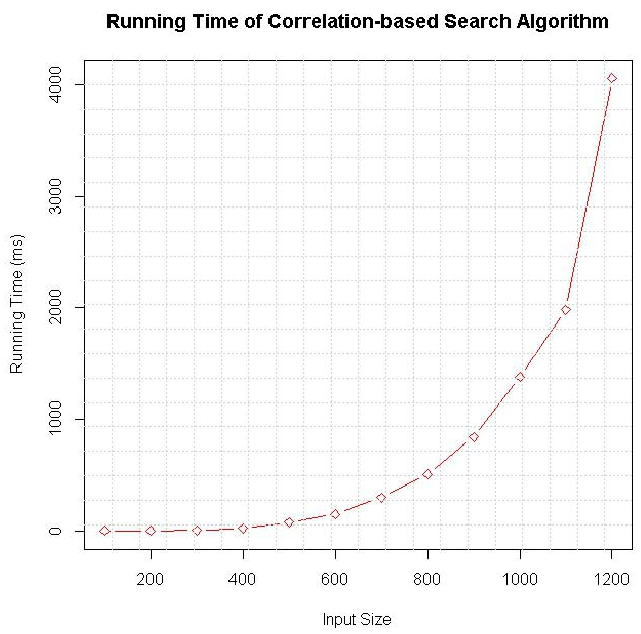
As shown in the performance charts, the running time for discovery remains stable even as the search space triples. This proves the Social Network model provides the necessary inductive bias to keep search times manageable in dense IoT environments.
Critical Insight & Future Outlook
The brilliance of this work lies in its Inductive Bias. By assuming that devices are more likely to interact with their "friends" (spatially or functionally related nodes), we can prune the massive search space of the global IoT.
Limitations: While the RESTful approach simplifies management, it may introduce overhead for ultra-low-power constrained devices (Class 0 devices) that cannot handle the verbose nature of HTTP/XML. Future iterations should look into mapping these social models onto more efficient binary protocols like CoAP.
Conclusion: This paper effectively argues that the future of the IoT isn't just "smarter" devices, but "socially aware" devices. By letting devices manage their relationships, we can build a more robust, decentralized, and responsive digital world.