
SOON: Transforming Smart Manufacturing through a Social Network of Machines
SOON: Social Network of Machines to Optimize Task Scheduling in Smart Manufacturing
The SOON project introduces a Multi-Agent System (MAS) architecture that leverages a "Social Network of Machines" to optimize task scheduling in Industry 4.0. It proposes two distinct paradigms—an Auction-based rule system and a Heterarchical Reinforcement Learning (RL) network—demonstrating SOTA flexibility in handling dynamic manufacturing constraints and machine failures.
Executive Summary
TL;DR: The SOON (Social Network of Machines) project shifts the manufacturing paradigm from rigid centralized control to an autonomous, social ecosystem. By combining Auction-based mechanisms for resource allocation and Deep Reinforcement Learning (DRL) for operational optimization, the researchers demonstrate a system where machines "negotiate" and "learn" to fulfill orders, resulting in recovery from failures and significantly faster training speeds through Curriculum Learning.
Background: Positioned at the intersection of IIoT and Multi-Agent Systems (MAS), this work addresses the "siloed intelligence" problem in Industry 4.0. It moves beyond simple connectivity into the realm of social cooperation between cyber-physical entities and humans.
Problem & Motivation: The Limits of Localized Intelligence
In traditional smart factories, intelligence is often trapped within individual machines. A CNC machine might be "smart," but it rarely "talks" to the assembly arm next to it in a meaningful social context. When a disruption occurs—such as a machine failure or a sudden change in order priority—these systems struggle to adapt dynamically. The authors argue that for a true Internet of Everything, machines must follow a shared social paradigm, acting as agents that can collaborate, compete, and even be managed by human "social" partners.
Methodology: Two Paths to Optimization
The paper proposes two specific architectural paths to solve the scheduling problem:
1. The Auction Paradigm (Rule-Based)
Specifically applied to a Wire Rod Mill use case, this approach treats scarce resources (like expensive rolling mill rolls) as items in an auction.
- Mechanism: A Poll Management and Aggregation System (PMAS) initiates auctions. Machine agents calculate their "bid" based on their current schedule and the projected depreciation cost of the tool.
- Optimization: The agent with the lowest cost (highest efficiency) wins the task.
2. Heterarchical RL Network (Learning-Based)
For mechanical part manufacturing, agents don't follow fixed rules but learn via Proximal Policy Optimization (PPO).
- Physical Intuition: Instead of a master controller, each machine observes the global state (storage levels, pending orders) and decides: Produce, Reconfigure, or Do Nothing?
- Curriculum Learning: To solve the sparse reward problem, the authors "guide" the agents by starting with simple tasks (e.g., storage already full of parts) and progressively increasing complexity.
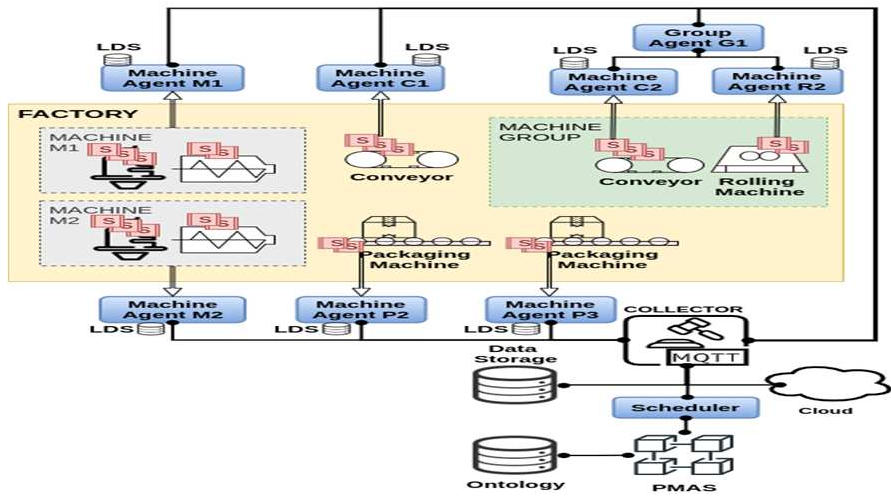 Fig 1: The Multi-agent framework bridging machines and human operators.
Experiments & Results: The Power of Guided Learning
The researchers evaluated the RL approach in a simulated workshop environment. The critical finding was the effectiveness of Curriculum Learning.
- Speed of Convergence: By starting the agents in a simplified "easy" environment and gradually moving to a "raw material only" state, the agents achieved the optimal policy 1.5x faster than the vanilla (standard) RL approach.
- Resilience: The system demonstrated an "automatic reconfiguration" capability. If Machine B2 fails, a neighboring machine can autonomously decide to reconfigure itself to take over the production of B2 parts to ensure the final order is met.
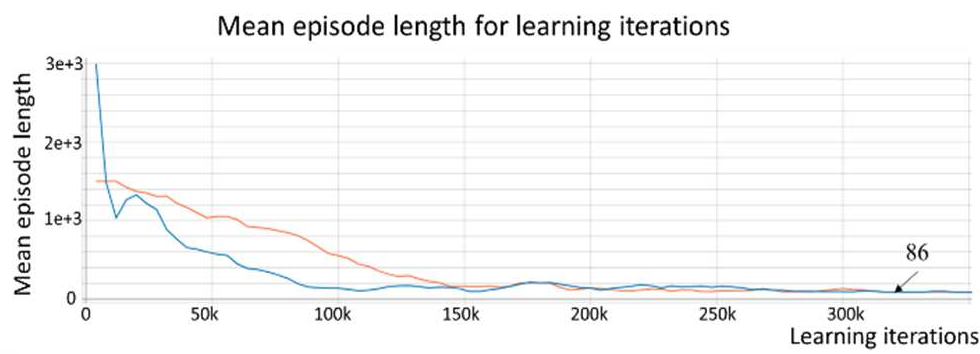 Fig 2: Average episode length reduction, comparing Vanilla (Orange) vs. Curriculum Learning (Blue).
Critical Insight & Conclusion
The SOON project proves that the "Social Machine" is not just a metaphor but a functional architecture for Industry 4.0.
Takeaway: The real value lies in the hybridity of the system—using robust, scalable Erlang-based brokers for auctions while employing DRL for complex, adaptive task logic.
Limitations & Future Work: While the simulation results are promising, the "real-world noise" of physical manufacturing (sensor drift, imperfect communication) remains a challenge. The next phase will involve stress-testing these agents against unpredictable machine failures and integrating more complex human-in-the-loop interactions.
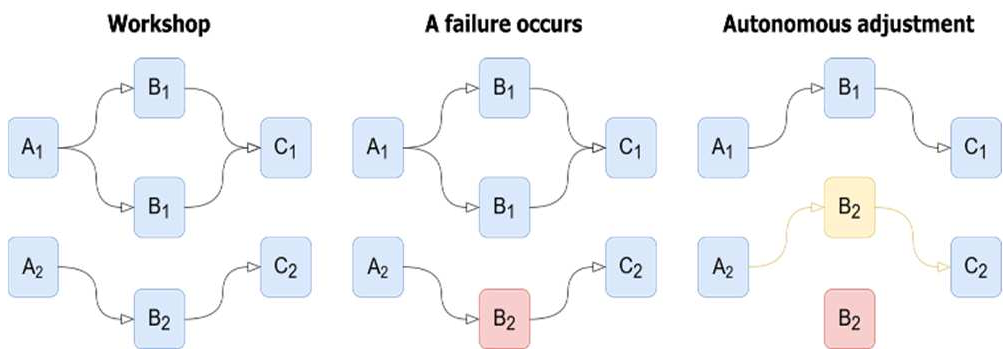 Fig 3: Visual representation of a workshop reconfiguring itself autonomously after a unit failure.