
Organizing Chaos: Enhancing Crisis Understanding via Automated Sub-topic Clustering
Organization of social network messages to improve understanding of an evolving crisis
This paper introduces a system designed to organize social network message streams into coherent sub-topics during evolving crises. Utilizing a specialized K-Nearest Neighbors (KNN) clustering approach with a similarity threshold of 0.2, the method achieves an average classification precision of 88.41% across diverse query topics.
TL;DR
In the wake of a crisis, social media becomes a firehose of critical but fragmented information. This paper proposes a system that utilizes a dynamic K-Nearest Neighbors (KNN) algorithm to cluster social media messages into distinct sub-topics. By filtering noise and merging redundant groups, the system achieves 88.41% precision and is preferred by 95% of users over traditional unorganized feeds for rapid situational awareness.
The Information Bottleneck in Crisis Response
When a disaster strikes—be it an earthquake or an oil spill—standard communication channels often fail. Social networks like Twitter (now X) fill the void, but they present a "needle in a haystack" problem. For emergency responders and affected citizens, scrolling through thousands of chronological tweets is inefficient.
The core challenge is not just finding information, but organizing it such that a user can see both the "big picture" (the main crisis) and the "fine details" (specific sub-events like local relief efforts or casualty reports).
Methodology: Beyond Simple Keyword Searches
The authors present a streamlined three-step workflow to transform raw streaming data into structured knowledge:
- Search & Retrieval: Initial filtering based on a query related to the crisis.
- Threshold-Based KNN Clustering: Unlike standard KNN which uses a fixed k, this system uses a similarity threshold of 0.2. In this model, k is the number of neighbors that meet this similarity bar. This allows the sub-topics to grow or shrink naturally based on the data density.
- Refinement & Merging:
- Noise Removal: Sub-topics below a certain size threshold are discarded.
- Subsumption Merging: If Sub-topic A is a subset of Sub-topic B (A ⊆ B), they are merged to reduce redundancy.
Note: The system acts as an organizational layer on top of the social network stream to facilitate human-centric understanding.
Empirical Performance & User Sentiment
The researchers tested their algorithm against 27,000 tweets from major news sources, evaluating precision across high-variance topics ranging from political movements to corporate crises.
Precision Metrics
The system performed exceptionally well, particularly in focused topics:
- Apple: 95.31% Precision
- Obama: 90.00% Precision
- BP Oil: 81.25% Precision (indicating higher complexity in environmental crisis data)
- Total Average: 88.41%
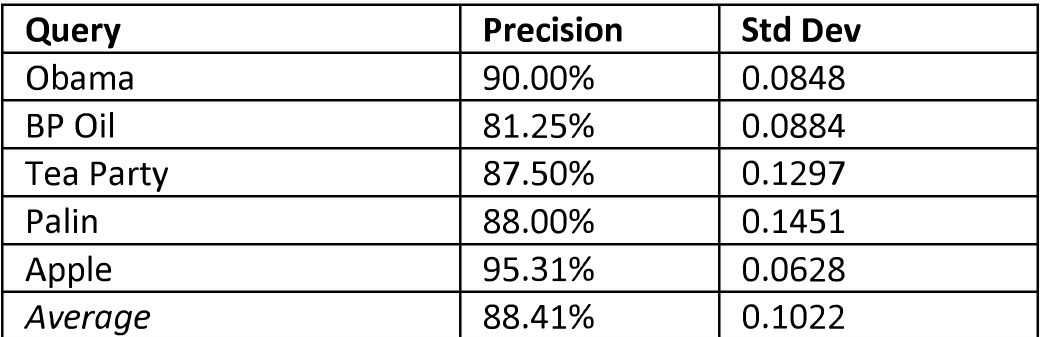 Table 1: High precision scores across diverse queries validate the robustness of the clustering logic.
Human-Centric Validation
Beyond the math, the user study of 21 social media power users provided the most compelling evidence. Over 90% of respondents reported that the sub-topic organization significantly reduced the cognitive load required to understand the evolving crisis.
Critical Analysis & Future Directions
The primary contribution of this work is its Inductive Bias toward hierarchical organization—recognizing that crisis data is naturally nested. However, the reliance on a fixed similarity threshold (0.2) may be sensitive to different languages or slang used in different regions.
Takeaway: While newer LLM-based embeddings (like BERT or GPT) would likely improve the "similarity" metric used in the KNN step today, the fundamental logic of "retrieve, cluster, and merge" remains a cornerstone of effective Crisis Informatics. Future iterations should focus on reducing sub-topic repetitiveness, perhaps through semantic deduplication rather than simple subset matching.
Conclusion
By shifting from a linear timeline to a structured sub-topic view, this system allows users to gain a deeper understanding of crises in less time. It serves as a vital bridge between raw social sensors and actionable human intelligence.