
Harmonizing Global Stature and Local Trust: A Multi-Tiered Approach to Social Recommendations
A Study on Social Network Metrics and Their Application in Trust Networks
This paper introduces a hybrid recommendation framework for social networks that integrates diverse social network analysis (SNA) metrics with a collaborative trust model. By combining global influence indicators like PageRank and Betweenness with local user-to-user trust links, the authors achieve superior content and user recommendation accuracy, specifically validated on the Epinions dataset.
TL;DR
Researchers from Harokopio University and San Jose State University have developed a framework that bridges the gap between Personal Trust and Global Influence. By blending traditional Social Network Analysis (SNA) metrics with a collaborative local scoring mechanism, they significantly improve recommendation quality, particularly for users with sparse connections.
The Core Tension: Influencers vs. Friends
In the digital world, we are pulled in two directions:
- Local Trust: We value the opinions of our immediate friends and colleagues.
- Global Influence: We are often swayed by "power users" who sit at the center of the information flow.
Most recommendation systems pick a side. This paper argues that the true "Network Value" of a user lies in the intersection of these two dimensions. The authors identified a major pain point: Local-only models suffer from sparsity (limited reach), while Global-only models lack personalization (irrelevance).
Methodology: The Hierarchical Influence Model
The authors build their model systematically, starting from the individual and moving to the network at large.
1. The Global Layer (Macro)
They utilize six classical SNA metrics to calculate a user's Global Influence (GI):
- Degree & PageRank: Measuring popularity and prestige.
- Betweenness: Identifying users who act as "bridges" between different communities.
- Closeness: Measuring how quickly a user can reach others.
2. The Collaborative Local Layer (Micro)
The Local Accumulative Score (LAS) introduces a temporal element—Freshness. A link created years ago is weighted less than a recent interaction. This extends into the Collaborative Local Score (CLS), which aggregates trust not just from your friends, but from the friends of your friends.
3. The Unified Formula
The final Influence Score () is a weighted combination of these layers:
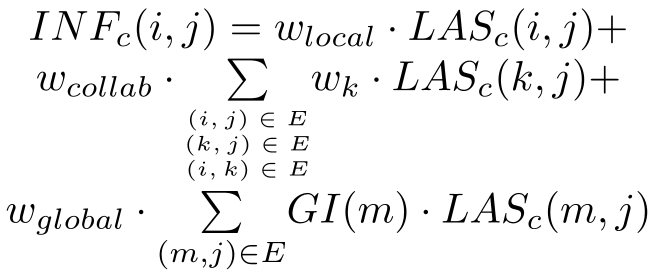 Where , , and allow the system to tune the balance based on user needs.
Experimental Insights
Testing on the Epinions dataset (132k users, 841k interactions), the researchers discovered a "Goldilocks zone" for weights.
- The "Celebrity" Paradox: Following only the highest-ranked global users (like those with high Authority or Hub scores) resulted in near-zero similarity to a user's actual interests.
- The Synergy: However, when Global Influence (specifically PageRank and Degree) was used to weight the suggestions coming from the local network, the performance jumped significantly.
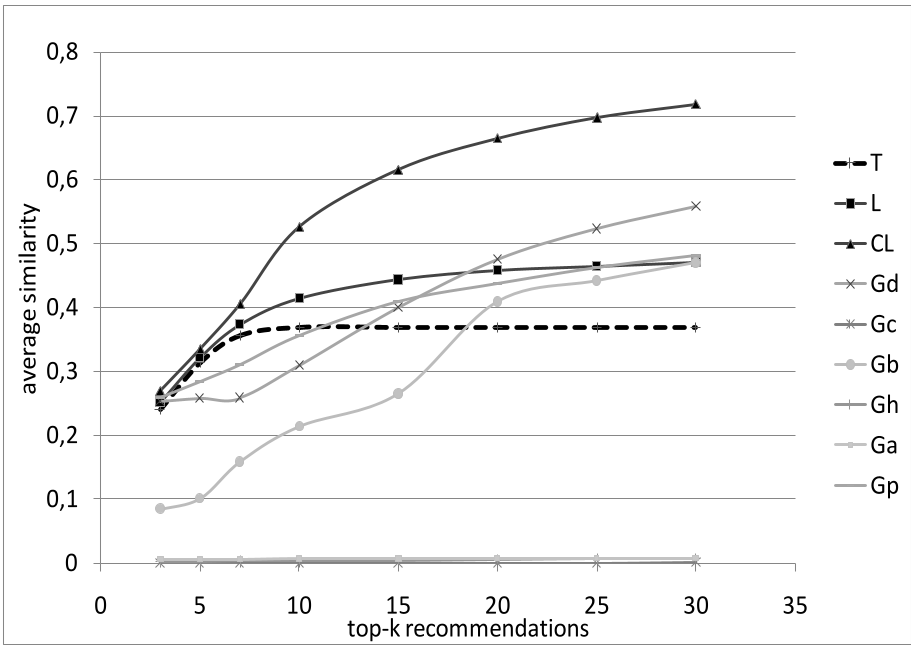 Figure 1: In Set A (users with fewer than 10 links), notice how the Collaborative Local (CL) model and combined models consistently outperform the simple Trust baseline.
Critical Analysis & Conclusion
The study’s most profound takeaway is that Global Importance is a multiplier, not a substitute. A globally influential user is only relevant if they are reachable through a chain of trust.
Strategic Implications:
- Cold-Start Solution: For new users who haven't built a "circle of trust," leveraging Degree Centrality and PageRank provides a high-quality initial recommendation set that local models cannot offer.
- The Power of PageRank: Among all global metrics, PageRank consistently proved to be the most reliable indicator of quality when integrated into local trust networks.
Future Work
The authors acknowledge that "Negative Influence" (distrust) remains a frontier. In an era of misinformation, understanding how to propagate "distrust" through the same graph structure is as vital as identifying which influencer to follow.