
Bridging the Virtual and Physical: A Collaborative Framework for Mobile-Social Interaction
When Social Network Meets Mobile Device! - An Efficient and Collaborative Framework for Mobile Application
This paper introduces an efficient, collaborative framework that bridges mobile devices and social networking for real-world interactions. Specifically, it presents the "Conference Appliance," a system that enables paperless event management through real-time note-taking, social matching, and collaborative feedback loops.
TL;DR
This research addresses the "information silo" and "paper waste" problems inherent in professional conferences. By proposing a dedicated Mobile-Social Collaboration Framework, the authors move social networking from the purely virtual realm into physical venues. The system enables real-time slide synchronization, collaborative note-sharing, and AR-based attendee matching, effectively turning a static event into a dynamic, paperless social ecosystem.
Problem & Motivation: The "Static" Conference Dilemma
Despite the rise of smartphones, conferences often remain analog. Printed booklets are hard to search, and networking is often left to chance. Prior works like Microsoft NetMeeting focus on virtual sessions, while existing "green" apps offer only static schedules.
The authors' core Insight is that the value of a physical meeting lies in simultaneous collaboration. People don't just want to see a slide; they want to see what their peers think of it in real-time. They don't just want a list of attendees; they want a system that calculates an "interest weighting" to tell them who they should actually talk to.
Methodology: The "Conference Appliance" Architecture
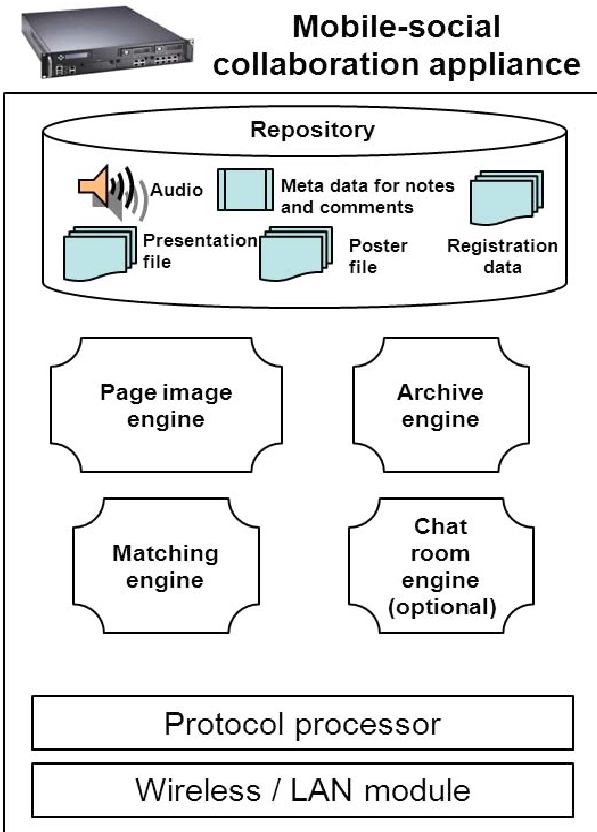
The proposed framework isn't just an app; it is a server-side "Appliance" that manages the flow of real-time data through several specialized engines:
- Page Image Engine: Post-renders meta-data (like user notes) directly onto presentation slides.
- Matching Engine: The "brain" of the social layer. It calculates a "matching ratio" based on specialty, company, and interests.
- Repository: Acts as the central nervous system, storing everything from specific slide annotations to audio recordings.
Real-Time Synchronization
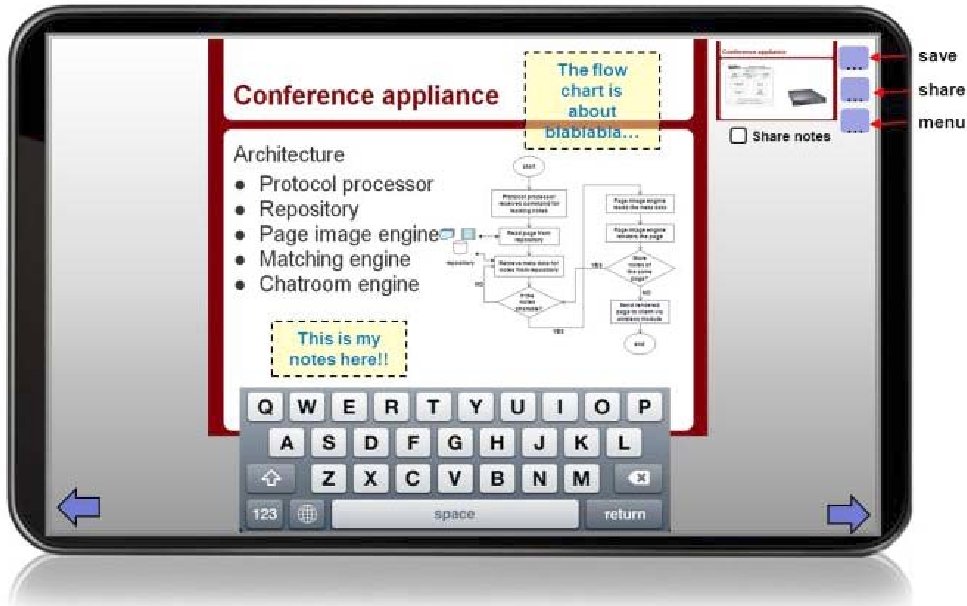
One of the standout features is the Progress Tracker. As a speaker changes slides, the appliance pushes the update to all connected mobile devices. If an attendee is busy writing a note, a "mini-view" (Picture-in-Picture) of the speaker's current page appears, ensuring the user is never out of sync with the live context.
Experiments & Case Study: Beyond the Lecture Hall
The authors validate their framework through two primary scenarios: Presentation Sessions and Poster Sessions.
1. Collaborative Intelligence
The system allows users to "publish" their notes. If a page has shared notes, other attendees are notified and can overlay their peers' insights onto their own screen. This transforms a one-way lecture into a collective intelligence exercise.
2. Socializing with Precision (AR Integration)
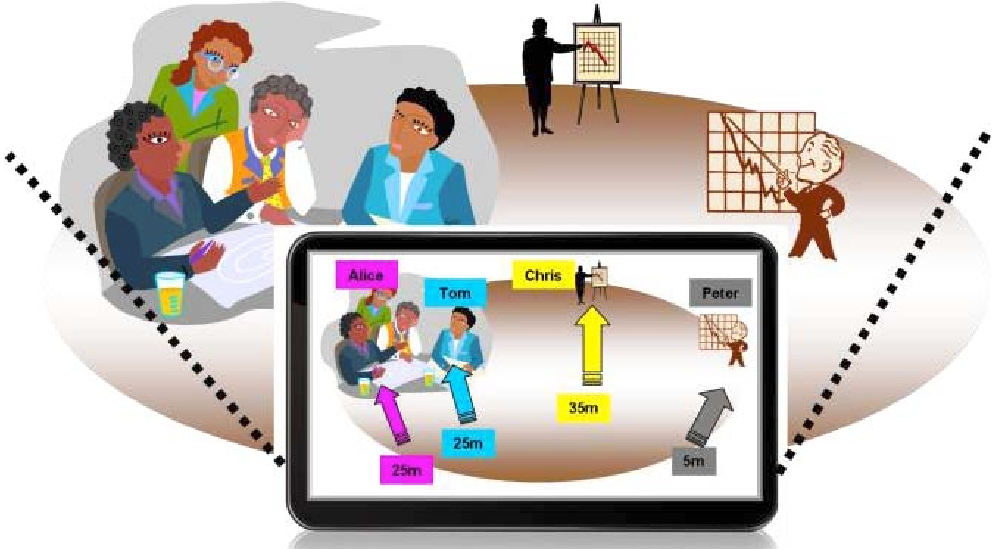
To solve the "who is who" problem, the framework integrates Augmented Reality (AR). By calculating matching ratios (e.g., weighing "Specialty" at 0.8 and "Company" at 0.2), the system suggests people to meet. Users can then use their phone's camera to see floating indicators in the room showing exactly where their "match" is standing.
Critical Analysis & Conclusion
Takeaway
The paper successfully demonstrates that "Social" is not just a platform (like LinkedIn) but a layer of interaction that can be injected into physical processes. By digitizing the "meta-data" of a conference (notes, comments, voices), they create a searchable, persistent record of an ephemeral event.
Limitations & Future Work
While the architecture is robust, the paper leaves the specific matching algorithm as a "black box" (configurable by administrators). Future iterations would benefit from more sophisticated AI-driven matching. Additionally, the reliance on local Wi-Fi/LAN modules for the "Appliance" might face scalability issues in massive conventions with tens of thousands of simultaneous users.
The logic presented here is highly extensible—the authors even suggest applying it to shopping malls, where customers could scan QR codes on products to see "try-on" photos and real-time comments from friends, proving the framework's broad industrial potential.