
Beyond Immediate Neighbors: A New Frontier for Academic Collaboration Networks
A Social Network Model for Academic Collaboration
This paper introduces a novel social network model specifically designed for Academic Collaboration, extending the Barabási-Albert scale-free framework. It proposes a growth algorithm combining random attachment with both secondary (Neighbor of Initial Contact) and tertiary (Neighbor of Neighbor) preferential contacts to enhance information flow and community interaction.
TL;DR
This research presents a sophisticated social network model tailored for the academic domain. By introducing Tertiary Contacts (Neighbor of Neighbor of Initial Contact), the model achieves a massive leap in clustering efficiency—moving from a standard decay to a much denser distribution—while preserving the essential "scale-free" nature of professional networks.
Background: The Limits of Direct Ties
In the world of academic research, a "cold call" or a random introduction (Initial Contact) rarely suffices for deep collaboration. Most fruitful partnerships occur through "weak ties" or extended networks. Existing models, like the Toivonen model, accounted for neighbors of contacts, but this paper argues that even that is too restrictive.
The author's core insight is that if a primary contact cannot provide adequate support, they often refer the seeker to a friend of a friend. Capturing this logic mathematically is key to simulating how interdisciplinary research actually grows.
Methodology: The Three-Tier Growth Algorithm
The model evolves through an iterative algorithm consisting of three distinct processes:
- Random Attachment: A new vertex connects to a random initial contact ().
- Implicit preferential contact (Secondary): The vertex connects to neighbors of that initial contact ().
- Tertiary Contact (NNIC): The vertex connects to the neighbors of neighbors ().
Model Architecture
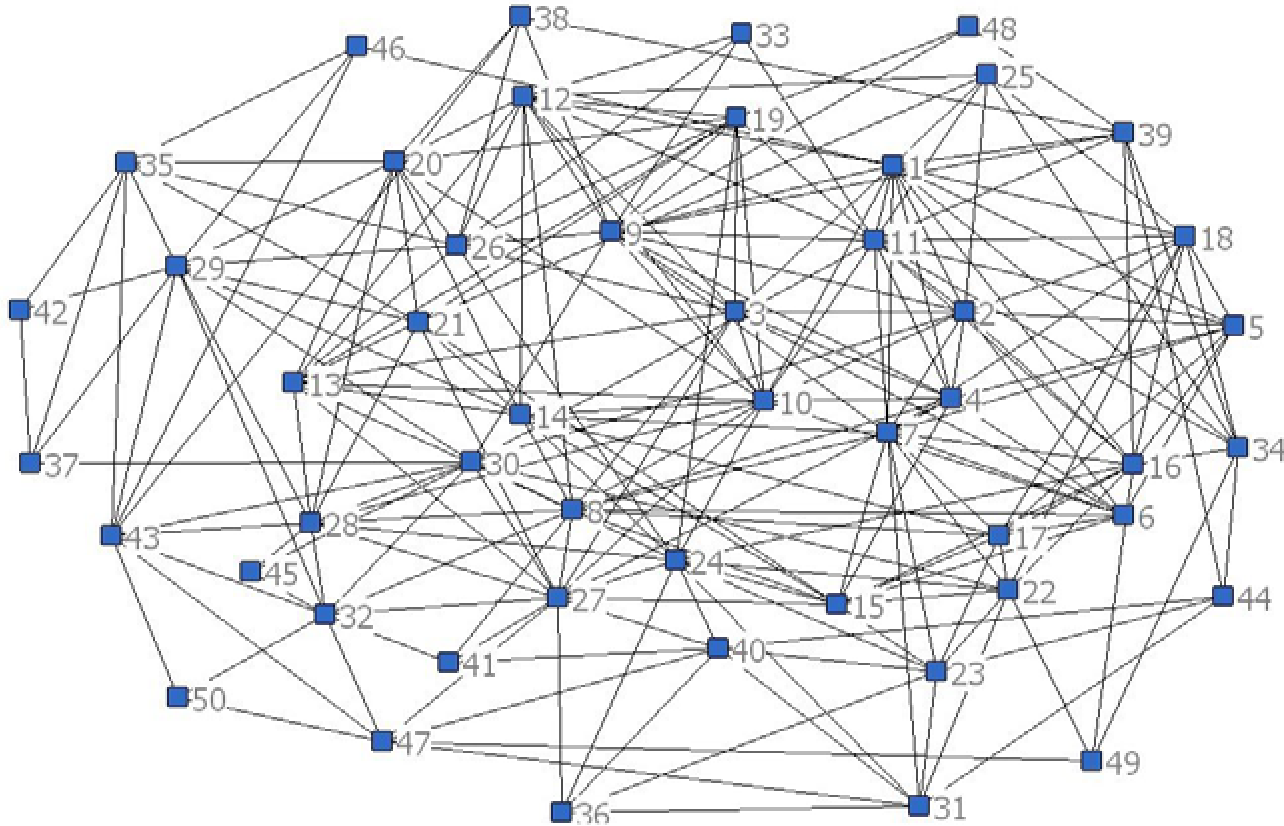
The following diagram illustrates the resulting complex structure of a 50-vertex network generated by this multi-tier growth process:
The Mathematics of Growth
The author derives a rate equation to describe how the degree () of a vertex changes over time:
This formula reveals that while the network remains scale-free (with a degree exponent lower bound of 3), the probability density is significantly higher than in traditional models, allowing for a much more "connected" academic community.
Experiments and Clustering Results
The most striking finding is in the Clustering Coefficient. In most social network models, clustering decays following . In this NNIC model, the clustering follows .
Comparative Growth
Simulation results show that the "degree" of nodes grows exponentially faster when tertiary contacts are introduced.
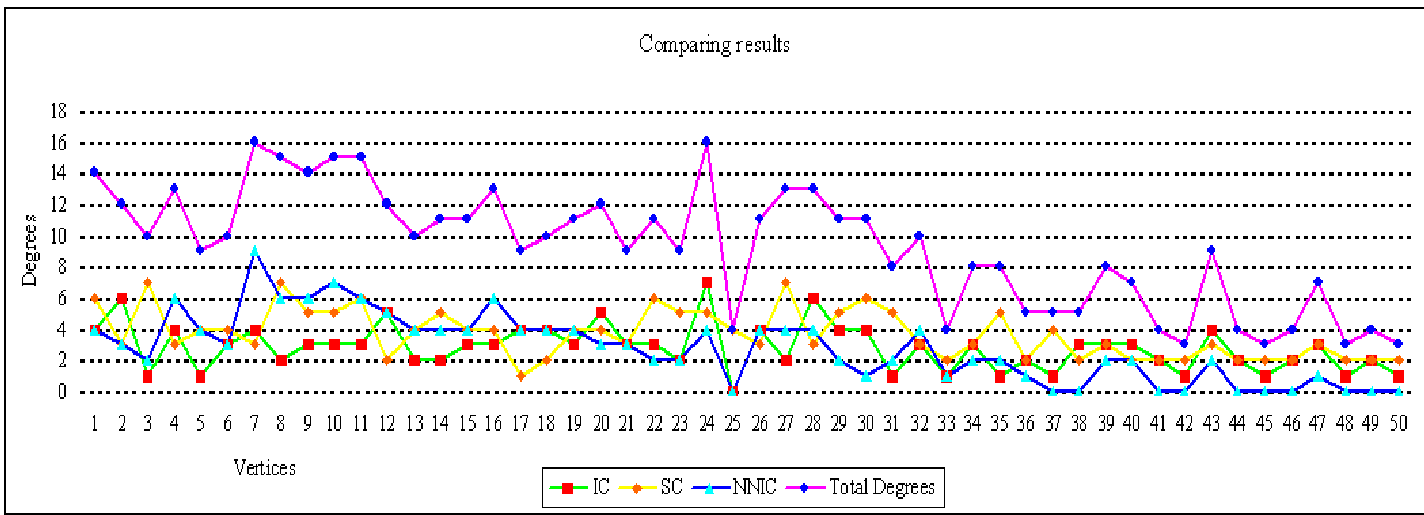
As seen in the comparison, the secondary and tertiary contacts (represented in the data table below) far outpace initial random contacts in terms of triangle formation—the bedrock of community structure.
| Contact Type | Vertices (Growth) | Triangles (Cluster) |
|---|---|---|
| Initial (IC) | 2.8 | 0.8 |
| Secondary (SC) | 5.56 | 6.0 |
| Tertiary (NNIC) | 2.78 | 6.44 |
Critical Insight & Conclusion
The value of this model lies in its efficiency of information flow. By allowing vertices to "leapfrog" across two neighbors (NNIC), the model simulates a network that is complex but highly functional for sharing research ideas and data.
Takeaway: For those building digital platforms for academic collaboration (like ResearchGate or LinkedIn for Scientists), this model suggests that recommendation engines should prioritize "friends of friends of friends" to stimulate cross-domain innovation while keeping the specialized "clusters" (communities) intact.
Limitations: The model is computationally more complex due to the tertiary search space. Future work should investigate how this model behaves in extremely large-scale networks (millions of nodes) where the "small world" diameter might shrink too fast, potentially leading to information overload.