
Beyond the Small-World: Modeling Modern Social Networks through Community Evolution
A Social Network Model Based on the Community Evolutions
This paper introduces a novel social network model based on community evolution, moving beyond traditional Small-World and Scale-Free models. By incorporating hierarchical evolution steps—intra-community and inter-community—the model accurately reflects modern social dynamics where digital and physical mobility break spatial constraints.
TL;DR
Researchers at Tsinghua University have developed a new social network model that shifts the focus from simple node-to-node links to a community-entry mechanism. By simulating how individuals join diverse communities (online/offline) and then form links, the model achieves the "Small-World" effect with a more realistic, lower clustering coefficient than traditional models like the NW Small-World.
Problem & Motivation: The "Space Limitation" is Dead
Twenty years ago, social networks were primarily constrained by physical geography. Models like the Watts-Strogatz (WS) or Newman-Watts (NW) Small-World captured the high clustering of "friends of friends" and the short paths between strangers.
However, the authors argue that today's social landscape is different:
- Broken Boundaries: The Internet and rapid transportation allow us to enter diverse, non-local communities.
- Community-First Logic: We don't just "link" to people; we enter a community (a university, a WeChat group, a virtual forum) and then make friends.
- The NW Gap: Traditional models result in clustering coefficients that are far too high for modern, fragmented social networks where different friend groups rarely interact.
Methodology: The Two-Stage Evolution
The core of the paper is a hierarchical evolution process that treats communities as the fundamental unit of expansion.
1. The Personal Perspective (Intuition)
Before modeling the math, the authors describe a person's life: born into a family (Community 1), entering a primary school (Community 2), and joining online forums (Community 3). Each step involves a choice: if you choose Harvard, you likely miss the chance to join the MIT community.
2. The Global Model (Execution)
The model starts with independent communities, each with nodes originally connected in a ring (nearest-neighbor).
- Intra-community Evolution: Nodes form random links within their own group with probability .
- Inter-community Evolution: This is the "secret sauce." A node tries to access a different community with probability . If successful, it connects to nodes in that external group.
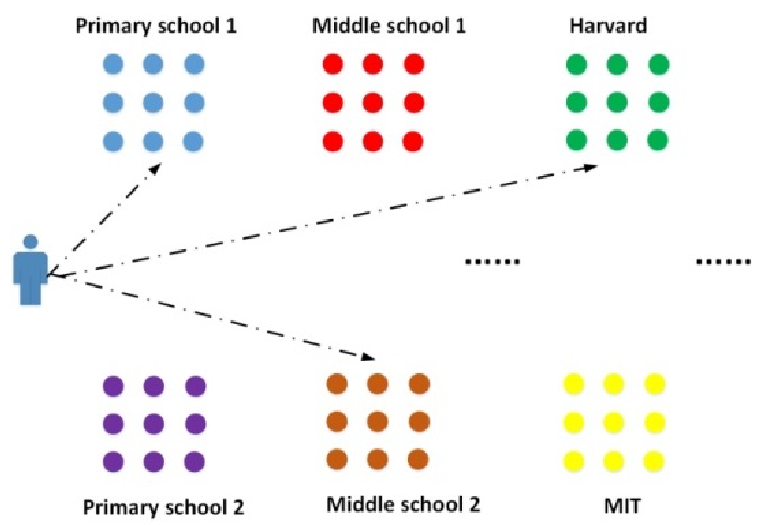 The Figure above illustrates the choice-based entry into communities, showing how nodes bridge different social clusters.
Geometrical Features: Achieving Realism
The authors derive the mathematical distribution of degrees () and the clustering coefficient ().
- Small-World Property: Even with small , the probability that two communities become connected is . Since is usually large, almost all communities link up, keeping the average distance very short.
- Clustering Coefficient: Unlike the NW model, where the coefficient is heavily tied to local density, this model's is lower because it accounts for the "difficulty" of friends in different communities becoming friends with each other.
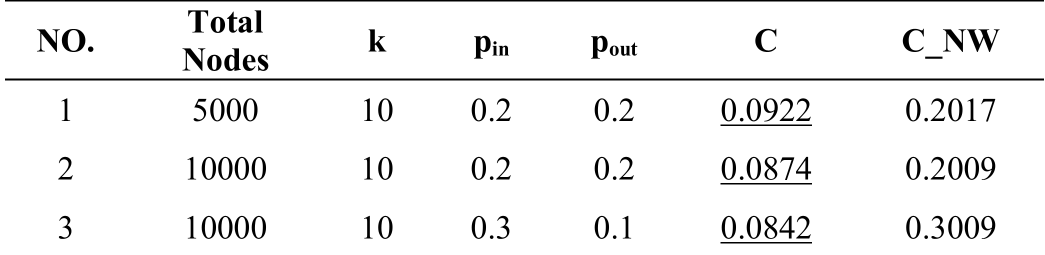 Table II shows that while the average distance remains similar to the NW model, the clustering coefficient is significantly more "relaxed," matching modern observed social trends.
Experimental Validation: The WeChat Test
To prove their point, the authors surveyed the WeChat friend counts of 130 individuals. The resulting "soft" degree distribution matched their model's simulation far more closely than the rigid peaks typically seen in simpler random graph models.
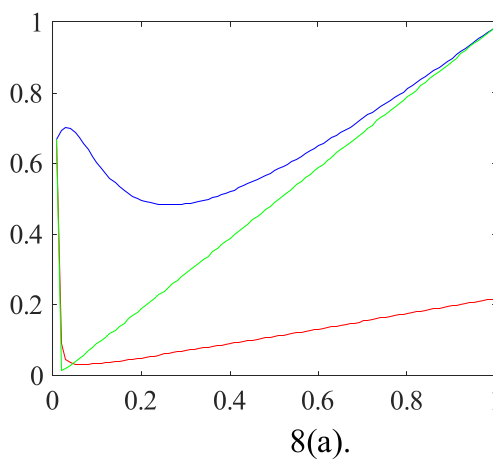 The degree distribution of real-world WeChat users shows a spread that aligns with the model's Soft-Degree-Distribution.
Critical Insight & Conclusion
The significance of this work lies in its sociological accuracy. In the 1990s, high clustering was a feature of fixed social circles. In the 2020s, our digital lives are a collection of "weakly connected clusters."
Takeaway: Future social algorithms for marketing or public opinion monitoring should look not just at how nodes connect, but at the access probabilities of nodes entering new community layers.
Limitations: The model assumes all communities have the same number of nodes , which is rarely true in the real world where some communities follow a power-law distribution of size. Integrating a Scale-Free community size distribution would be a natural next step for this research.