
Beyond Chitchat: Multi-Dimensional Social Networks in Open Source Collaboration
Constructing methods of social network model with cooperative relationship
2011-07-01
Summary
Problem
Method
Results
Takeaways
Abstract
This paper introduces a hybrid Social Network Model (SNM) for distributed collaborative work, integrating both communication-based "contact relations" and task-based "cooperative relations." By mining forum discussions and code submission metadata from open-source platforms like CodePlex, the method achieves significantly higher network connectivity and more accurate identification of key team roles compared to traditional communication-only models.
## TL;DR
In the era of distributed work, who talks to whom is only half the story. This paper presents a novel social network construction method that fuses **communication logs** with **work activity similarity**. By analyzing CodePlex data, the researchers proved that including "cooperative relations" reduces isolated nodes by over 50% and finally gives project leads the "Closeness Centrality" they deserve.
## The Context: The "Silent Leader" Problem
Traditional Social Network Analysis (SNA) treats information exchange as the gold standard for connectivity. However, in open-source communities, a lead developer might spend more time committed to code nodes than replying to forum threads. In a traditional model, these vital contributors appear peripheral. The authors argue that if User A and User B are working on the same code module or similar bug reports, they share a **Cooperative Relationship** that must be quantified.
## Methodology: Fusing Talk and Action
The paper defines a five-tuple model: `(User1, User2, DW, DS, DA)`. The secret sauce lies in how they calculate two distinct types of weights.
### 1. Contact Relationship (DS)
Instead of simple counts, the authors use three nuanced rules:
* **Direct Response**: Does post B mention User A's name?
* **Quote Mode**: Does post B include text from post A?
* **Discuss Mode**: Do they participate in the same temporal window of a thread?
### 2. Cooperative Relationship (DW)
This is the most innovative part of the work. The authors analyze the "description" of work activities (like code commit messages).
* **Similarity Logic**: They use **Cosine Similarity** on the morphemes (keywords) of the work descriptions.
* **The Intuition**: If two people are frequently touching the same modules or solving similar problems, their relationship degree increases, even if they never direct-message each other.
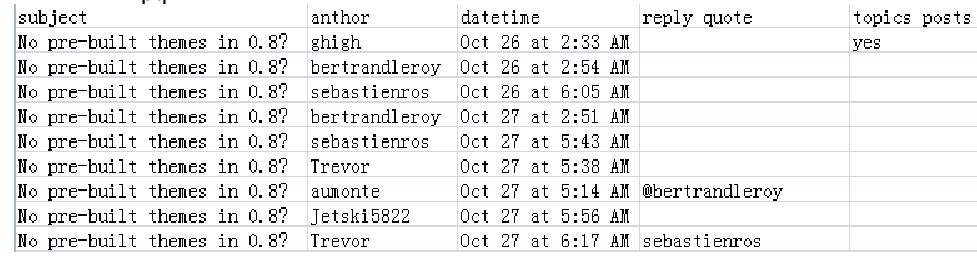
*Figure 1: Extracting relationship threads from forum data.*
## Experimental Validation
The researchers crawled data from **CodePlex**, including 9,707 posts and 12,705 code update records. They compared a "Communication-Only" model (Model 2) with their "Combined Model" (Model 1).
### Quantitative Leap
* **Connectivity**: Model 1 saw a **25.66% increase** in connections.
* **Fragment Reduction**: Isolated nodes dropped from 98 to 44 (**55.6% reduction**).
### Qualitative Accuracy: The "Project Orchard" Case Study
In "Project Orchard," the promoter (User A) was identified as a non-center node in the communication-only model because they commented less frequently. However, when work activities were added, User A’s **Closeness Index** jumped by 1.5x, correctly identifying them as the most central figure in the network.
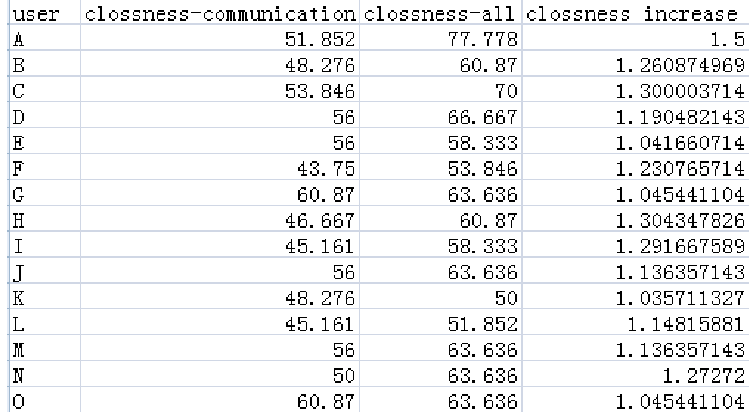
*Figure 2: Closeness values showing the dramatic shift in perceived importance of key developers.*
## Critical Analysis & Conclusion
This research moves SNA from "Social Media Analysis" toward "Professional Interaction Analysis." By bridging the gap between what people **say** and what they **do**, the model provides a much more robust map of organizational reality.
**Limitations**: The similarity of work activities currently relies on keyword matching in descriptions. Future iterations could benefit from deeper semantic analysis (like BERT embeddings) or dependency graph analysis of the code itself to define "cooperation."
**The Takeaway**: If you are building tools for remote team management or developer productivity, remember: **actions speak louder than words.** Mapping the "Cooperative Relationship" is essential to finding the true heartbeat of any technical project.