
EIM: Decoding Social Evolution Through the Dual Lens of Events and Interests
A social network model driven by events and interests
This paper introduces the Event-Interest Model (EIM), an agent-based framework for social network evolution. EIM merges attribute-based and structure-based approaches by driving link formation through participation in "events" (via weighted random walks) and "interests" (via homophily in a social space). The model successfully reproduces critical SOTA patterns, including power-law degree distributions and densification.
Executive Summary
TL;DR: The Event-Interest Model (EIM) is a generative agent-based model that treats social tie formation as a two-stage process: meeting through shared events and bonding through shared interests. By combining structure-based weighted random walks with attribute-based social distance, EIM achieves superior fidelity in replicating real-world network statistics like hierarchical clustering and densification.
Background: This work sits at the intersection of physics-oriented complex networks and sociology. It moves beyond the "rich-get-richer" (preferential attachment) dogma to explore the micro-level behaviors—homophily and focal closure—that actually drive human interaction.
Problem & Motivation: Why Current Models Fall Short
Traditional models often suffer from a "dimensionality crisis."
- Attribute-based models (e.g., Social Space Model) assume nodes link just because they are similar, often resulting in flat clustering spectra that fail to reflect the hierarchical modules seen in real life.
- Structure-based models assume links form purely based on network topology (like degree), ignoring the "Why" behind the connection.
The authors realized that in reality, you don't just link with someone because they are famous (structure) or because they like the same music (attribute); you link because you both attended the same party (event) and then discovered you had mutual interests.
Methodology: The Mechanics of EIM
EIM simulates evolution through three distinct processes:
1. Weighted Random Walks for Event Participation
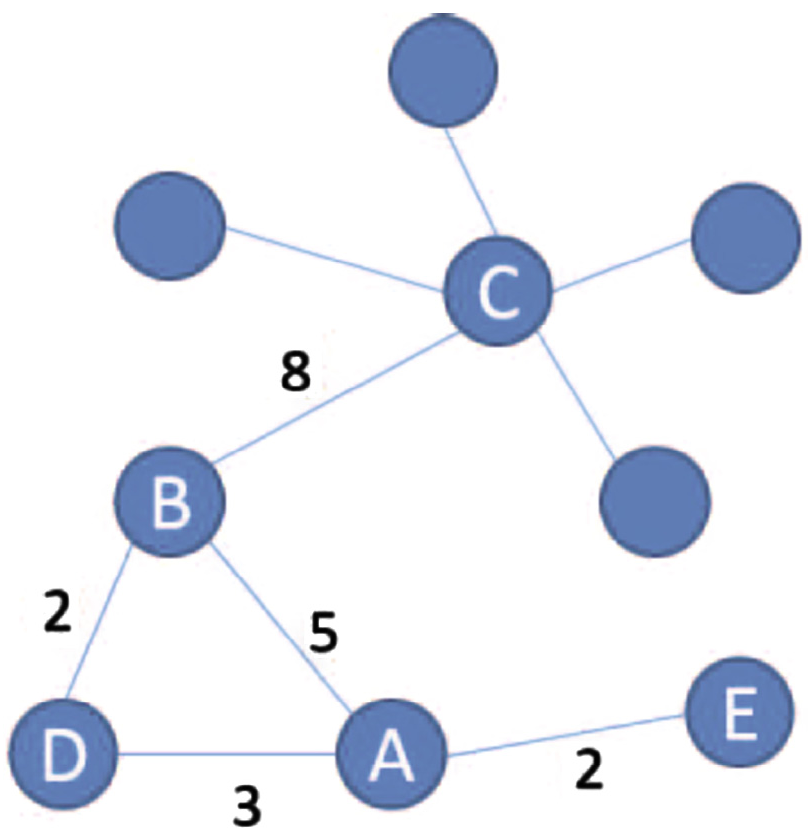
To simulate an event, the model initiates a random walk. Unlike simple random walks, the probability of moving to a neighbor is weighted by the number of times two nodes have successfully interacted in the past. This captures the intuition that popular individuals or those with common friends are more likely to be co-invited to activities.
2. Interest-Driven Link Formation
Once a group of agents is gathered in an event, a link is formed based on the Social Distance. Here, represents a node's coordinates in a latent social space. If the distance is small (high interest similarity) and the path distance in the event was short, a tie is formed or reinforced.
3. Global Attachment & Removal
To maintain realism, the model allows for "random encounters" (global attachment) and the natural "deactivation" of ties (removal process), ensuring the network remains dynamic and avoids stagnation.
Experiments & Results: Matching Reality
The EIM was validated against the Email, CA-AstroPh, and DBLP networks.
SOTA Comparison
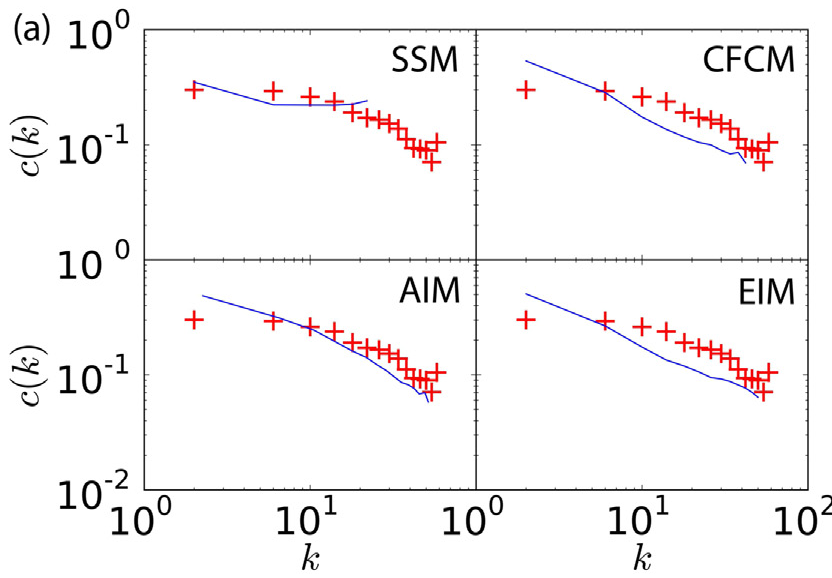
Compared to the Social Space Model (SSM) and the Cyclic and Focal Closure Model (CFCM), EIM consistently provided the best fit for:
- Hierarchical Clustering: Appropriately showing that lower-degree nodes have higher clustering.
- Assortativity: Correcting the tendency of previous models to over- or under-estimate the correlation between high-degree nodes.
Growth and Densification
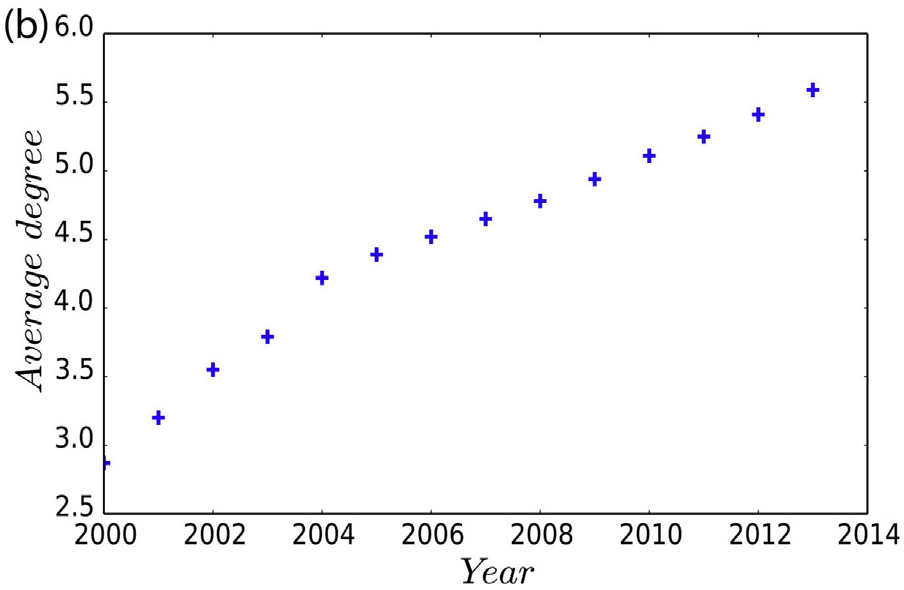
Crucially, EIM satisfies the Densification Power Law. As the network grows, the number of edges increases super-linearly (), matching the empirical observation that people gain more collaborators over time as the scientific community expands.
Critical Analysis & Conclusion
Takeaway
The EIM's success suggests that Events provide the "structural opportunity" for a network to grow, while Interests act as the "selection pressure." Without both, a model cannot capture the rich, hierarchical community structures of human society.
Limitations & Future Work
- Dimensionality of Interests: The current study primarily uses a 1D social space for simplicity. Real human interests are hyper-dimensional.
- Parameter Optimization: The model currently relies on hill-climbing for parameter fitting; moving toward Maximum Likelihood Estimation (MLE) would improve scalability.
- Applications: The authors envision using EIM for Link Prediction and Recommender Systems, as it predicts not just if a link forms, but in what context it happens.
Final Thought: EIM is a robust bridge between the physics of networks and the sociology of human behavior, offering a more nuanced simulation tool for researchers and data scientists alike.