
Beyond Incentives: How Social Networks Drive ICT Use in Rural Medicine
Towards a social network model for understanding information and communication technology use for general practitioners in rural Australia
This study develops a social network theoretical model to examine how Information and Communication Technology (ICT) use by General Practitioners (GPs) in rural Australia is influenced by their ego-centric network properties. The research identifies that task-level ICT adoption is significantly driven by degree centrality and functional tie diversity rather than geographical proximity or professional experience.
TL;DR
Why do some professionals embrace digital transformation while others remain tethered to paper-based workflows? This study of rural Australian General Practitioners (GPs) reveals that the secret isn't $10,000 grants or years of experience—it's the diversity and structure of their professional social networks. GPs with diverse professional ties (Functional Diversity) and more connections (Degree Centrality) are significantly more likely to use ICT for clinical tasks.
The Missing Link: Why TAM Isn't Enough
For decades, the Technology Acceptance Model (TAM) has focused on "perceived usefulness" and "ease of use." However, in knowledge-intensive fields like medicine, technology use is a social act. Previous research often failed to account for how an individual's position in a social structure influences their technological behavior.
The authors argue that for rural GPs—who are often geographically isolated—the social influence of peers is the primary driver for overcoming technology obsolescence. They move beyond the "What" of technology to the "Who" of the network.
Methodology: Mapping the Ego-Centric Network
The study utilizes an ego-centric approach, where each GP (the "ego") identifies their professional contacts ("alters").
The Core Framework
The researchers tested three pillars of social network theory:
- Strength of Weak Ties: Does novel information come from distant acquaintances?
- Structural Hole Theory: Do "brokers" who bridge disconnected groups use more ICT?
- Social Influence: How do coworkers' attitudes shape individual use?
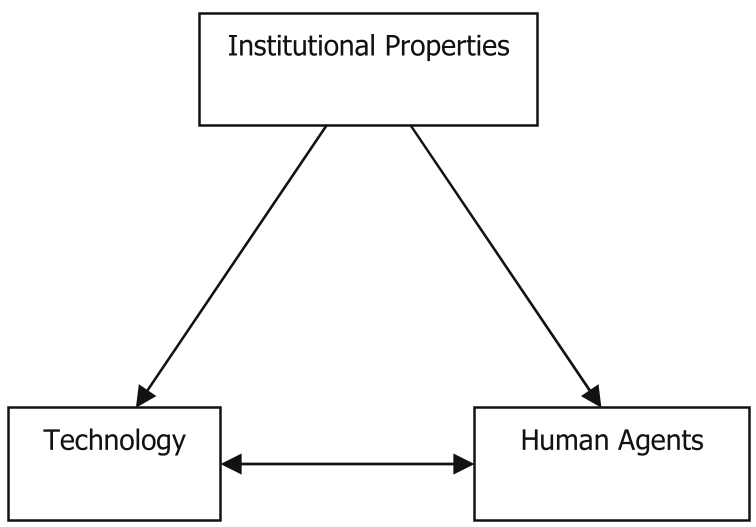 Figure 1: The recursive relationship between technology, human action, and institutional properties.
Key Findings: Diversity Over Distance
The results from 110 surveyed GPs yielded several counter-intuitive insights:
1. The Power of Functional Diversity
Functional diversity—having a network comprising different types of professionals (specialists, nurses, admin staff)—was the most potent predictor of task-level ICT use. It explained nearly 10% of the variance in usage.
2. The Efficiency Paradox
Surprisingly, network efficiency was negatively correlated with communication-level ICT use. This suggests that GPs who use the internet heavily for professional communication might actually be communicating with a redundant group of people who already know each other, rather than bridging new gaps.
3. Experience is Not a Barrier
While common lore suggests older doctors are "luddites," the study found that once you account for network properties, years of experience become less relevant. The issue isn't age; it's social isolation.
 Table: Statistical correlation showing the strong link between Functional Diversity and Task-level ICT use ().
Critical Insight: Designing "Networked" Organizations
The fundamental takeaway for policy makers and tech implementers is that digital strategy is social strategy.
- Isolation = Stagnation: Individuals who isolate themselves from peers are slow adopters.
- Opinion Leaders: To drive ICT uptake, it is more effective to target "central" nodes in the professional network rather than using top-down bureaucratic mandates.
- Diversity Drives Context: The more diverse your circle, the more "use cases" for ICT you are exposed to, increasing the likelihood of clinical task integration.
Conclusion & Future Outlook
This work highlights that in geographically distributed settings, ICT doesn't just span distances—it is embedded in the social fabric. Future research should look at longitudinal changes: as a GP adopts more ICT, does their network structure eventually shift from closed cliques to open, efficient clusters?
For now, the message is clear: If you want to modernize a workforce, don't just give them better computers; give them more diverse professional connections.