
Beyond String Matching: Decoding Social Topology via Semantic Forests
Social Network Model Based on Keyword Categorization
This paper introduces a "Forest" model to categorize user profile keywords and quantify semantic similarity to model Online Social Network (OSN) topology. By defining "Weak" and "Strong" similarity functions based on keyword distances within hierarchical trees, the authors successfully simulated a social graph that mimics real-world Facebook connectivity patterns.
TL;DR
In the world of Online Social Networks (OSNs), we aren't just connected by who we know, but by what we love. This paper proposes a Forest-based semantic model that moves beyond literal keyword matching to understand the "hidden" relationships between user interests. By mapping keywords into hierarchical trees, the authors create a similarity metric that accurately predicts social ties, proving that being interested in "soccer" and "football" should, and does, bring users closer in the digital graph.
The "Soccer-Football" Problem: Why Simple Matching Fails
Most social discovery engines suffer from a semantic blindness. If user Bob searches for "soccer" enthusiasts but their profiles contain the word "football," the system returns a null result. This is the Homophily Gap: humans connect based on shared meanings, but machines often connect based on identical characters.
The authors observed that keyword usage follows Zipf’s Law—a few keywords are very popular, but a massive "long tail" of unique, low-frequency keywords exists. To bridge this gap, we need a structure that understands that "equine" is related to "horse rider" even if the strings don't match.
Methodology: The Forest and the Trees
The core innovation is the Forest Structure. Instead of a single, messy hierarchy, the authors suggest a collection of trees (a Forest), where each tree represents a semantic domain (e.g., Sports, Arts, Geography).
1. Distance Metric
The distance between two keywords and is defined by their Least Common Ancestor (LCA). If two words are in different trees, their distance is infinite. If they are in the same tree, the distance is the maximum depth required to reach their common root.
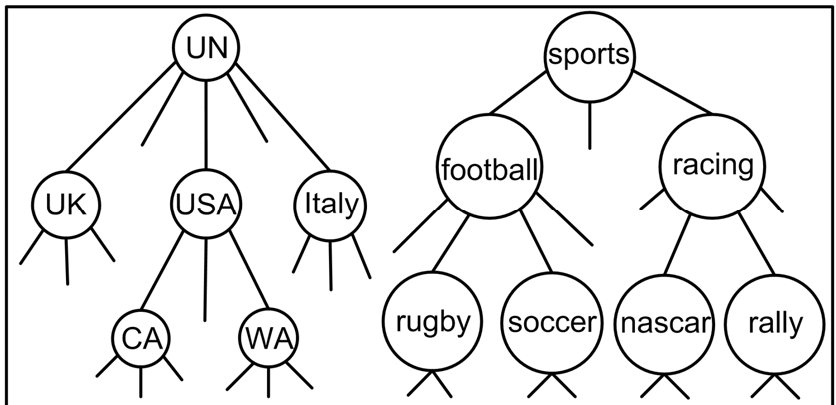 Figure: A sample forest where 'sports' and 'United Nations' form separate thematic roots.
2. From Words to Friendships: Similarity Functions
The paper defines two types of similarity:
- Weak Similarity (): Simply the ratio of keywords that share a tree.
- Strong Similarity (): A sophisticated metric where the contribution of a keyword pair decays exponentially with their tree distance ().
The probability of a friendship is then modeled as being proportional to this Strong Similarity, localized to each user's potential connection pool.
Does it Work? Evidence from Facebook
The authors validated their model by comparing a simulated graph (built using their Forest rules) against a real-world dataset of 1,265 Facebook profiles.
Semantic Effectiveness over Volume
A key finding was that content matters more than volume. In a comparison between users, a pair with only 40 keyword pairs but high semantic overlap (e.g., basketball, dancing, soccer) showed higher similarity than a pair with 70 pairs that were semantically disjoint (e.g., water sports vs. knitting).
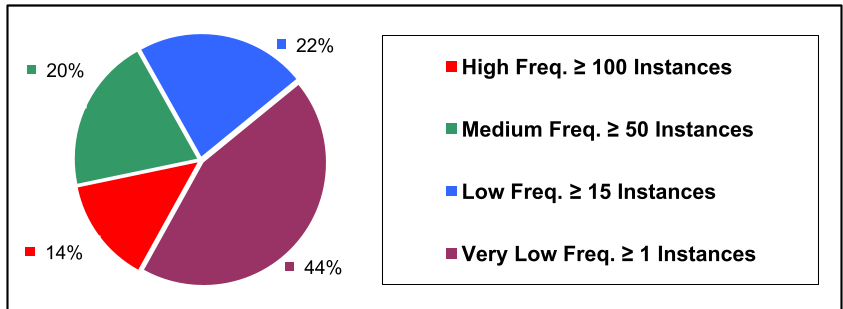 Figure: The distribution of keywords follows a power law, necessitating a semantic model to handle the "long tail" of unique interests.
Resistance to "Profile Inflation"
One might worry that a user could "game" the system by adding thousands of random keywords. However, the results in Figure 5 show that for direct friends, the number of related keywords () scales linearly with the total keywords (). This implies that the similarity ratio remains stable, making the model immune to irrational user activity or "profile stuffing."
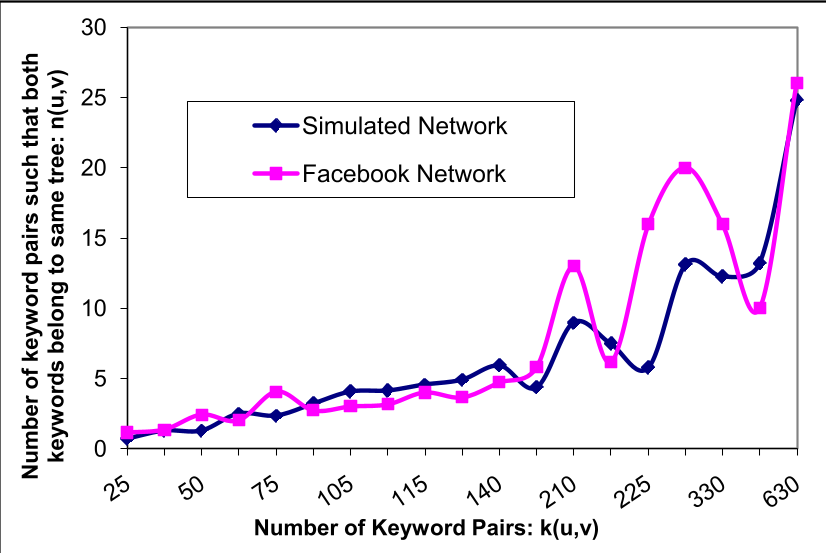 Figure: The proportional relationship between related and total keywords indicates that similarity values are robust against profile padding.
Critical Insight & Future Outlook
This work serves as a precursor to modern embedding-based approaches (like Word2Vec or BERT) by recognizing that topology is a function of semantics.
Takeaway for Engineers: If you are building discovery algorithms, don't just calculate interest overlap. Map your users' interests to a taxonomy (like WordNet or a custom Forest) and calculate distance within that taxonomy. It captures the human "vibe" of similarity far better than a database JOIN ever could.
Limitations: The current forest construction was semi-manual or based on basic WordNet API calls. In 2024, replacing the "Forest" with a high-dimensional Latent Space (embeddings) would likely yield even higher accuracy, but the underlying principle—that social distance mirrors semantic distance—remains a cornerstone of network science.