
Beyond the BA Model: Capturing the "Topology Vision" of Real Social Networks
A Social Network Model Based on Topology Vision
The paper proposes a novel social network model based on "topology vision" that accounts for the high frequency of single-degree nodes often ignored by traditional models. It introduces the "Condensed Clustering Coefficient" (C') to better evaluate network cohesion and validates the model using real-world data from the Opel Astra Club (OAC) forum.
TL;DR
Most social network models focus on "Super-Hubs" but ignore the "Leaves." This paper introduces a modified growth model that accounts for the high volume of single-degree nodes in real data and proposes the Condensed Clustering Coefficient (C') to provide a clearer picture of social cohesion.
Background Positioning
In the spectrum of network science, this work sits between the Small-World (Watts-Strogatz) and Scale-Free (Barabási-Albert) models. While it respects the power-law degree distribution, it identifies a critical "topology vision" gap: existing models struggle to generate the large number of "degree-1" nodes observed in real-world forum data.
The Problem: The "Degree-1" Blind Spot
The Barabási-Albert (BA) model assumes every new node attaches to existing nodes. If , it is mathematically impossible to have a node with only one connection (a leaf node). However, empirical data from the Opel Astra Club (OAC) shows that nearly 34% of users (O = 0.339) have only one social tie.
Furthermore, because clustering coefficients are calculated based on neighbors' connections, these "leaf" nodes yield a zero value, dragging down the global average. This leads to a misleadingly low metric for community density.
Methodology: Tunable Topology
The author proposes a growth algorithm driven by four functions to bridge the gap between theory and reality:
- First Attach (FA): Preferential attachment to maintain scale-free properties.
- Friend Function (FF): Connects neighbors of neighbors to simulate social "triadic closure," boosting the clustering coefficient.
- s-max Function (SF): Specifically targets high-degree hubs to connect with one other, increasing the S-Metric.
- Random Function (RF): Provides stochastic noise typical of human interaction.
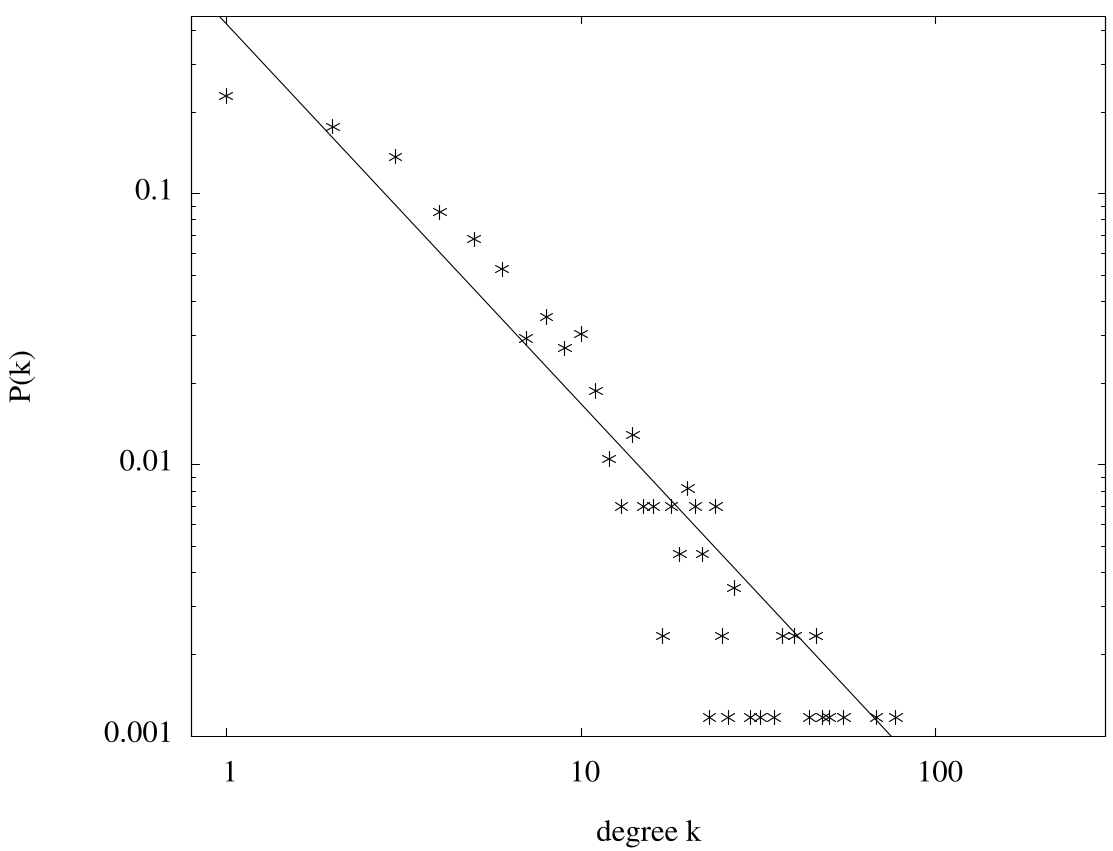 Fig 1: The log-log degree distribution of the proposed model showing a clear power-law slope ().
The Condensed Clustering Coefficient (C')
To solve the "dilution" of metrics caused by leaf nodes, the paper defines: Where is the ratio of degree-1 nodes. This metric essentially measures the "internal heat" of the connected core of the society by ignoring participants who haven't yet integrated.
Experiments & Results
The author compared the model against the OAC (a real forum with 835 nodes and 2,223 edges).
| Metric | OAC Real Data | Simulation (f=0.15, x=0.20) |
|---|---|---|
| Shortest Path (L) | 3.574 | 3.641 |
| Clustering (C) | 0.0979 | 0.0975 |
| Condensed Cluster (C') | 0.1481 | 0.1250 |
| S-Metric (S) | 0.645 | 0.656 |
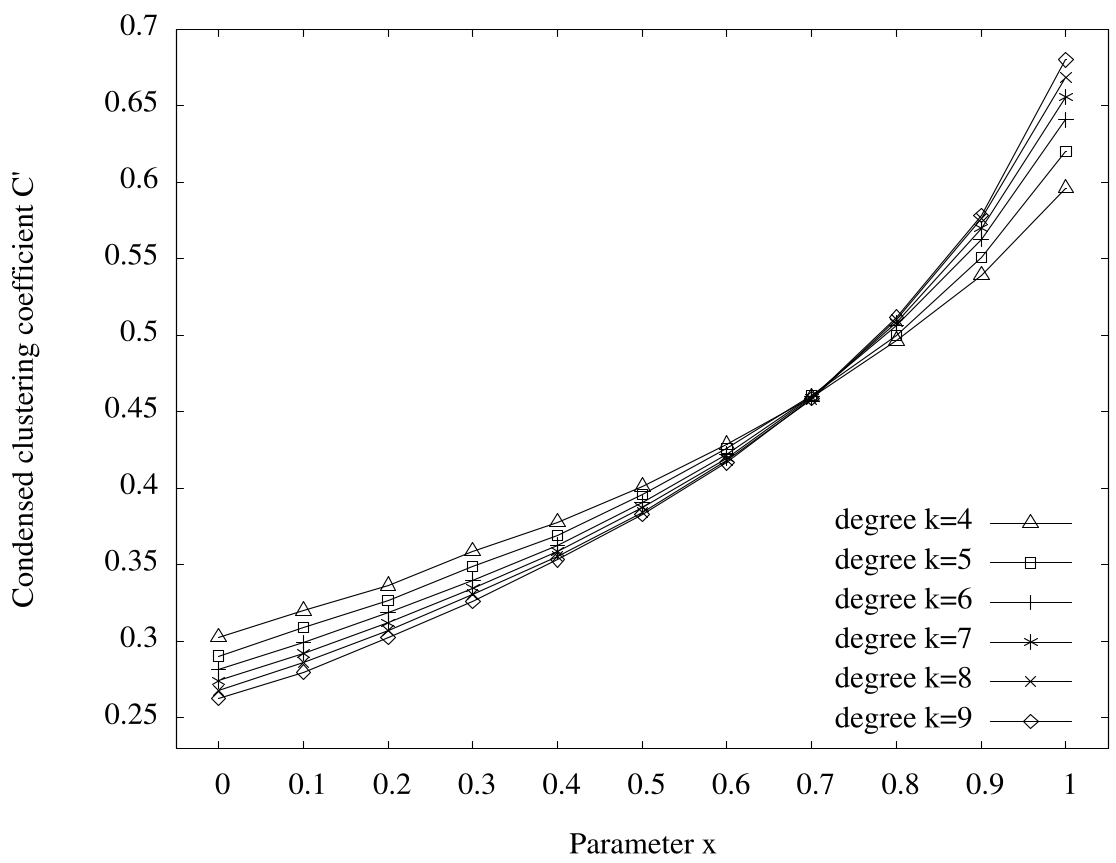 Fig 2: Relationship between parameter x (hub connectivity) and C'. As hub connections increase, the core density of the network rises significantly.
Critical Analysis & Conclusion
The primary value of this paper is the acknowledgment that peripheral nodes are not noise; they are a structural component of human networks. By allowing (ratio of degree-1 nodes) to be a tunable part of the model, we can better simulate:
- Rumor Spreading: How information stays trapped in "dead ends."
- Epidemiology: How peripheral members act as the final recipients of transmission.
Limitations: The model currently uses two main tuning parameters ( and ) to try and hit six different targets (). This leads to some discrepancies—for instance, the model's tail index () slightly overshoots the OAC's extreme value of 1.439.
Takeaway: If you are measuring community health, don't just look at the average clustering. Calculate the Condensed Clustering Coefficient to see if your active core is truly connected or just being averaged out by "lurkers."