
Beyond Scale-Free: Rethinking Social Network Structures via the LBD Model
Social Network Models
This paper introduces a tri-parameter structural model for social networks defined by Leadership (L), Bonding (B), and Diversity (D). It proposes a generative algorithm that modifies preferential attachment to better align with empirical social network data, outperforming standard Erdos-Renyi, Small-World, and Scale-Free models.
TL;DR
Popular network models like Erdos-Renyi (Random), Watts-Strogatz (Small-World), and Barabasi-Albert (Scale-Free) are staples of graph theory, but they share a common flaw: they don't actually look like real social networks. MIT’s Whitman Richards proposes a new framework based on three "atomic" motifs—Leadership (L), Bonding (B), and Diversity (D)—revealing that real social structures consistently favor bonding over diversity (B > D), a feature standard models fail to replicate.
The Structural Mismatch
Why do our theoretical models miss the mark? The author argues that social networks aren't just collections of nodes with specific degree distributions; they are driven by social incentives. Traditional Scale-Free models create "star-like" hubs but often result in sparse "tails" that lack the tight-knit clustering (triangles) found in human friendships.
When plotted on a triangular simplex, 20 empirical social networks (ranging from Enron emails to terrorist cells) cluster in a specific zone. Meanwhile, the "gold standard" models mentioned above fall outside this range entirely.
Methodology: The LBD Parameterization
To bridge this gap, Richards decomposes network topology into three metrics:
- Leadership (L): Measured by the dominance of a central vertex (the "star" motif).
- Bonding (B): Measured by the number of triangles, representing group cohesion (the "clique" motif).
- Diversity (D): Measured by disjoint dipoles, representing "weak ties" or bridging links between different groups.
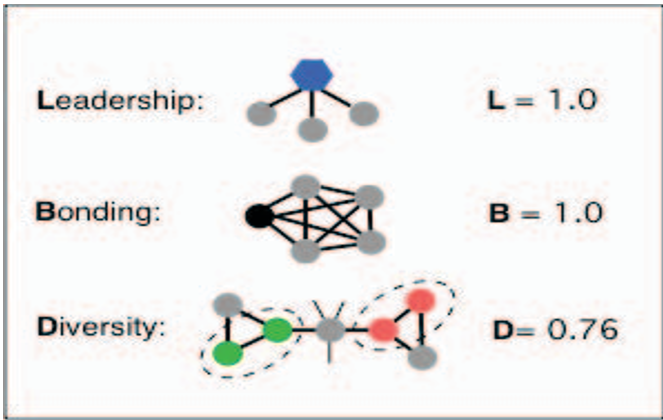 Figure 1: The atomic motifs (L, B, D) used to parameterize the network space.
The Generative Algorithm
The solution isn't to scrap preferential attachment, but to refine it. The paper proposes two key adjustments:
- Controlling Leadership: By varying the nonlinearity of how new nodes attach to old ones (from uniform to quadratic), the model explores the spectrum of leadership dominance.
- Ensuring B > D: New members are forced to attach to the neighbors of their first connection. This "friends-of-friends" attachment naturally creates triangles, boosting the Bonding index and accurately reflecting social recruitment.
Empirical Results & The Simplex
The power of this research is best visualized in the LBD Simplex. In the figure below, the red numbers represent real-world social networks. Note how they congregate away from the "Small World" (purple) and "Scale-Free" (MS) loci.
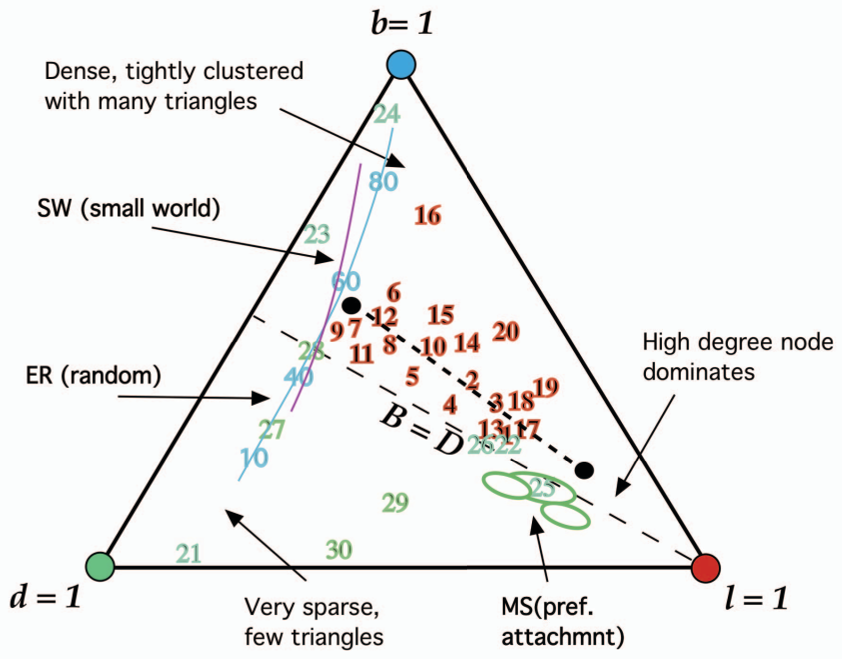 Figure 2: The LBD Simplex. The black dashed line shows the author's model, which successfully captures the empirical cluster of social networks (red numbers).
Key Findings:
- The B > D Barrier: Almost all social networks reside in the region where Bonding (B) exceeds Diversity (D).
- The Random Barrier: Social networks never cross the "Erdos-Renyi" line; they are fundamentally more structured than random graphs.
- The Terrorist Exception: Data point #16 (a terrorist network) showed unusually low Diversity, highlighting how extreme covert organizations prioritize secrecy and tight cells over bridging connections.
Critical Insight & Future Outlook
The "take-home message" is a cautionary tale for network scientists: Scale-free properties are not enough. Preferential attachment alone creates hierarchical trees, not communities. To model humanity, we must account for the Inductive Bias of social bonding—the tendency for humans to close triangles.
Limitations: The model currently struggles with specific outliers like highly decentralized "grassroots" movements. Future work will likely quantify these variations through even finer motif analysis, perhaps moving beyond 3-node interactions to 4 or 5-node subgraphs to capture even deeper social nuances.
Richards, W. (2011). Social Network Models. MIT CSAIL Technical Report.