
Digital Shadows: Why Identifying Social Media Offenders is a Regulatory Nightmare
A survey of current social network and online communication provision policies to support law enforcement identify offenders
This paper surveys the regulatory policies of 22 popular social networks and communication platforms to assess their effectiveness in supporting law enforcement. It identifies critical gaps in account verification, data retention, and the legal feasibility of tracking online offenders.
TL;DR
Online harassment and cybercrime are surging, yet law enforcement is often blindfolded by the very platforms where these crimes occur. Graeme Horsman’s survey of 22 major platforms reveals a systemic failure: unverified sign-ups, ambiguous data retention, and a lack of standardized cooperation protocols make tracking offenders a matter of luck rather than law.
Positioning: This work serves as a foundational "state of the sector" analysis, highlighting the friction between user-growth-driven "frictionless" sign-ups and the requirements of criminal forensics.
The "Anonymity Veil" and the Motivation for Reform
The internet's "disinhibition effect" allows individuals to act with a level of cruelty they would never exhibit in person. For the police, the challenge isn't just seeing the crime—it's identifying the person behind the screen.
The author's core insight is that social media companies prioritize user acquisition friction reduction over accountability. By allowing users to register with fake names and unverified emails, platforms inadvertently create a "troller's paradise" where accounts can be burned and recreated in seconds.
Methodology: Mapping the Regulatory Gaps
The study breaks down the ability to catch an offender into three validation mechanisms:
- Direct Validation: Real-name policies. (Found to be mostly ineffective as most platforms don't verify IDs).
- Indirect Validation: Identifying users through the content they post (e.g., photos or accidental disclosures).
- Metadata Validation: The "last line of defense"—using IP addresses, device IDs, and timestamps.
The Critical Infrastructure of Investigation
The survey meticulously catalogs the data retention habits of 22 providers, focusing on how long "Log Data" (the digital breadcrumbs) exists before being purged.
 Note: The survey covers a broad spectrum of platforms from Facebook to niche services like Hi5.
Key Findings: The Data Volatility Problem
The most alarming discovery is the lack of transparency. While some platforms like Reddit explicitly state 100-day IP retention, others are intentionally vague. This ambiguity creates a "ticking clock" for victims and police:
- Content Deletion: If an offender deletes a post or their account, the police are reliant on "backup copies" that may only exist for 30–90 days.
- Jurisdictional Hurdles: 20 of the 22 platforms are US-based, requiring international police forces to use Mutual Legal Assistance (MLA) treaties, which are notoriously slow. By the time the paperwork is signed, the data is often gone.
Comparative Retention Table
The researcher provided a breakdown of service policies, highlighting that "reasonable period" is a common, yet legally useless, term in many privacy policies.
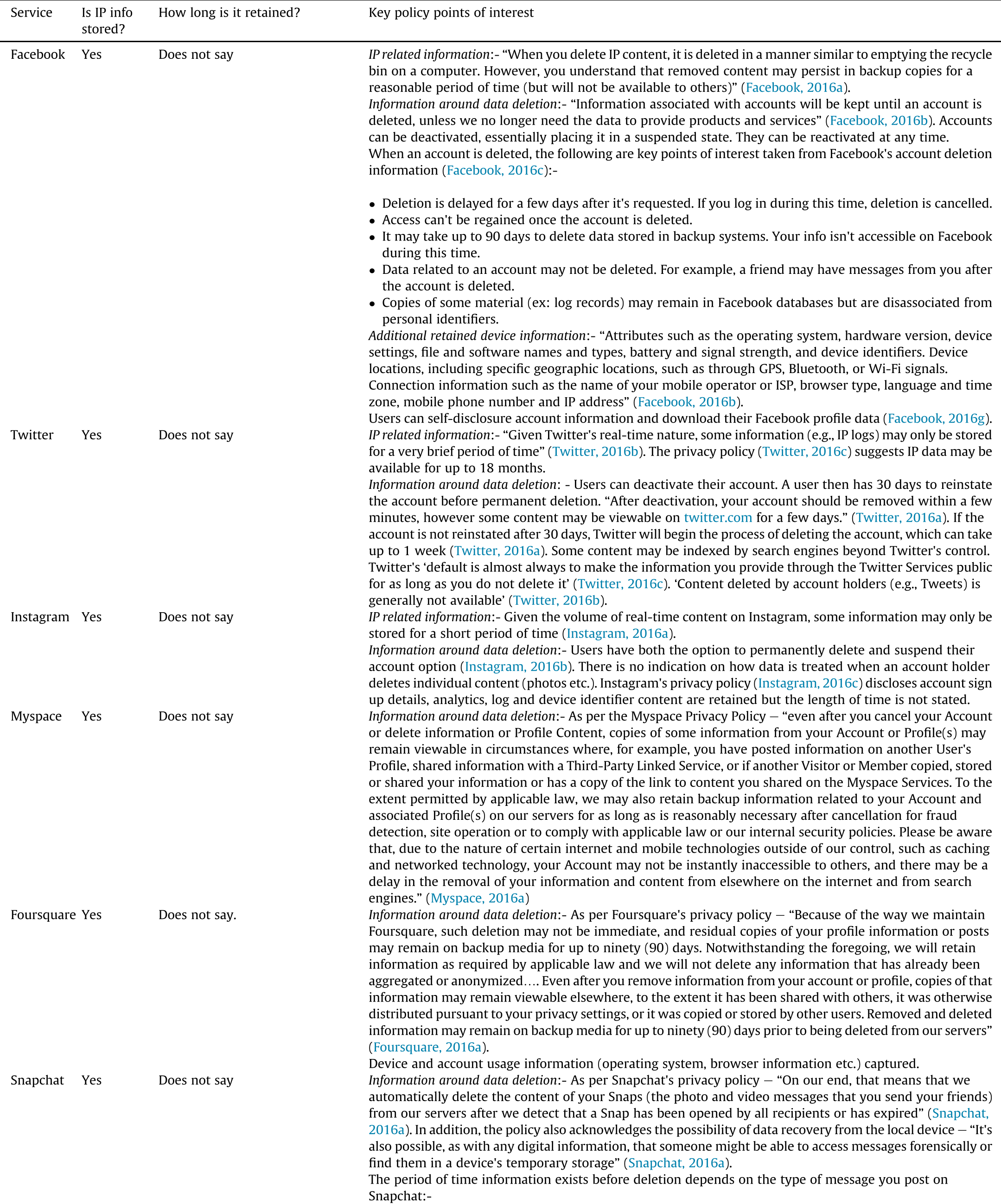 Snapshot of the data retention policies analyzed across major platforms.
Critical Analysis: A Call for Global Standards
The paper argues that we cannot rely on the "goodwill" of tech giants. The UK's Investigatory Powers Act 2016 was a step toward forcing data retention, but as the author notes, it is limited by the way modern apps maintain "always-on" connections, making simple IP logs less useful than they used to be.
Takeaways for Research & Policy
- Standardization is Mandatory: We need a global baseline for how long "forensically relevant" logs are kept.
- The Sign-up Paradox: Platforms must balance "no-fuss" sign-ups with at least minimal email verification (as LinkedIn does) to deter automated bot-trolling.
- Preservation Orders: These 90-day "freezes" are vital, but their success depends entirely on the victim reporting the crime immediately.
Conclusion
Horsman’s survey proves that the technology of communication has outpaced the technology of regulation. Until social networks treat account accountability as a core feature rather than a hurdle to growth, the "veil of anonymity" will continue to protect those who use these platforms as weapons.