
Beyond the Pixels: Leveraging Social Networks for Human Recognition
Leveraging social network information to recognize people
This paper proposes a framework to enhance pedestrian recognition in camera networks by integrating social network information with visual data. By formulating person identification as a bipartite graph matching problem with a pairwise social configuration cost, the authors achieve a performance boost over traditional visual-only matching methods.
TL;DR
Recognizing people in surveillance networks is notoriously difficult due to noisy visual data. This paper introduces a novel approach: using social network ties (like friendship or email frequency) as a prior to help identify individuals. By assuming that acquaintances are more likely to appear together, the system uses a group-based optimization strategy to disambiguate visually similar people, significantly boosting accuracy over visual-only baselines.
Background & Motivation: The Social Intuition
In traditional computer vision, the "Data Association" problem—matching a person in a camera view to a database—is usually treated as a series of isolated 1-to-1 visual matches. However, the authors observe a fundamental truth of human behavior: socially connected people appear together.
Imagine a camera view where one person is clearly identified as "Person A," but another person looks equally like "Person B" or "Person C." If social data tells us that A and B are close friends while A and C are strangers, the likelihood shifts dramatically toward B. This paper formalizes this intuition into a mathematical framework.
Methodology: Fusing Visuals with Social Graphs
1. Visual Foundation: Large Margin Metric Learning
The system uses Large Margin Nearest Neighbor (LMNN) to learn a Mahalanobis distance metric. The goal is to transform the feature space so that images of the same person are "pulled" together while different people are "pushed" apart by a specific margin.
2. The Social Configuration Cost
The authors model social ties via an affinity matrix . The core of their innovation is the joint identification cost function: Where the social cost is computed as the inverse exponential of friendship strength. If two people in a view have a high friendship score, the cost of assigning them those identities is lowered.
3. Iterative Optimization
Because the pairwise social term turns the task into a combinatorial optimization problem, the authors use an iterative approach. They start with an initial guess using the Hungarian Algorithm and then refine individual identity assignments one-by-one until the total cost converges.
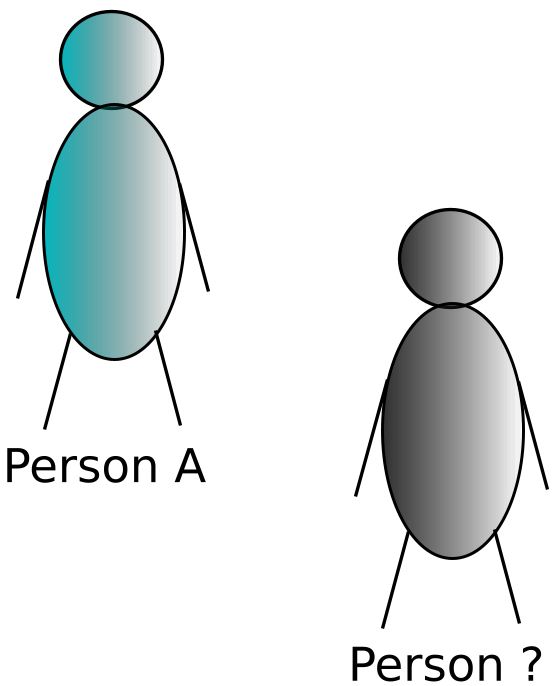 Figure 1: The core intuition—using the known identity of one person to resolve the ambiguity of their acquaintance.
Evaluation: The VIPeR-Enron Hybrid
Since no public dataset combined both visual Re-ID and social networks, the authors synthesized one by mapping the VIPeR pedestrian dataset to the Enron Email Dataset. They defined "friendship" based on normalized email correspondence frequency.
Key Findings:
- Performance Boost: Adding social information increased recognition accuracy from 33.4% to 38.4%.
- Diminishing Returns: As more people appear in a single view (e.g., the entire network), the utility of the social prior decreases because the "group" no longer provides selective information (Figure 4).
- Robustness: The system is remarkably resilient. Even when "noise" was added to the social data to simulate inaccurate friendship records, the system still outperformed the visual baseline.
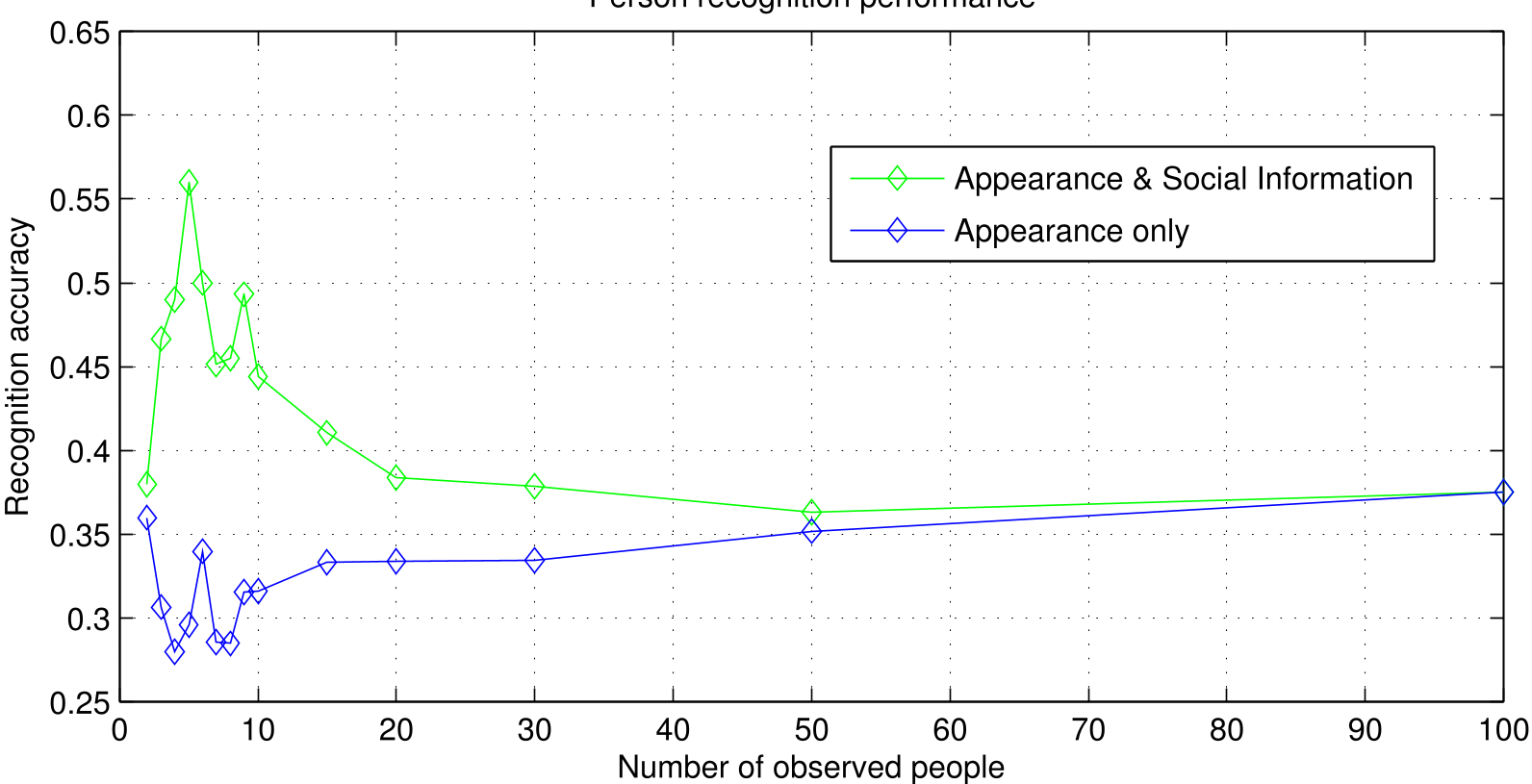 Figure 2: Performance vs. Group Size. The "Social Network" advantage is strongest in smaller, more specific groups.
Critical Insight & Conclusion
This work marks a shift from "Pure Vision" to "Context-Aware Vision." By treating identity not as an isolated pixel-matching task but as a socially situated problem, the authors open the door for more robust surveillance systems.
Limitations: The current model assumes that the social network is known exactly and that co-occurrence is a direct proxy for friendship. In the real world, "stranger co-occurrence" (e.g., crowds at a bus stop) adds noise that this model might struggle with.
Future Outlook: Integrating more complex social signals—such as temporal patterns (when people move) or hierarchy (boss-employee dynamics)—could further refine these priors, making AI recognition feel less like a sensor and more like a social observer.