
α-Proximity: Shielding Social Networks from Neighborhood Attribute Inference
Social Network Privacy for Attribute Disclosure Attacks
This paper introduces α-proximity, a novel anonymization framework designed to protect social networks against Attribute Disclosure Attacks. The authors present a greedy edge-addition algorithm that ensures the label distribution in every node's neighborhood closely approximates the global distribution, effectively preventing adversaries from inferring sensitive user traits through local friendship ties.
TL;DR
Identities aren't the only thing at risk in social networks; your friends' data can leak your private attributes. This paper introduces α-proximity, a formal privacy model that ensures the mix of "labels" (attributes) in your local neighborhood reflects the global average, making it impossible for an attacker to guess your secrets by looking at who you know. The authors provide a greedy edge-addition strategy to "mask" these sensitive distributions without destroying the graph's utility.
The Hidden Danger: Attribute Disclosure
Most social network privacy research focuses on Identity Disclosure—the "Who is this person?" problem. However, even if your identity is hidden (anonymized), an adversary can perform an Attribute Disclosure Attack.
Imagine a medical support network. Even if you are just "User 123," if 90% of your friends are labeled with "Disease X," an adversary can conclude with high confidence that you also have "Disease X." Current graph anonymization techniques (like k-anonymity) fail to address this because they focus on graph structure (degrees, subgraphs) rather than node labels.
Methodology: The Logic of α-Proximity
The core insight of the authors is that privacy is maintained when the local distribution of sensitive attributes is "proximal" to the global distribution.
1. Mathematical Intuition
If the entire network has a 50/50 split of labels A and B, an adversary learns nothing new if your neighborhood is also 50/50. However, if your neighborhood is 90% A, the adversary gains significant information. The paper defines the distance between distributions: Where is the neighborhood of vertex , and is the entire vertex set. The goal is to keep this distance small.
2. The Solution: Greedy Edge Addition
How do we fix a graph that violates this? The authors propose adding edges strategically. They partition nodes into "beneficial" groups:
- : Nodes with label a that need more neighbors with label b to balance their distribution.
- : Nodes with label b that need more neighbors with label a.
- By connecting nodes across these groups, the algorithm efficiently moves the neighborhood distributions toward the global mean.
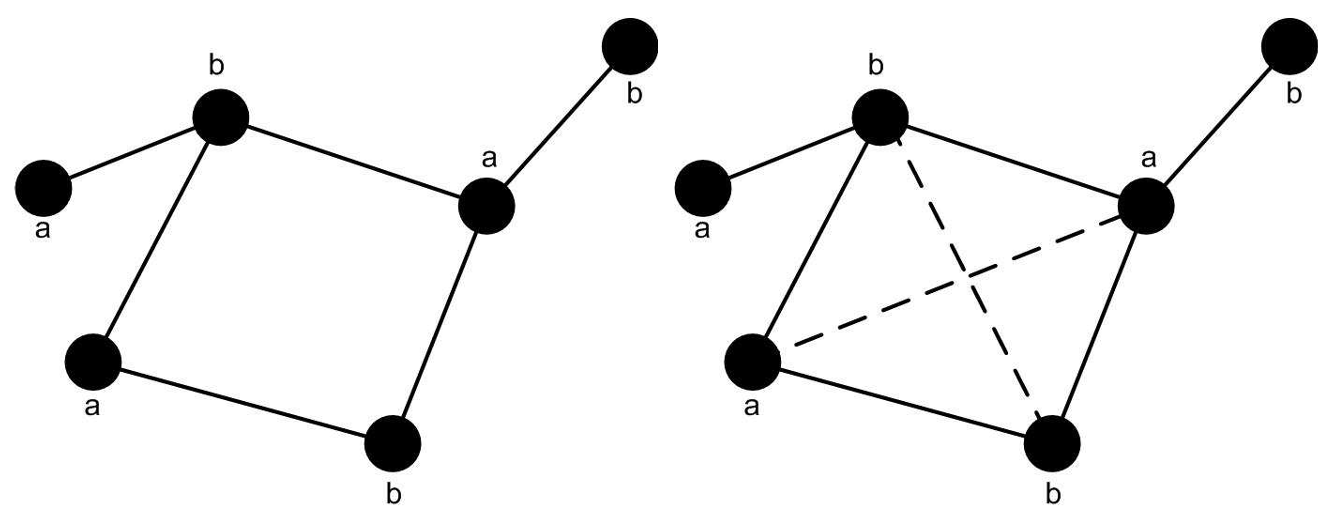 In Figure (a), node label distributions are skewed. In (b), specific edges (dotted) are added to balance the local "label sequences," achieving α-proximity.
Experimental Insights
The researchers tested their greedy algorithm on synthetic graphs to answer a critical question: Does anonymizing the graph turn it into a useless "complete graph" ()?
Key Findings:
- Utility vs. Privacy: For most cases, the required "occupancy change" (added edges) was surprisingly low, often under 10%.
- The Power of α = 0.1: They found that at , the graph retains significant structural property while providing robust protection.
- Scale Invariance: The number of vertices didn't significantly impact the algorithm's effectiveness, suggesting it may scale to larger networks.
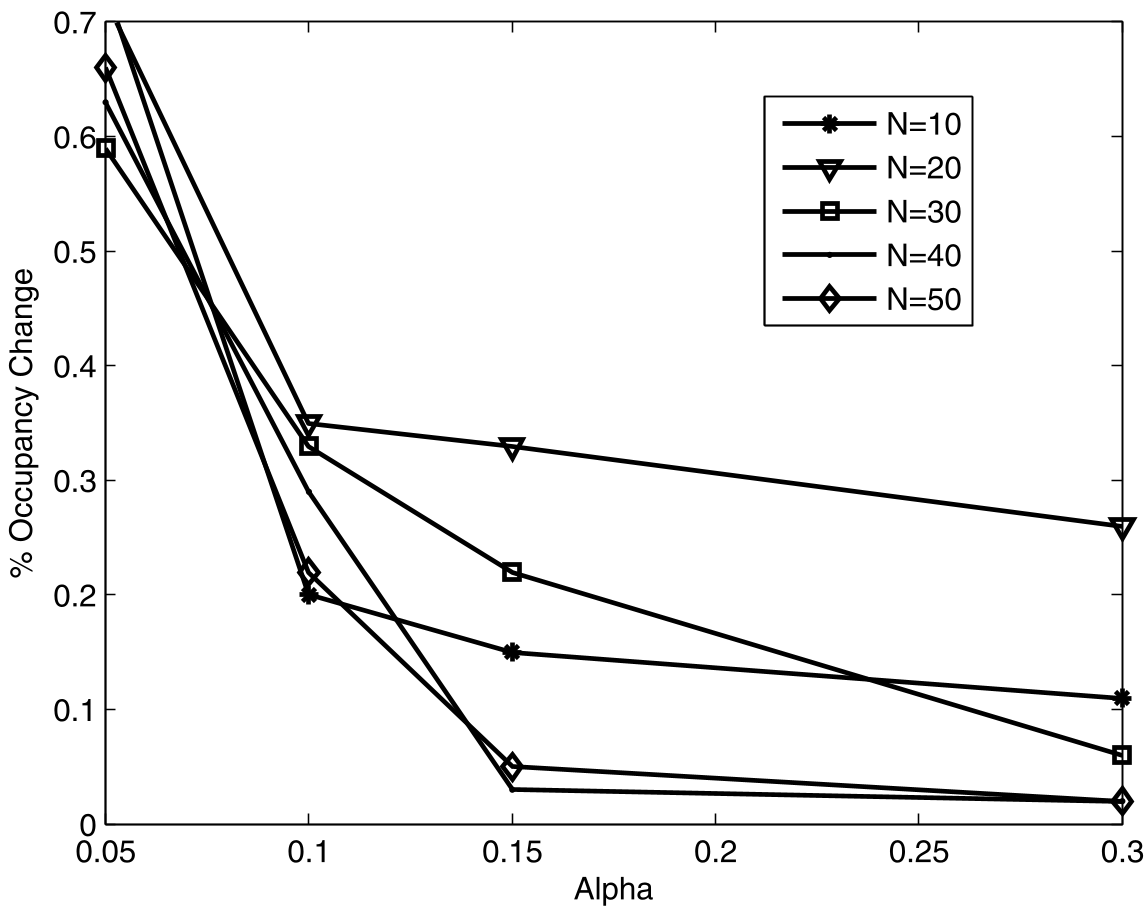 The charts above show that as our tolerance for distributional difference (α) increases, the number of edges we need to add drops significantly, preserving more of the original graph's structure.
Critical Analysis & Conclusion
Takeaway
The paper effectively bridges the gap between tabular privacy (like t-closeness) and graph theory. α-proximity provides a quantifiable way to prevent users from being "profiled" by the company they keep.
Limitations
- Metric Simplicity: The distance measure used is a simplified sum-of-differences. More complex metrics (like Earth Mover's Distance) might yield different results.
- Binary Focus: While the theory generalizes, the experiments primarily look at binary labels (e.g., Has Disease vs. Healthy).
- Edge Addition only: The method only adds edges. In some real-world scenarios, removing edges or modifying labels might be more efficient for privacy.
Future Work
The next frontier is applying this to Real-world Power Law graphs and exploring how these added edges affect "Clustering Coefficients"—a key measure of how "social" a network still feels after it's been anonymized.