
The Social Network Paradox: Why More Connections Might Hinder Rural Entrepreneurship
Does Social Network always Promote Entrepreneurial Intentions? Part II: Empirical Analysis
This empirical study utilizes a Structural Equation Model (SEM) to investigate the impact of social networks on the entrepreneurial intentions of Chinese College-graduate Village Officials. Key findings reveal that while network heterogeneity positively influences intentions, larger network sizes and superior "top node" properties surprisingly exert a negative influence.
TL;DR
In a counter-intuitive twist on traditional social capital theory, this study of 157 Chinese College-graduate Village Officials reveals that larger social networks and higher-status connections actually decrease entrepreneurial intentions. While diverse connections (heterogeneity) remain a powerful catalyst, the sheer volume of a network and the influence of high-ranking "top nodes" often act as obstacles rather than springboards for rural start-ups.
Contextual Positioning
Within the landscape of entrepreneurial psychology, most literature treats social capital as a "the more, the better" resource. This paper challenges that status quo, positioning itself as a critical empirical check on how social structures function specifically within the Chinese "College-graduate Village Official" system—a unique demographic caught between grassroots service and career transition.
The "Common Sense" Fallacy: Why Size Isn't Everything
The authors identify a significant gap in prior work: the failure to distinguish between the quality of information and the quantity of contacts.
- The Redundancy Trap: A large network often consists of people within the same occupation or social circle, leading to homogeneous information that provides no competitive "structural hole" advantage.
- The Opportunity Cost of Status: Officials with "high-status" connections (powerful "top nodes") often have better pipelines into established corporate or government career paths, making the risky path of entrepreneurship less attractive.
Methodology: A Modified Structural Approach
The research utilized a Structural Equation Model (SEM) to map the causal pathways between social network dimensions and the cognitive precursors of entrepreneurship.
The Core Framework
The authors initially proposed a model where all network dimensions were mediated by Desirability and Feasibility. However, empirical data forced a pivot to a Modified Model where network size and top node properties impacted intentions directly, without the psychological mediation layers.
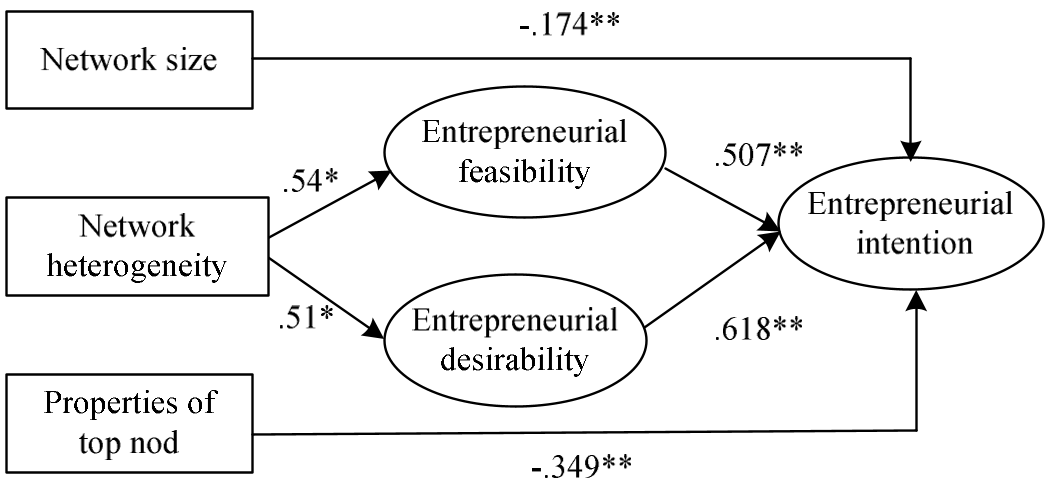 Figure 1: The modified SEM showing direct negative paths from Size and Top Node to Intentions.
Key Findings & Visual Evidence
The results provide a sophisticated breakdown of how social capital manifests in the rural Chinese business environment.
1. Heterogeneity is King
A positive correlation was found between network heterogeneity and entrepreneurial intention. Interacting with individuals across different sectors provides the "heterogeneity information" (market gaps, policy shifts) necessary to make a business venture seem feasible and desirable.
2. The Negative Pressure of Social Capital
The most striking result is the quantitative proof of negative correlation for network size and top node properties. As shown in the model fit comparison, the modified direct-effect model significantly outperformed the original mediation theory.
 Table 1: Comparison of original vs. modified model fit indices showing the improved validity of the "negative impact" direct paths.
Critical Analysis: Beyond the Data
The authors' insight into the "Top Node" is particularly profound. They argue that officials from grassroots backgrounds with less status-heavy social capital are actually more "rooted" in rural areas. For these individuals, starting a business is a primary vehicle for upward mobility. In contrast, those with high-status networks view rural entrepreneurship as a low-priority option compared to the "exit paths" their elite connections offer.
Limitations
- Sample Constraints: The "one village, one official" rule in China makes large-scale sampling difficult.
- Cultural Specificity: The use of the "Chinese New Year Greeters' Network" provides a culturally rich dataset but may require adaptation (e.g., to "Christmas Greeters") for Western contexts.
Conclusion: A New Strategy for Rural Development
The paper concludes that simply expanding the social reach of village officials is insufficient. To foster a true entrepreneurial spirit, the focus must shift toward diversifying their networks rather than just growing them. This study serves as a vital reminder that in the world of social capital, the structure of the network often matters far more than its volume.