
Social Network Interaction Quantification: A Multi-Agent Reinforcement Learning Perspective
Social network interaction quantification and relationship trend analysis with multi-agent systems
This paper introduces a Multi-Agent System (MAS) framework for quantifying social network interactions and predicting relationship trends. It utilizes interaction payoff functions and neighborhood cumulative reward averages to model how interpersonal bonds evolve based on call and SMS data.
TL;DR
How do we measure the "strength" of a friendship using only phone logs? This paper proposes a multi-agent framework that treats social interactions as cumulative rewards. By calculating the "payoff" of calls and texts—weighted by reciprocity and decayed over time—the system identifies whether a relationship is trending toward growth or abandonment.
Background: Friendship as an Economic Exchange
In social science, Social Exchange Theory suggests that social behavior is the result of an exchange process. The purpose of this exchange is to maximize benefits and minimize costs. However, translating this into a mathematical model for Multi-Agent Systems (MAS) is notoriously difficult. Existing models often overlook the reciprocity (is the other person calling me back?) and the temporal decay (does a call from six months ago still matter today?).
The Core Logic: Payoffs and Reciprocity
The researchers define the value of an interaction not just by its duration, but by its balance.
1. Interaction Payoff Functions
The "benefit" of an interaction is calculated using the ratio of incoming to outgoing communications. For example, if agent calls agent more frequently than vice versa, agent perceives a higher "Friendship Weight" from agent .

The model introduces a Cost Per Minute (CPM) and Cost Per SMS (CPMs) to represent the "effort" expended, resulting in a net Payoff:
2. Cumulative Rewards and Time Decay
The most critical insight is the use of a Time Discount Factor (). Relationships aren't built on a single day; they are the sum of historical payoffs. However, recent interactions should carry more weight than old ones. The formula for cumulative reward () at time is: This recursive structure effectively creates a "sliding window" of social relevance.
Methodology: The Neighborhood Evaluation
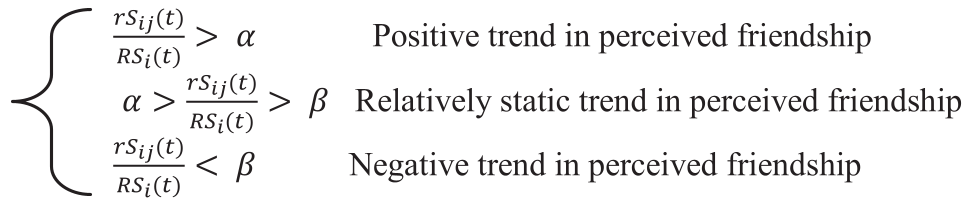
To determine if a relationship is "healthy," the model doesn't just look at the raw score. It compares the reward of a specific friend () against the Average Reward of all neighbors ().
- Positive Trend: (You are a better friend than my average contact).
- Negative Trend: (You are falling behind my other social ties).
Experiments and Results
The authors tested this on a dataset of 125 agents. By varying (from 0.2 to 0.8), they observed how sensitive the "Friendship Weight" was to sudden bursts of activity versus long-term stability.
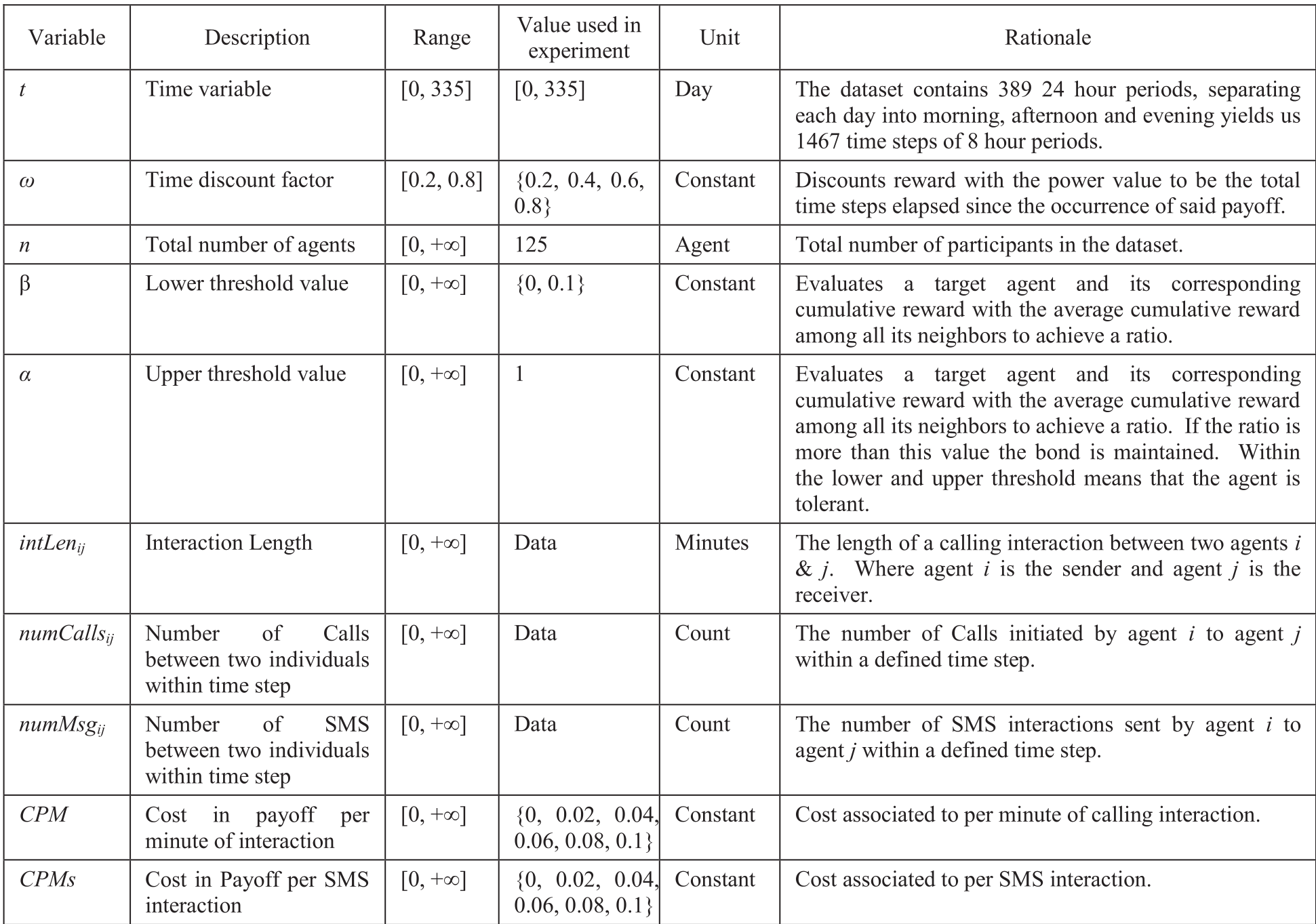
The results demonstrated that higher discount factors () lead to more stable, "loyal" relationship modeling, whereas lower factors () create a system that is highly reactive to the most recent interaction, potentially misidentifying temporary silence as a permanent break in the bond.
Critical Insight: Why This Matters
Most social algorithms (like those on Facebook or LinkedIn) focus on Graph Topology (who you know). This paper shifts the focus to Dynamic Reciprocity (how you interact). By quantifying the "perceived friendship" from the perspective of an individual agent, we can build more human-centric AI that understands the fragility and momentum of social bonds.
Limitations
- Data Bias: The model relies on metadata (call length, count) but lacks semantic context (the quality or sentiment of the conversation).
- Simplified Cost: Treating cost as a constant (CPM) ignores the fact that for some users, a 5-minute call is "cheaper" (emotionally or financially) than for others.
Future Outlook
This work lays the groundwork for "Socially Intelligent Agents" that can autonomously navigate human networks by mimicking our natural tendency to favor those who reciprocate our efforts. Future iterations could integrate Sentiment Analysis to weigh the "benefit" of a call based on the emotional tone of the voices.