
SocSLIM: Elevating Top-N Recommendation by Fusing Social Networks with Sparse Linear Models
Social network regularized Sparse Linear Model for Top-N recommendation
This paper introduces SocSLIM, a Social network regularized Sparse Linear Model for Top-N recommendation. It integrates social connection data into the Sparse Linear Model (SLIM) framework by learning a sparse coefficient matrix that simultaneously reconstructs user-item interactions and user-user social structures, achieving a significant improvement in recommendation accuracy.
TL;DR
SocSLIM is a robust framework for Top-N recommendation that bridges the gap between item-based sparse models and social collaborative filtering. By regularizing sparse linear coefficients with social adjacency information, it captures user influence more effectively than traditional Matrix Factorization. The result? A 12% improvement in Hit Rate and a local-learning extension that is 10 times faster than standard global approaches.
The "Rating Prediction" Trap
For years, the recommendation community was obsessed with Rating Prediction—minimizing the error on a 1-5 star scale. However, in real-world e-commerce, Top-N Recommendation (ranking items for potential purchase) is much more valuable.
The industry-standard Matrix Factorization (MF) often fails here because:
- Ignoring Unrated Items: MF generally only looks at what has been rated, ignoring the vast "sea" of unobserved interactions that are vital for ranking.
- Information Bottleneck: Compressing user-item interactions into low-dimensional latent vectors often discards the "long tail" of specific user preferences.
The authors argue that the Sparse Linear Model (SLIM) is a better foundation, but it lacks the human element: the social network.
Methodology: Socially-Aware Sparse Learning
The core innovation of SocSLIM is the simultaneous reconstruction of two matrices using a single coefficient matrix .
1. Collaborative Representation
Instead of latent factors, SocSLIM assumes a user's preference can be linearly reconstructed by other users' behaviors.
2. Social Regularization
To ensure the coefficients are socially meaningful, the authors force to also reconstruct the social adjacency matrix :
3. Distance-Based Penalty
They introduce a distance vector that ensures higher weights are assigned to socially connected or highly similar users. This prevents the model from assigning arbitrary weights to dissimilar "strangers."
 The workflow shows how user-item matrices and social networks are combined to learn the weights used for final recommendation scoring.
Scalability through Local Learning (LocSocSLIM)
Sparse models can be computationally expensive as the number of users grows ( complexity). Inspired by Manifold Learning and Locally Linear Embedding (LLE), the authors proposed LocSocSLIM. Instead of looking at all users, it only learns weights from the -nearest neighbors of a user.
Specifically:
- It preserves the local geometric structure of the user space.
- It reduces computation time from thousands of seconds to mere dozens.
- It maintains accuracy because most "important" weights in a sparse model are naturally local anyway.
Experiments & Results
The authors tested SocSLIM on Epinions (directed trust network) and Flixster (undirected friendship network).
SOTA Comparison
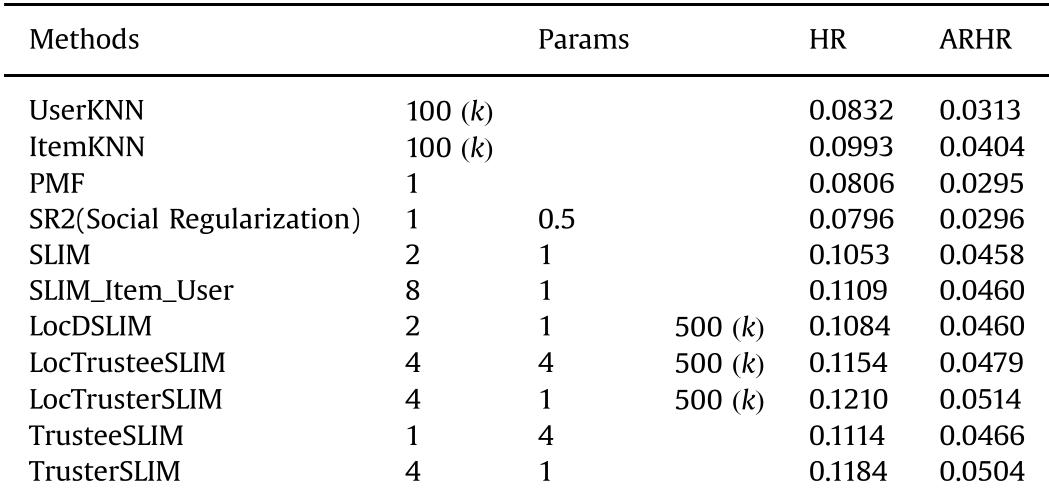
As the table below illustrates, SocSLIM variants consistently outperform Matrix Factorization (PMF, SR2) and basic SLIM.
Detailed Insights:
- Hit Rate (HR@10): SocSLIM achieved significant gains, proving that social links are a strong predictor for Top-N ranking.
- Per-Rating Hit Rate (rHR): Interestingly, SocSLIM performs exceptionally well at recommending items that users eventually rate highly (4-5 stars) and correctly avoids items that users dislike. This suggests the model successfully learns "quality" influence from social circles.
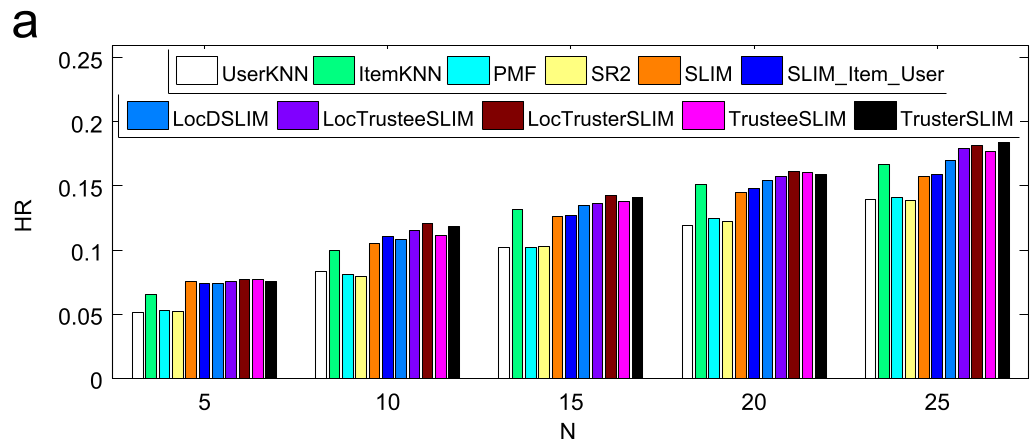 The charts demonstrate that as more items are recommended (increasing N), SocSLIM maintains a lead over traditional baseline methods.
Final Thoughts
SocSLIM proves that you don't always need complex Deep Learning to achieve SOTA results. By smartly regularizing a linear model with social graph data and utilizing local learning for efficiency, this paper provides a highly practical blueprint for modern recommender systems.
Key Takeaways for Engineers:
- If your task is ranking (Top-N), favor Sparse Linear Models or BPR-loss based methods over standard RMSE-optimized Matrix Factorization.
- Social networks act as a high-quality filter for the "Sparsity" problem in recommendation.
- Don't underestimate Local Learning: it's not just a speed trick; it respects the underlying manifold of your data.