
Game On: Decoding Rumor Dynamics Through Strategic Autonomy
Research on Rumors of Social Networks Considering Game Between Nodes
This paper introduces a novel rumor spreading model based on Game Theory within scale-free social networks. It incorporates a unique "selection safety factor" to quantify strategy risk and a "decision-making conversion factor" to model how users change their minds over time, achieving high consistency with real-world Twitter data.
TL;DR
Why do some rumors die out while others paralyze a network? This paper moves beyond biological virus analogies (SIR models) to treat social network users as rational agents. By combining Scale-Free network topology with Game Theory, the authors reveal that rumor spread is a calculated balance of risk, reward, and the time-sensitive "Conversion Factor."
The Missing Piece: Human Agency
Most classical models assume that if you are exposed to a rumor, you have a fixed probability of "infection." However, humans aren't cells; we are strategists. We weigh the benefit of being "in the know" against the social risk of being wrong.
The authors identify two fatal flaws in previous research:
- Static Decisions: Ignoring that people change their minds as they learn more facts.
- Risk Negligence: Ignoring that spreading a rumor is a "risky" choice that depends on how many others are doing it (the Safety Factor).
Methodology: The Game of Information
The model treats each interaction as a two-player game. A node decides to spread (Strategy 1) or keep quiet (Strategy 2) based on a payoff matrix.
1. The Selection Safety Factor ()
The authors introduce a "Safety Factor" . If fewer than half of a node's neighbors are spreading the rumor, the risk is too high (). If more than half are involved, scales with the proportion of spreading neighbors. This creates a nonlinear threshold for viral growth.
2. The Conversion Factor ()
Recognizing that humans aren't static, the model uses: This formula captures the "attention cycle." Early on, as we understand a rumor better, our likelihood of changing our strategy increases. As time passes and the rumor becomes "old news," the conversion rate drops back toward zero.
 The probability of state transition depends heavily on this dynamic .
Experimental Insights
Using a scale-free network (BA model) with 1,000 nodes, the research highlights several counter-intuitive findings:
- The Critical Threshold: There is a specific "Selection Safety Factor" value (). Below this, the rumor technically cannot survive in the network regardless of the initial infection rate.
- Autonomy vs. Scope: Surprisingly, a higher "Autonomous Selection Factor" (meaning nodes decide for themselves more aggressively) leads to smaller final rumor scales. As nodes gain deep understanding, their rational self-interest eventually leads them to stop spreading the falsehood.
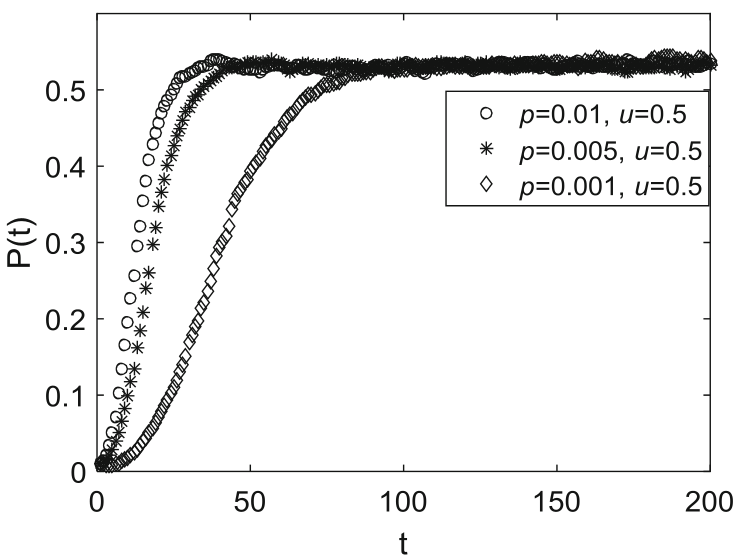 Figure: The Evolution of Rumor Proportion over time across different parameters.
Real-World Validation: The Twitter Test
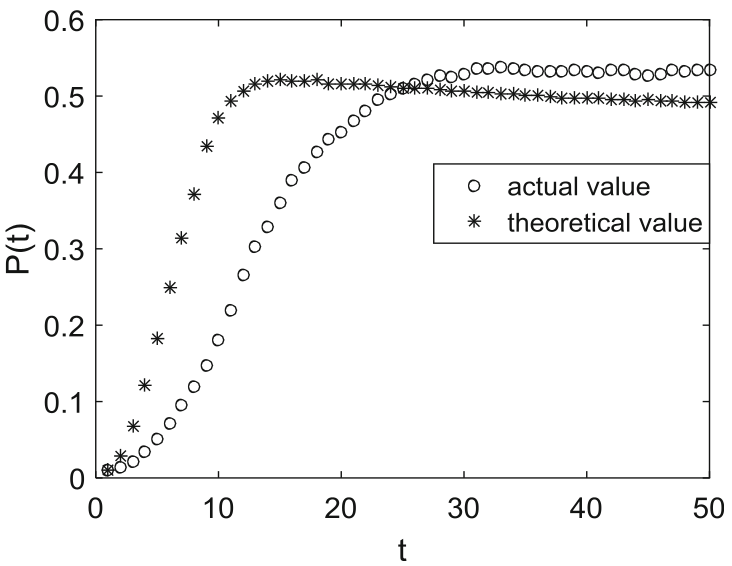
To prove this wasn't just mathematical fiction, the authors tested the model against a massive Twitter dataset consisting of 81,306 users and over 1.7 million edges.
The result? The theoretical "Game Theory" curve matched the actual propagation data with remarkable accuracy. The slight discrepancy (actual values being slightly higher) was attributed to the difficulty of perfectly quantifying "social gain" in a matrix, as humans sometimes spread rumors for emotional rather than purely economic reasons.
Critical Insight & Conclusion
This paper shifts the paradigm of rumor control from "censorship" to "incentive alignment." If we understand that rumor spreading is a choice based on safety and perceived payoff, we can combat misinformation by:
- Increasing the Risk: Lowering the "Safety Factor" by highlighting the social cost of misinformation.
- Accelerating Conversion: Providing factual clarity earlier to hit the peak of the curve sooner, causing nodes to switch back to "non-spreading" states before equilibrium is reached.
The future of social network defense isn't just better filters; it's understanding the game the nodes are playing.