
Securing the Social Fabric: A Deep Dive into SNS Security Challenges and Solutions
Social network security: Issues, challenges, threats, and solutions
The paper "Social network security: Issues, challenges, threats, and solutions" is a comprehensive survey that taxonomizes security and privacy risks in Social Network Services (SNS). It introduces a multi-dimensional classification of threats—Multimedia, Traditional, and Social—and evaluates a wide array of state-of-the-art defense mechanisms such as digital watermarking, steganalysis, and automated malware detection.
TL;DR
Social Network Services (SNS) have evolved into complex data ecosystems where the viral sharing of multimedia content creates unprecedented security blind spots. This paper provides a master-level taxonomy of SNS threats, categorizing them into Multimedia, Traditional, and Social vectors, while evaluating the effectiveness of diverse solutions from digital watermarking to machine-learning-based spam detection.
Contextual Positioning
In the landscape of cybersecurity literature, this paper serves as a seminal comprehensive survey. It bridges the gap between technical exploit analysis and social-behavioral studies, positioning the "Multimedia Content" as the new frontier for privacy leakage and identity theft.
The Core Conflict: Why Traditional Security Fails
The authors argue that traditional security tools like firewalls are insufficient for SNS because the "threat" is often legitimate functionality used maliciously. For instance:
- Geotagging: A high-resolution vacation photo unintentionally broadcasts an empty home address to potential burglars.
- Shared Ownership: If three people are in a photo, but only one controls the privacy settings, the privacy of the other two is compromised—a logic conflict that standard access control systems cannot resolve.
Methodology: The Three Pillars of Defense
The paper breaks down the defense landscape into three strategic aspects:
- Control over Personal Information: Moving beyond basic privacy settings to semantic-web-based access control.
- Trust Management: Using hybrid models (structural + interactional) to calculate the "reputation" of users before interaction.
- Defense Against Attacks: Deploying specialized detectors for cloned profiles and smart spammers.
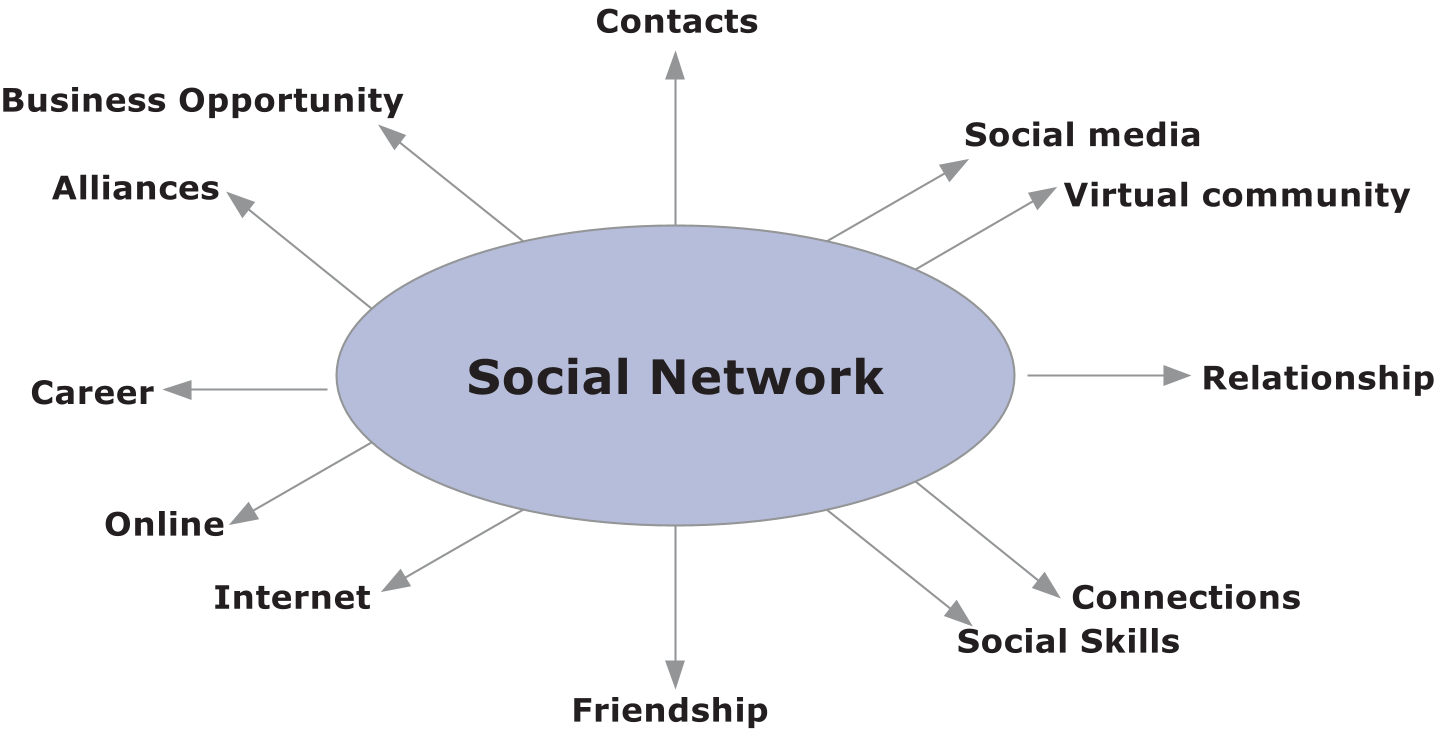 The multidimensional approach to SNS security, moving from general internet threats to specialized social threats.
Detailed Analysis of Threats
The taxonomy presented is one of the most granular in the field:
- Steganography in SNS: Attackers can hide malware or command-and-control (C2) instructions within innocuous profile pictures.
- De-anonymization: Techniques that use group membership and network topology to unmask users who think they are browsing anonymously.
- Corporate Espionage: Using SNS to map organizational hierarchies and spear-phish employees.
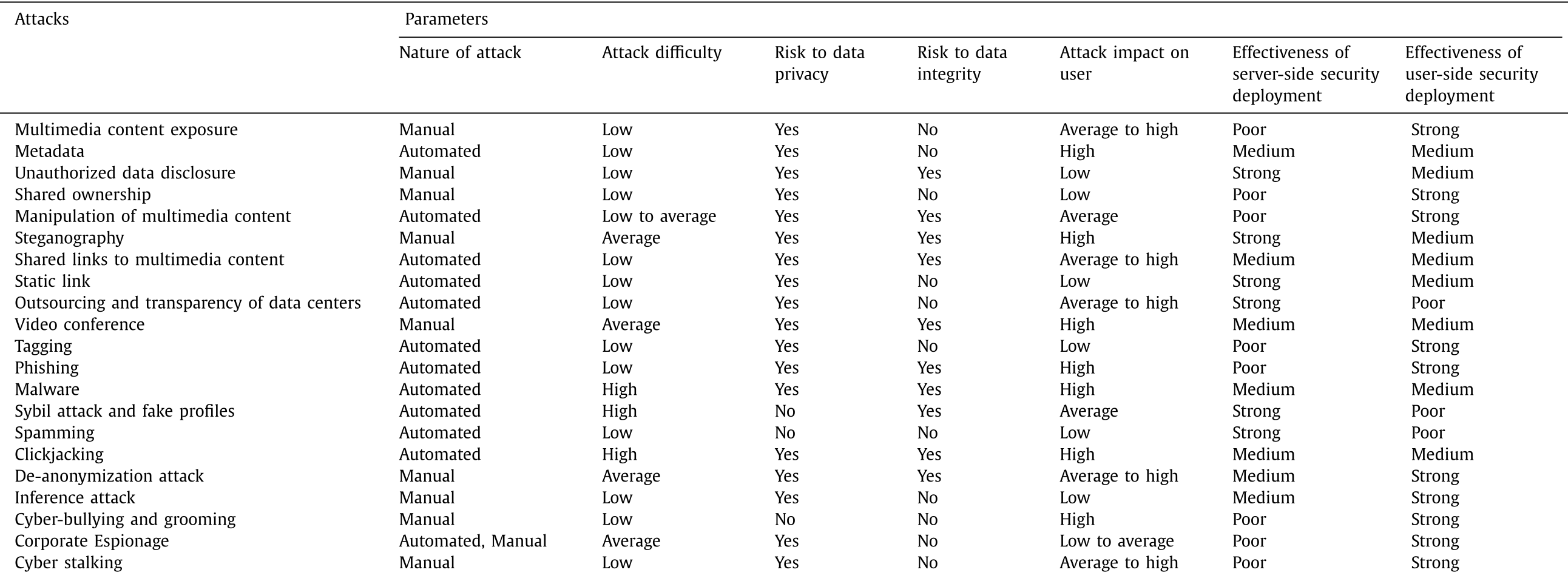 Comparative matrix of attack vectors, showing the trade-off between attack difficulty and user impact.
SOTA Solutions and Their Limitations
The authors evaluate current defenses, highlighting a critical gap. Tools like Steganalysis and Watermarking provide high security but come with massive computational overhead (Processing Cost), making them difficult to scale for real-time processing of millions of daily uploads on platforms like Facebook or Twitter.
| Solution | Primary Target | Limitation |
|---|---|---|
| Digital Oblivion | Right to be forgotten | Relies on third-party expiration protocols |
| SybilDefender | Fake profiles | Computationally expensive on large graphs |
| PhishAri | Twitter Phishing | High dependency on feature engineering |
Critical Insight & Future Outlook
The most striking takeaway is the authors' "Research Roadmap." They advocate for a shift toward Lightweight Authentication and User Awareness. Technological solutions alone won't suffice; the next generation of social networks must integrate Cognitive Psychology to detect misinformation and propaganda.
Conclusion
We are moving toward a "trustworthy and secure social network ecosystem," but the journey requires a synthesis of data mining, cryptographic ownership, and user education. This paper provides the foundational map for that journey.
Limitations
While the survey is exhaustive, it was published before the explosion of LLM-based social engineering and Deepfakes, which now represent the "High Effort/High Impact" peak of the threat landscape. Future research must integrate these AI-driven vectors into the existing taxonomy.