
SoCo: Transforming Mashup Creation with Social Intelligence
Towards a Social Network Based Approach for Services Composition
This paper introduces SoCo (Social Composer), a framework that leverages social network intelligence to assist end-users in semi-automatic Web services composition. It specializes in dynamic recommendation of mashup components by building an implicit social graph from user-service interactions and composition patterns.
TL;DR
The SoCo (Social Composer) framework bridges the gap between social networking and Web service composition. By analyzing the "implicit" social ties formed through shared usage patterns, it provides real-time, context-aware recommendations to help non-experts build complex "mashup" applications without deep programming knowledge.
The Persistence of the "Indecision Problem"
In the era of Web 2.0, creating value-added services by reusing existing ones (mashups) has moved from enterprise back-ends to the hands of end-users. However, while tools like Yahoo Pipes or Microsoft Popfly simplified the UI, they left the logic to the user. When a user selects a service, they often face an "indecision problem": Which service should follow this one to achieve my goal?
Existing solutions are either too rigid (expert-driven) or too generic (community-wide ratings). Authors of this paper argue that the missing ingredient is the Social Dimension—the specialized knowledge within a user's local network of friends and colleagues who likely share similar tasks and trust levels.
Methodology: The Architecture of SoCo
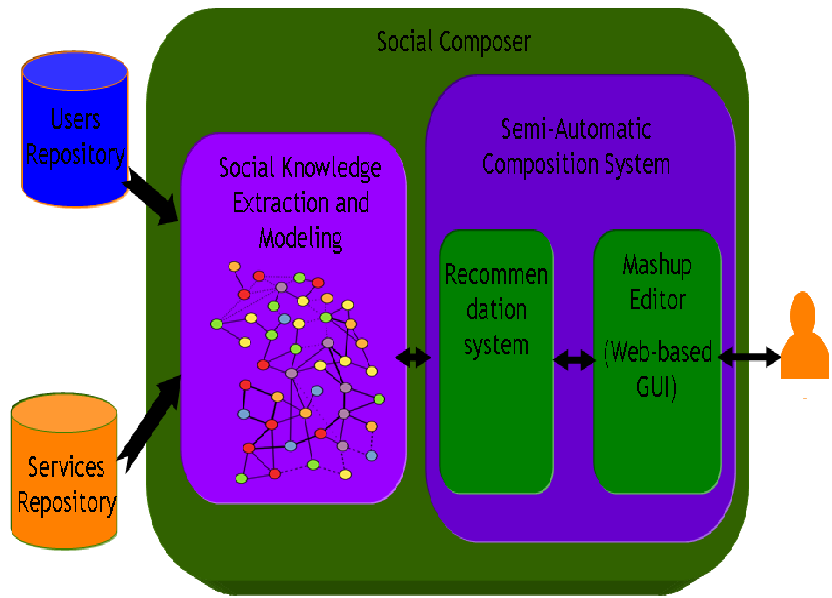
The SoCo framework operates on a dual-component architecture designed to turn raw interactions into actionable insights.
1. Social Knowledge Extraction
SoCo doesn't just rely on "Facebook Friend" lists. It builds a Social Graph automatically. If Alice frequently uses services authored or used by Bob, the system infers a social tie. From this, it calculates:
- User Profiles: Tracking composition patterns and expertise.
- Social Proximity (SP): A metric defining how "close" two users are based on their collaborative history.
2. The Recommendation Engine
When Alice adds a service to her workspace, SoCo calculates a Recommendation Confidence (RC) score for potential next steps.
The logic is captured in a specific formula:
- NC: How often this "link" has been used by others.
- Fit: Is the person who used it an "expert" in this domain?
- SP: Do I trust/know the person who used it?
Experimental Use-Case: Cinema Planning
The authors illustrate a scenario where "Alice" wants to create a personalized movie-outing app.
- She selects a FilmAdviser service.
- SoCo instantly recognizes that her social circle often pairs this with Cine-Map-Calendar.
- As she builds, the system provides a ranked sidebar of "next-best" services.
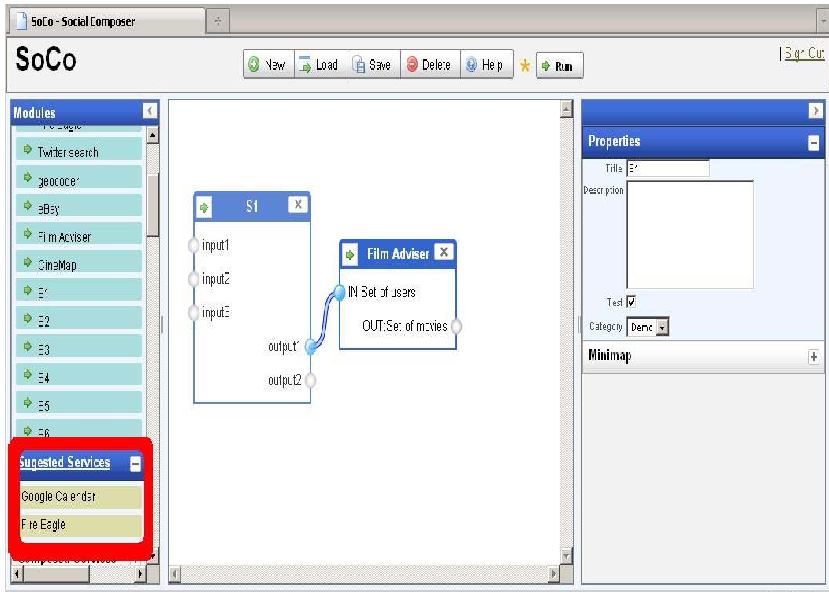
This visual programming approach, powered by the WireIt library, demonstrates how social metadata can reduce the cognitive load of service discovery from a needle-in-a-haystack search to a guided click-and-drag flow.
Critical Insight & Conclusion
The true value of SoCo lies in its definition of the Implicit Social Network. By decoupling "social relations" from simple friend requests and anchoring them in service interaction data, the system captures a higher-fidelity "interest graph."
Limitations: The framework currently faces a cold-start problem (it needs data to provide good recommendations) and lacks an automated strategy for updating the social graph as user interests drift over time.
Future Outlook: As we move toward LLM-based autonomous agents, the principles in SoCo—using social proximity and "expertise" to choose the next tool—provide a foundational roadmap for how Multi-Agent Systems might collaborate in the future.