
Social Network Signatures: Why You Are Who You Call
Social Network Signatures: A Framework for Re-identification in Networked Data and Experimental Results
This paper introduces the Random Graph Approximation (RGA) framework, a scalable approach for entity re-identification in dynamic social networks. By leveraging graph theory metrics like clustering coefficients and degree distributions, the method achieves accurate entity matching across time periods without requiring exhaustive pairwise comparisons.
TL;DR
Can you be identified simply by your social circle, even if you change your name? This paper proves that your "social network signature" is a remarkably robust identifier. The authors introduce the Random Graph Approximation (RGA) framework, which allows for large-scale entity re-identification (matching the same person across different time periods) without the need for intensive pairwise computations. Their findings reveal a critical hierarchy of threats to privacy: missing data is manageable, but behavioral "noise" is the ultimate enemy of recognition.
Background: The Economics of Fraud
In industries like telecommunications, subscription fraud is a persistent headache. A fraudster signs up, defaults, and then returns under a new alias. While names and IDs are easy to fake, changing one's entire social circle—friends, family, and associates—is incredibly difficult. This paper moves beyond just "doing" re-identification to asking "Why does it work?" and "When does it fail?"
The Problem: The Curse of Scale
Standard re-identification involves comparing every node in Time A with every node in Time B. If you have nodes, you face an problem. On a network with millions of users, this is a computational graveyard. Furthermore, we often don't know the "Ground Truth" for false negatives (fraudsters we missed), making it hard to calibrate models.
Methodology: The 4-Step RGA Framework
The authors bypass the comparison trap by modeling the problem using graph theory. They assume that if a network behaves somewhat like a random graph, we can predict the distribution of "match" (the same person) and "non-match" (different people) scores using only a few parameters: network size (), average degree, and clustering coefficient ().
Step-by-Step Logic:
- Estimate Degree & Size: Check if the degree distribution is normal (or can be made normal by pruning high-degree "hubs").
- Match Distribution: Predict the mean and variance of overlap for the same node across time.
- Non-Match Distribution: Predict how much overlap two different nodes might accidentally have.
- Performance Projection: Calculate the optimal threshold where these two distributions intersect to maximize True Positives while minimizing False Positives.
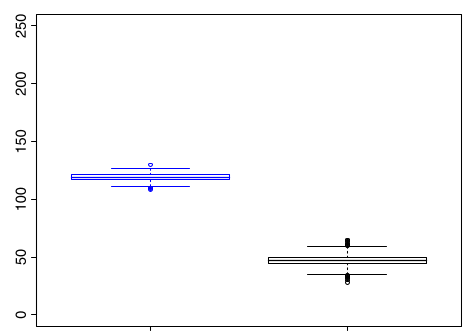 Figure: The RGA model accurately predicts the separation between match (blue) and non-match (black) distributions.
Key Insights from Experiments
1. Robustness to Graph Types
The framework was tested on three major network types:
- Random Graphs: The theoretical ideal; RGA fits perfectly.
- Small World Networks: Despite higher clustering, the approximation still holds with high accuracy.
- Scale-Free Networks: These require "hub removal" to normalize the distribution, but once pruned, they become highly predictable.
2. Missing Data vs. Noise
This is the paper's most intuitive "Aha!" moment.
- Missing Data: If you only see 50% of an entity's calls in , the match mean drops, but the non-match mean drops proportionally. You can still distinguish the person.
- Noise (Behavioral Change): If the entity starts calling new people (rewiring), the match score drops while the non-match score stays high. This creates a "collision" of distributions, making re-identification significantly harder.
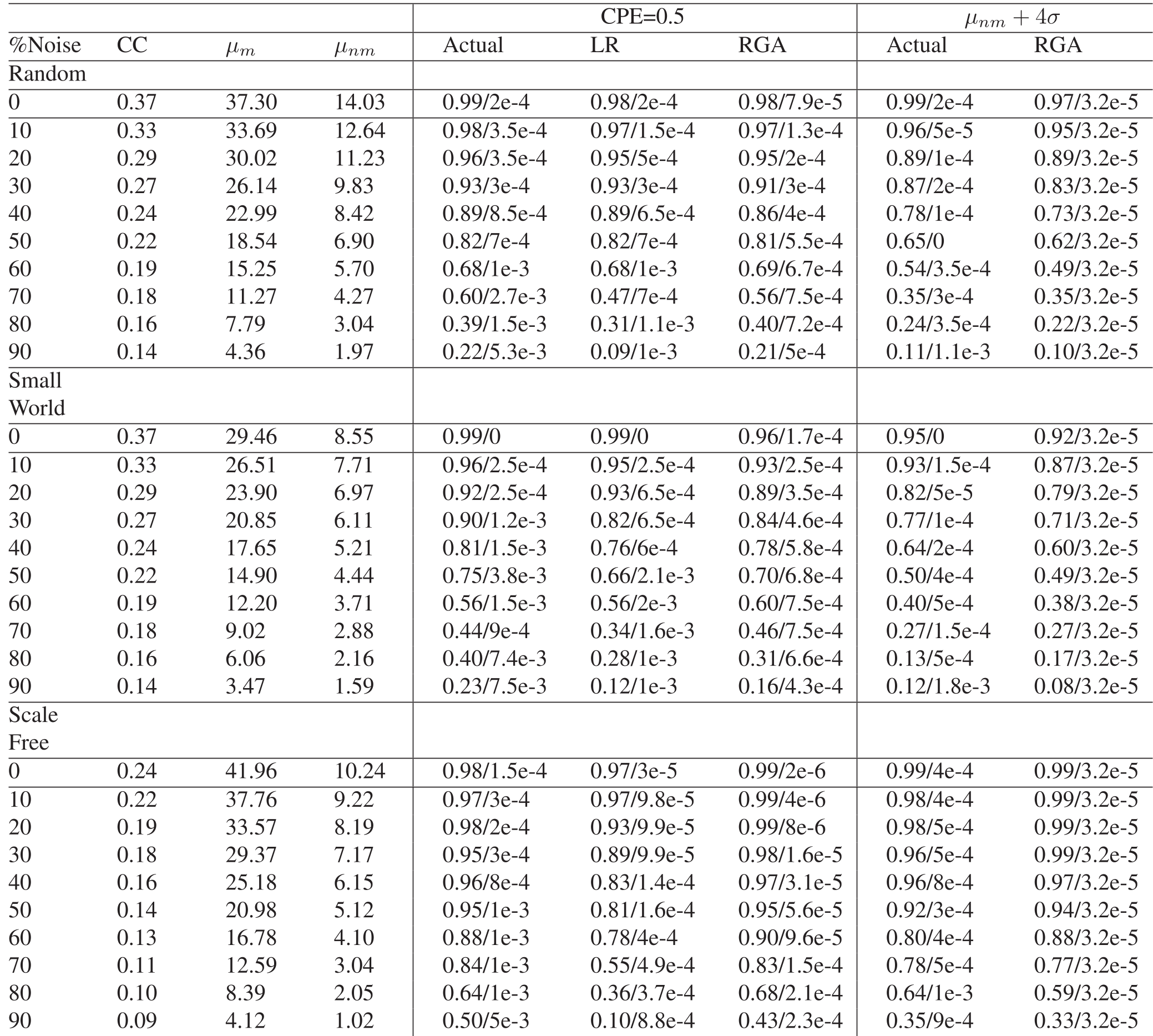 Table: Comparison of Actual vs. RGA predicted performance across different noise levels.
Critical Analysis & Conclusion
Takeaway
The RGA framework is a "lean" alternative to heavy machine learning models. It tells us that re-identification success depends on the Clustering Coefficient. If your social circle overlaps too much with others (high ), you are harder to find. If your circle is unique, your "signature" is indelible.
Limitations
The primary hurdle is the Scale-Free nature of the real world. Pruning the top 10% of high-degree nodes (the "influencers") makes the math work, but it means the method might struggle to re-identify the most active members of a network—who are often the most important to track in fraud scenarios.
Future Outlook
As we move toward 2026, combining these structural signatures with temporal metadata (the timing of calls) will likely close the gap that behavioral noise currently creates. The "Social Network Signature" remains one of the most powerful, and perhaps under-discussed, identifiers in the digital age.
Author Note: This work bridges the gap between raw data mining and pure graph theory, providing a roadmap for practitioners to estimate the ROI of re-identification efforts before spinning up expensive clusters.