
Social4School: Teaching Privacy Awareness Through Reactive Gamification
A Social Network Simulation Game to Raise Awareness of Privacy Among School Children
This paper introduces Social4School, an innovative gamification platform designed to enhance online privacy awareness among primary school children. By simulating information propagation in a controlled artificial social graph, the tool enables students to experience how personal data spreads through "likes" and "shares."
Executive Summary
TL;DR: Social4School is a web-based educational simulation that addresses the high-risk online behaviors of "digital natives." By placing students in a controlled social network simulation, the platform demonstrates the "butterfly effect" of a single social action, using custom metrics (Active, Passive, and Leakage scores) to quantify privacy risk. Experimental data from 450+ students proves it significantly shifts student behavior toward safer online practices.
Academic Context: This work moves beyond traditional "frontal instruction" (lectures) and sits at the intersection of Digital Literacy and Serious Games. It transitions from simply telling children "don't post that" to showing them exactly how their data migrates through a network.
Problem & Motivation: The Digital Native Delusion
Current statistics reveal a troubling trend: while 51% of teenagers believe they know privacy rules, nearly 60% admit they don't care. This "privacy fatigue" and lack of perceived risk lead to dangerous behaviors, such as sharing sensitive data with strangers or ignoring the secondary spread of information.
The authors argue that the problem is a perception gap. Children view social networks as private chats rather than public graphs. Existing educational tools are often too abstract. The researchers' intuition was simple: build a "sandbox" social network where the consequences of a post are made visible and measurable.
Methodology: The Social Graph Sandbox
The core of Social4School is its multi-phase simulation. Unlike a real OSN, the game is synchronous and teacher-led, ensuring students focus on one specific dynamic at a time.
1. The Dynamic Social Graph
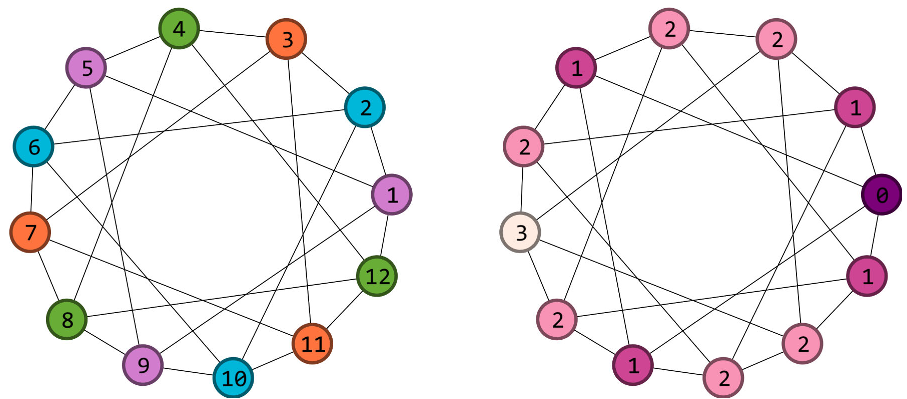
The system generates a graph where students are clustered into groups (simulating "close friends"), but crucially includes bridge users—nodes that connect different clusters. This architecture is essential for demonstrating how information escapes a "private" circle.
2. Strategic Phases
- Active Phase: Users publish predefined sentences with hidden sensitivity scores (0 for "I like burgers" to 5 for "Mom takes strange pills").
- Reactive Phases: This is the "How" of the learning process. Students see a friend's post. If they "Like" or "Share" it, that post travels to their own friends in the next step.
- Discovery: By the second or third reactive phase, students realize they are seeing posts from people they aren't "friends" with—visually demonstrating the Leakage effect.
3. Quantitative Feedback (The Scoring System)
Instead of a simple "Pass/Fail," the game generates:
- Active Score: How much you endangered others.
- Passive Score: How much you endangered yourself.
- Leakage Score: How much the community allowed your data to spread.
Experiments & Results: Real Behavioral Change
The study involved 22 classes across seven Italian schools. The researchers used a split-group methodology (Control vs. Experimental) to validate the tool's impact.
Critical Findings:
- Score Improvement: Between the first and second sessions, distributions for all three scores shifted significantly toward "safer" values.
- Behavioral Shift: In surveys, students who completed the simulation showed a dramatic drop in their willingness to share private family photos (a 33% reduction in risky intent compared to the control group).
- Teacher Acceptance: 100% of involved teachers expressed a need for more such materials, noting that students were "driving the discussion" rather than being passive recipients of information.
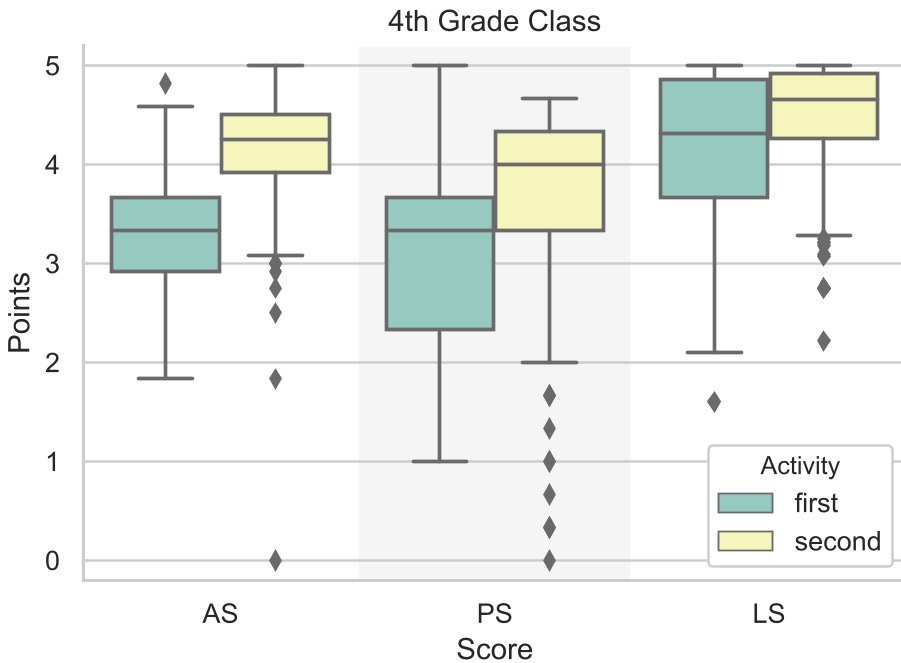
The figure above illustrates the shift in sensitivity scores across different questions (Q1: Usage Intent, Q2: Personal Photos, Q3: Friends' Privacy), showing consistently lower (safer) scores for the experimental group.
Critical Analysis & Conclusion
Takeaway: Social4School succeeds because it leverages Active Learning. By making the "Invisible" (data propagation) "Visible" (through reactive phases and scoring), it converts abstract privacy concepts into tangible social experiences.
Limitations:
- The current version uses predefined posts to maintain scoring accuracy, which limits student self-expression.
- The study focuses on short-term behavioral shifts; long-term habit formation remains an open question.
Future Outlook: The integration of mobile apps (tablets) and the expansion of scenarios for older demographics (addressing cyberbullying and professional profiling) represent the next frontier for this platform. This research proves that when it comes to digital literacy, experience is the best teacher.