
Network Topology as Destiny: Why Some Online Communities Thrive While Others Die
The Impact of Social Network Structure on the Growth and Survival of Online Communities
This paper investigates how the internal social network structure of Reddit communities (subreddits) influences their long-term growth and survival. By analyzing 15 distinct network features across 4,823 communities, the authors demonstrate that while structural features are strong predictors of a community's remaining lifetime, they have minimal impact on activity growth.
TL;DR
Is the fate of an online community written in its social graph? This research analyzes thousands of Reddit communities to find that structure is survival. While you can't easily predict if a community will grow based on its network, you can certainly predict if it will die. Surviving communities are modular, decentralized, and form "core-periphery" structures over time.
Background: The High Mortality of Digital Spaces
Creating an online group is easy; keeping it alive is notoriously difficult. Statistics show that the majority of new communities become "ghost towns" within months. This paper aims to move beyond simple membership counts to look at the internal architecture of interaction—the "social plumbing" of a community—to see if specific network motifs act as early warning signs for success or failure.
The "Survival" Structure vs. The "Growth" Mystery
The researchers arrived at a counter-intuitive conclusion: Growth and Survival are driven by different engines.
- Growth (increase in activity) is largely unpredictable through network metrics. This suggests growth might be driven by external factors (virality, news events) or content quality rather than how people are connected.
- Survival (longevity) is deeply tied to network topology. By looking at how users reply to one another in the 2nd month of a community's life, we can statistically forecast its remaining lifespan.
Methodology: Mapping the Reddit Galaxy
The authors tracked 4,823 subreddits created in early 2013, building networks where nodes are users and edges are "replies." They extracted 15 structural features, ranging from simple Density to complex Centralization and Modularity.
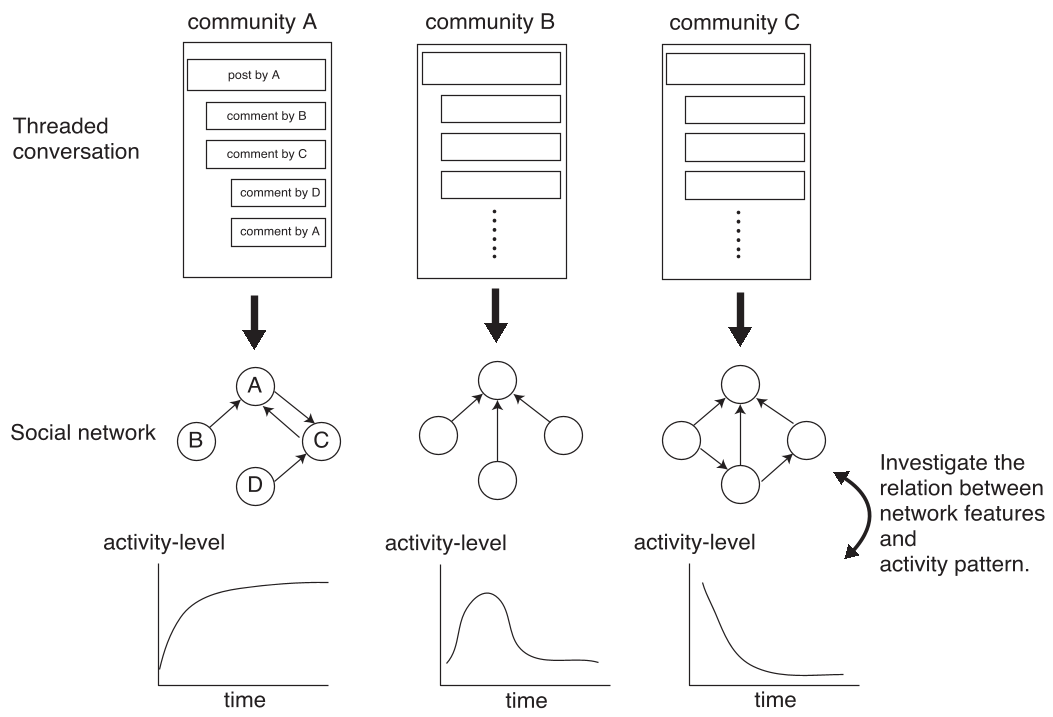 Fig 1. The research pipeline: Converting threaded conversations into social graphs to correlate structural features with community longevity.
Key Findings: The Anatomy of a Healthy Community
1. The Perils of Centralization
The data shows that high Centralization (where a few users dominate all interactions) is a death sentence. While "star" contributors are great for getting things started, they eventually face information overload. If the "stars" burn out or leave, the community collapses. Long-lived subreddits are more egalitarian.
2. Modularity and Diversity
Communities with a higher Number of Clusters (Modularity) tend to survive longer. This suggests that healthy subreddits are actually "meta-communities" that handle diverse sub-topics. If one sub-topic loses interest, the others keep the community afloat.
3. The "Core-Periphery" Evolution
Interestingly, while low density is good for survival early on, surviving communities eventually develop a dense core (clique ratio) surrounded by a loose periphery. This core provides the "social glue" and reciprocity needed for long-term stability.
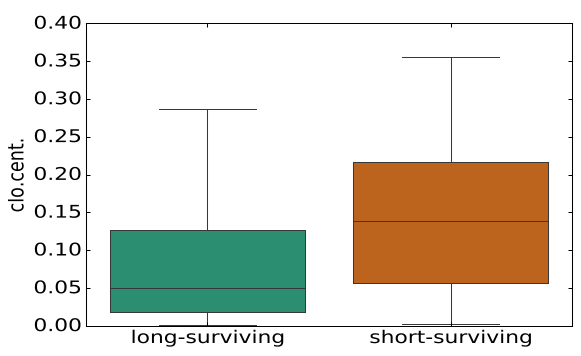 Fig 2. Comparative analysis of Density, Clustering, and Closeness Centralization between long-surviving and short-surviving communities.
Predictive Power: Can Machines Foresee Community Death?
Using Random Forest classifiers, the study achieved significant results in predicting death (the bottom 25% of lifespan).
- Survival Prediction: The "Full" model (Network + Activity) significantly outperformed activity-only models.
- Growth Prediction: Almost no model could significantly beat a random guess.
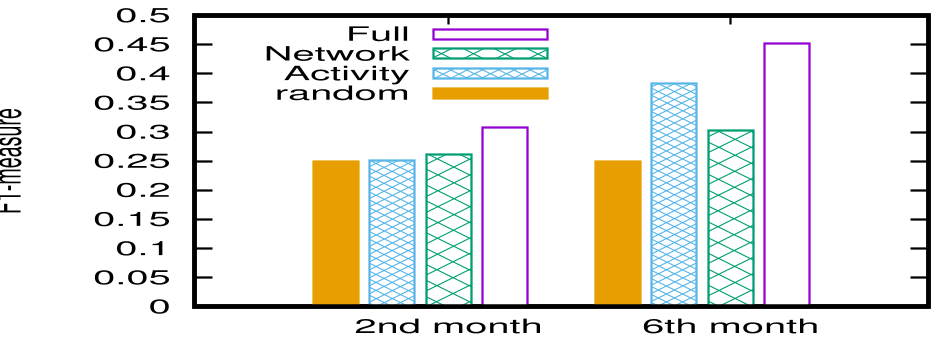 Fig 3. F1-measures for survival prediction show that structural network features provide vital information that raw activity counts miss.
Critical Insight & Practical Takeaway
The most striking takeaway for community practitioners is the "Density Trap." We often assume that the more everyone talks to everyone else (High Density/Clustering), the stronger the group. This data suggests the opposite for Reddit: high density in the early stages often leads to quicker dissolution.
The Secret Sauce? Build "small worlds" within your community. Encourage subgroups and decentralized leadership. If your community is just one big tightly-knit clique, it might feel successful today, but it lacks the structural resilience to survive tomorrow.
Future Work & Limitations
The study admits to being a "snapshot" analysis of the 2nd and 6th months. Future research should look at Temporal Dynamics—the "motion picture" of how these networks shift right before a community thrives or dies. Additionally, incorporating NLP (Natural Language Processing) to see how the tone of these interactions matches the shape of the network could provide the next level of predictive accuracy.