
Social Network Architecture: The Hidden Trade-off Between Wealth and Well-being
Social network structure and the trade-off between social utility and economic performance ଝ
This paper introduces a computational multi-agent model based on the Watts-Strogatz network structure to analyze the impact of social capital—categorized into degree, centrality, bridging, and bonding—on economic performance and social utility. The study identifies a fundamental trade-off between economic output and social well-being driven by the density and nature of social ties.
TL;DR
Is a highly connected society always a better one? This research utilizes a sophisticated multi-agent computational model to prove that while dense, diverse networks maximize economic performance, they often erode the "social utility" derived from close-knit family ties. The study identifies Small World networks as the optimal compromise for human societies that value both prosperity and emotional support.
Problem & Motivation: The "Amoral Familism" Dilemma
For decades, sociologists like Putnam and Fukuyama have observed a curious phenomenon: why are some regions (like Northern Italy) economically vibrant while others (like Southern Italy) remain stagnant despite having strong social bonds?
The root cause often cited is "amoral familism"—a state where individuals are so dedicated to their family (bonding social capital) that they distrust and refuse to cooperate with outsiders (bridging social capital). However, these theories remained largely qualitative. This paper seeks to quantify these "invisible" social forces using a computational multi-agent model, bridging the gap between sociological intuition and economic mathematics.
Methodology: Simulating Society in a Circle
The researchers utilize a Watts-Strogatz network where agents are positioned on a circle. Key variables include:
- r (Radius): Determines network density.
- p (Rewiring Probability): Controls the transition from local cliques to random, inclusive networks.
- : Represents the share of cliques that are family-based.
The model treats economic interaction as a Prisoner's Dilemma. Trust is the gatekeeper: if you don't trust someone, you don't interact. If you do interact, the "payoff" is higher if the person is different from you (bridging capital), but the "security" is higher if they are like you (bonding capital).
 Figure 1: Conceptual framework linking social network structure to ultimate socio-economic outcomes.
The Core Discovery: The ∩-Shaped Curve of Happiness
The most striking result of the simulation is the divergent paths of Economic Performance (EU) and Social Utility (SU):
- Economic Performance grows linearly with density () and randomness (). Put simply: more connections and more "stranger" interactions lead to more wealth.
- Social Utility, however, follows a -shaped relationship with density. It peaks at (roughly 6 close acquaintances). Beyond this "Dunbar’s Number" limit, adding more social ties actually decreases aggregate social utility.
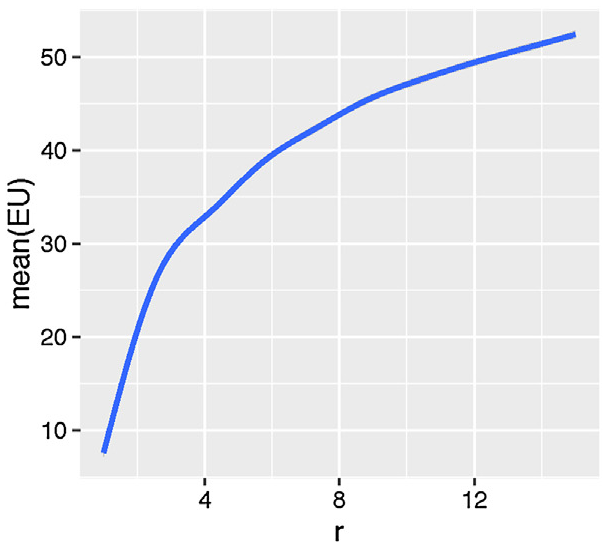 Figure 2: Impact of network density (r) and rewiring (p) on economic performance.
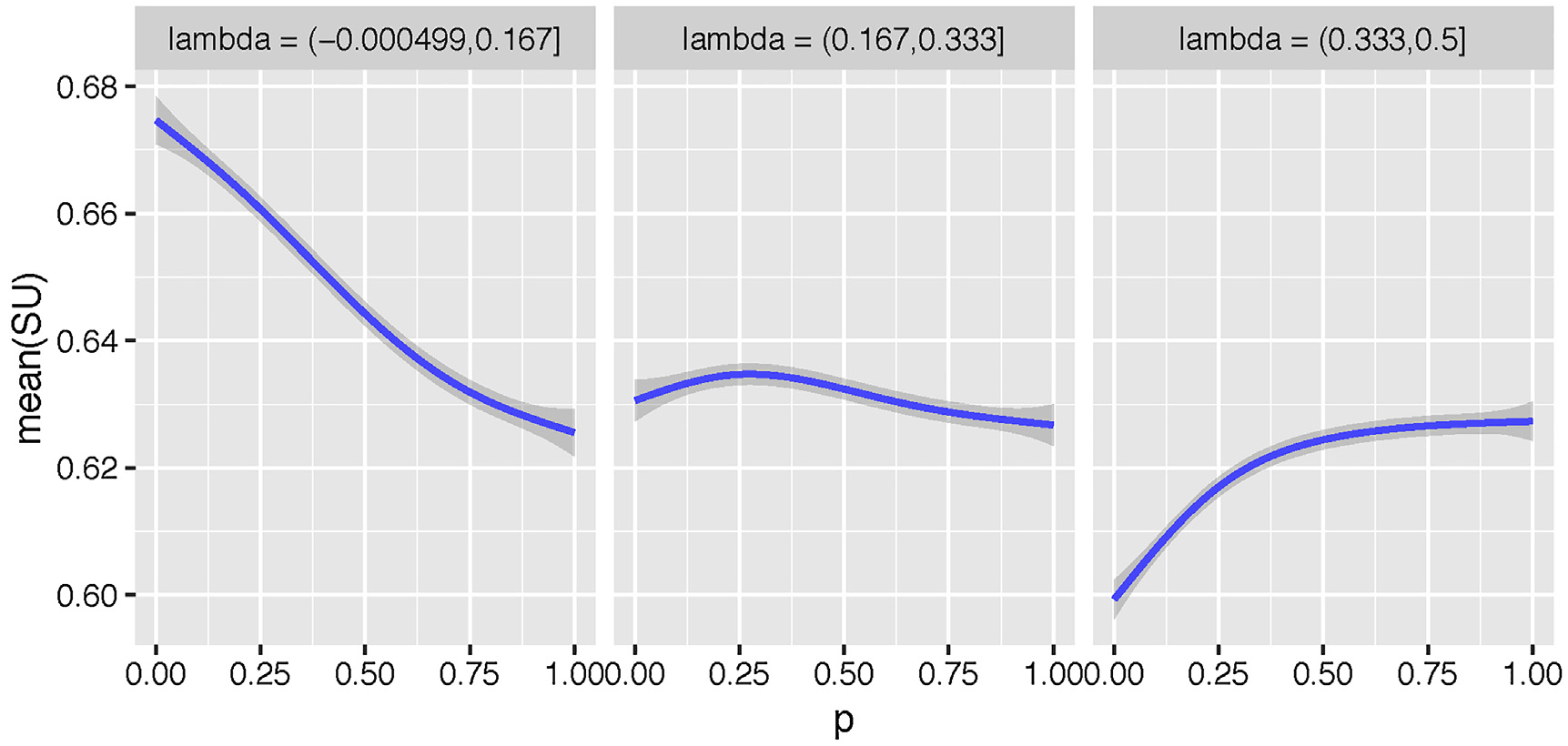 Figure 3: The non-linear impact on Social Utility, showing the peak at low density.
Experiments & Results: Why "Small Worlds" Win
The study finds that in societies where family ties are highly valued (high ), there is a harsh trade-off. You can have a high-growth, high-trust "inclusive" society (high ), or a high-bonding, family-centric society (low ).
Small World networks (moderate ) function as the "Goldilocks zone." They provide enough local clustering to satisfy the human need for deep, family-based emotional support, while maintaining enough "long-range shortcuts" to allow for the flow of information and economic opportunity.
Critical Analysis & Conclusion
Takeaway
The paper confirms that social trust is a functional substitute for social networks. In highly trustful societies, individual ties matter less because the "system" works. In distrustful societies, your specific network is your only lifeline.
Limitations
The model is static; it does not allow agents to dynamically form or dissolve ties based on experience (e.g., "unfriending" someone who defects in the Prisoner's Dilemma).
Future Outlook
The authors suggest that future research should focus on dynamic network formation. As digital social networks (like LinkedIn vs. Facebook) begin to reshape these and parameters in real-time, understanding the trade-off between our "economic" and "social" selves becomes a matter of national policy, not just academic curiosity.