
The Social Architecture of Care: Why Less Hierarchy Leads to Better Diabetes Outcomes
Social Network Structures of Primary Health Care Teams Associated with Health Outcomes in Alcohol Drinkers with Diabetes
This study utilizes Social Network Analysis (SNA) to evaluate how instrumental and expressive tie structures within primary care teams influence the health outcomes of diabetic patients who consume alcohol. The research identifies that less hierarchical, more densely connected face-to-face networks correlate with significantly improved glycemic control (HbA1c), LDL cholesterol, and blood pressure levels.
TL;DR
Can the way a doctor talks to a medical assistant over coffee actually lower a patient's blood sugar? This study says yes. By analyzing the social networks of primary care teams, researchers found that less hierarchical, face-to-face-heavy social structures result in significantly better biometric outcomes (HbA1c, LDL, and BP) for diabetic patients who consume alcohol.
Background: Beyond Clinical Protocols
Diabetes care, particularly for patients who consume alcohol, is notoriously difficult to manage. While most research focuses on medication or patient behavior, this study shifts the lens toward the Primary Care (PC) team. The authors argue that the "Care Team" is a social organism, and its internal architecture—how information flows and how emotional support is exchanged—is a primary driver of clinical success.
Problem: The "Black Box" of Team Dynamics
While we know primary care is essential (treating 85% of diabetes patients), we haven't historically understood the causal pathways between team interactions and patient biology. Previous work often overlooked the difference between Instrumental Ties (task-based info) and Expressive Ties (trust and friendship). This study seeks to "crack the code" of these interactions using Social Network Analysis (SNA).
Methodology: Mapping the Human Network
The researchers conducted intensive 30-minute face-to-face interviews with 110 health professionals. They focused on three key network parameters:
- Density: How interconnected is everyone?
- Transitivity (3-tie closures): Does "A" talk to "B", "B" talk to "C", AND "A" talk to "C"? High transitivity indicates an egalitarian, non-hierarchical "triadic" structure.
- Centralization: Is all communication bottlenecked through one leader (usually the physician)?
The study then linked these social maps to actual Electronic Health Record (EHR) data for patients, looking at the percentage of the team's panel that met clinical targets for HbA1c, LDL, and Blood Pressure.
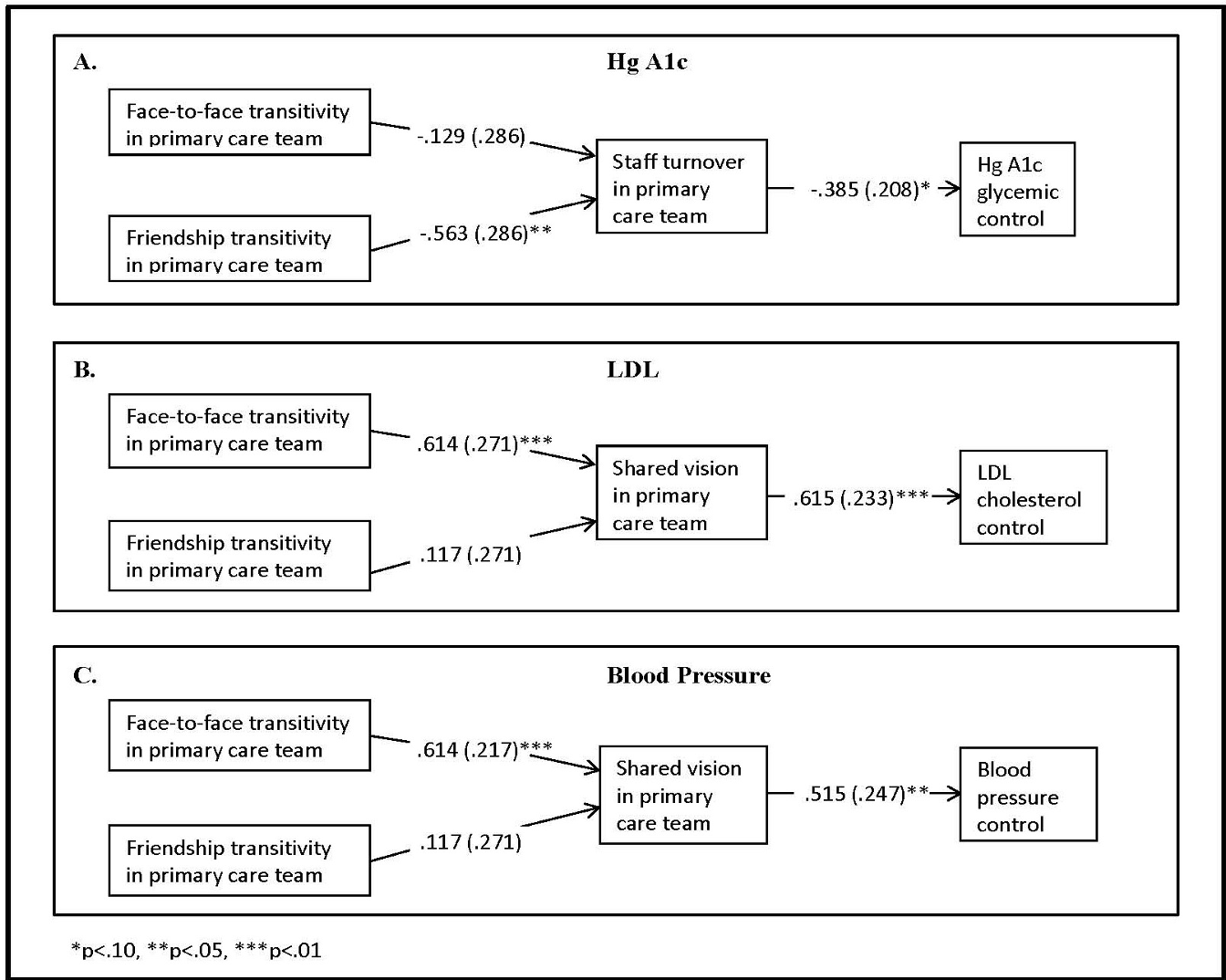 Above: The Structural Equation Modeling (SEM) shows how friendship and face-to-face transitivity drive outcomes through mediators like reduced staff turnover and shared vision.
Key Insights and Results
1. The "Egalitarian Premium"
Teams that were less hierarchical (lower centralization) had patients with better-controlled biometric measures. When medical assistants, receptionists, and nurses feel empowered to communicate directly within the network, the "Shared Vision" of the team improves, leading to higher quality care.
2. The Electronic Paradox
One of the most striking findings was that high electronic communication density (email/EMR) was associated with POORER HbA1c control. The authors posit that electronic communication is "lean"—it lacks the nuance, non-verbal cues, and immediate feedback of face-to-face interaction, which are crucial for complex patient cases.
3. Friendship as a Clinical Tool
Expressive ties (friendship and emotional support) were not just "nice to have." They directly correlated with reduced staff turnover. In clinics where staff felt they were working with friends, turnover was lower, ensuring continuity of care—a critical factor for chronic disease management.
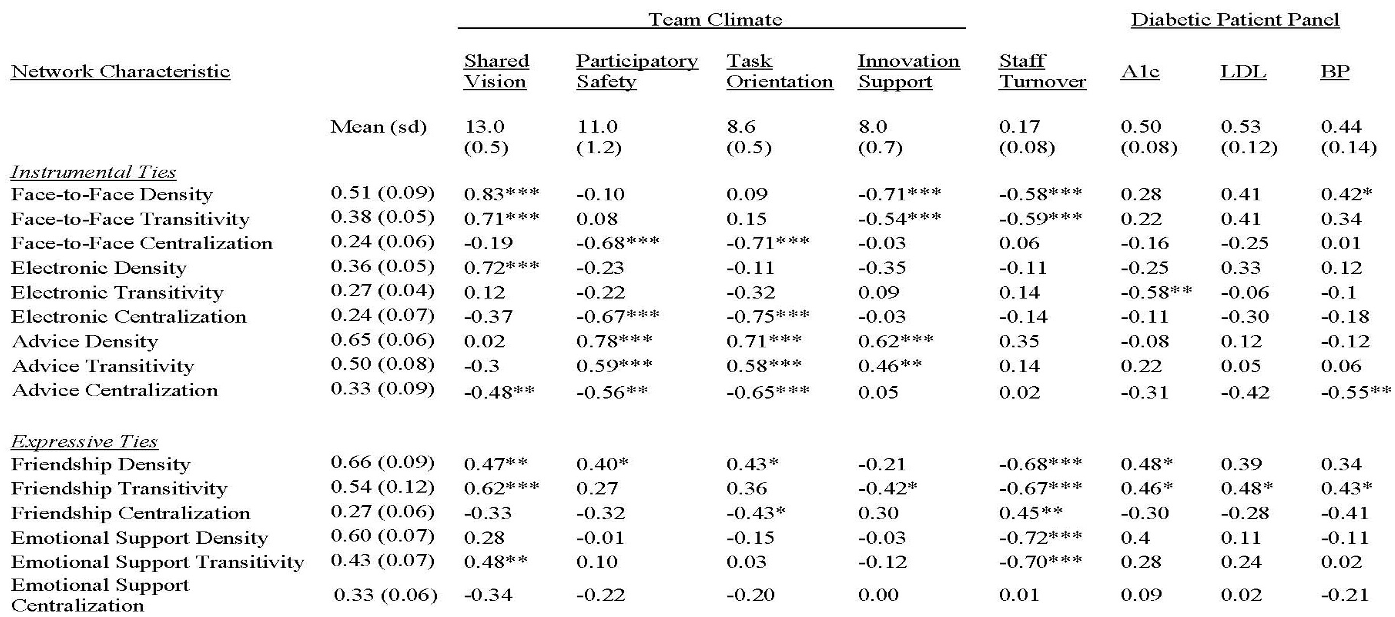 This table highlights the strong positive correlations (**) between face-to-face density and shared vision, and the negative correlations with staff turnover.*
Critical Analysis & Conclusion
This paper provides empirical evidence for what many clinicians feel intuitively: a "happy" or "tight-knit" team produces better medicine.
Takeaway: To improve diabetic outcomes, healthcare administrators should focus less on digital dashboards and more on creating physical spaces for face-to-face interaction and fostering an egalitarian culture that breaks down the rigid physician-at-the-top hierarchy.
Limitations: The study is a pilot with a small sample size (n=20 teams). It doesn't adjust for patient-level socio-economics, which might influence biometric success regardless of the team's social structure.
Future Outlook: As we move toward AI-driven healthcare, this research serves as a reminder that the human social network remains the most powerful "algorithm" for managing complex, long-term patient health.