
Beyond the Linear Lecture: Re-Engineering Open Learning through Social Topology and Multimedia
Uses of social network topology and network-integrated multimedia for designing a large-scale open learning system: case studies of unsupervised featured learning platform Design in South Korea
This paper explores the design of Large-scale Open Learning Systems (OLS) for unsupervised learning by integrating social network topology and network-integrated multimedia. It highlights two South Korean case studies, NOOC and GMOOC, demonstrating how diverse network models can achieve higher learner retention and engagement in informal education.
TL;DR
The traditional MOOC era is hitting a stalemate, characterized by static content and low interaction. This paper proposes a radical shift: designing Open Learning Systems (OLS) using Social Network Topology and Network-Integrated Multimedia. By analyzing South Korean case studies like NOOC and GMOOC, the research demonstrates how non-linear, unsupervised learning environments can be scaled effectively by mimicking natural social structures (like small-world and scale-free networks).
The Stalemate of Modern MOOCs
Despite the global reach of platforms like edX and Coursera, the authors argue that the "instruction and delivery format have not kept pace" with technology. Most current systems are Centralized, mimicking the industry-era classroom:
- Static Content: Reliance on simple video lectures and multiple-choice quizzes.
- Hierarchical Bottlenecks: Learning is measured by "seat-time" rather than social integration.
- Rigid Architecture: Lack of support for "meta-literacy"—the ability to make sense of information through crowdsourcing and collective intelligence.
The Core Insight: Learning as a Network Topology
The paper’s breakthrough lies in treating a learning platform not as a website, but as a topology. Different learning goals require different network "shapes" to succeed:
1. The Scale-Free Network (The NOOC Model)
The Nano Open Online Course (NOOC) was designed for civic education. It employs a Scale-Free network, where a few highly connected hubs (like Facebook or Google community spaces) allow the network to expand infinitely (Power-Law distribution). This is ideal for meta-literacy and global participation.
2. The Small-World Effect (The GMOOC Model)
The Genesis Project (GMOOC) aimed to connect 13 million citizens in Gyunggi Province. It utilizes the Small-World effect, ensuring that any learner can reach any other learner or expert in a few steps, facilitating rapid problem-solving and community formation.
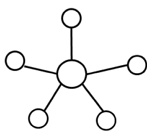 Figure: Various Social Learning Network Models including Decentralized, Hierarchical, and Modularized structures.
Methodology: Qualitative Interpretive Meta-synthesis (QIMS)
To derive these models, the authors used QIMS, a method aimed at aggregating findings from diverse qualitative studies to form a grounded theory. This allowed them to cross-correlate concepts like:
- Distributed Learning: Breaking content into manageable "chunks" to avoid data transfer overloading while supporting personalized "Small Private Online Courses" (SPOCs).
- Network-Integrated Multimedia: No longer just "embedding video," but a unified system where digital communication devices (SNS, Web-casting, Hypermedia) work in a shareable processing flow.
Experimental Proof: Case Studies from South Korea
The research highlights two distinct architectural successes:
| Feature | NOOC (Kyung Hee Cyber University) | GMOOC (Gyunggi Province) |
|---|---|---|
| Primary Goal | Global Citizenship Education (GCED) | Lifelong Learning / Civic Engagement |
| Network Model | Scale-Free (expanding to Nth degree) | Small-World (Hierarchical + Modular) |
| Key Outcome | Cultural adaptability via meta-literacy | Business Intelligence (BI) for public opinion |
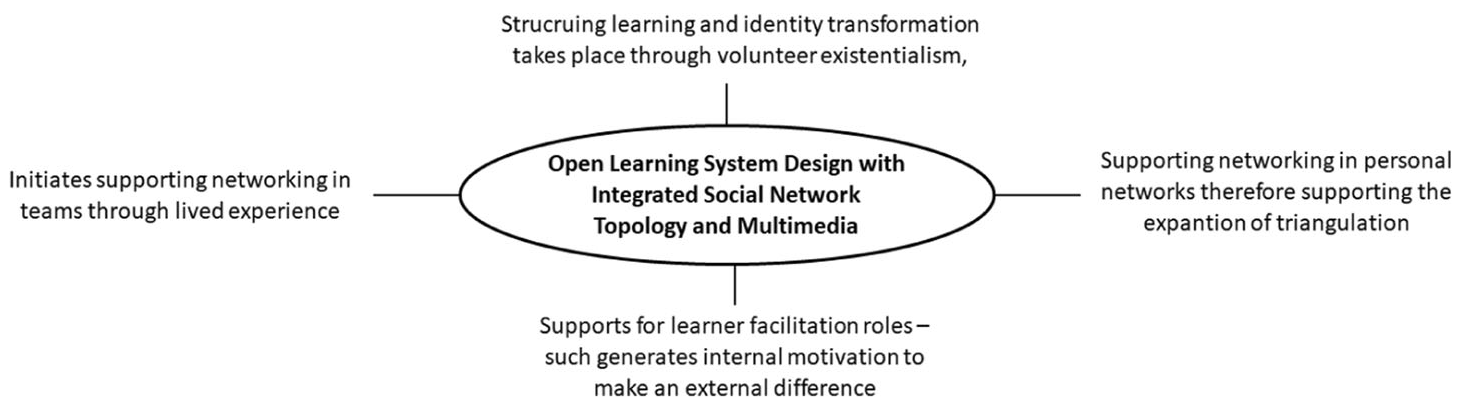 Figure: The interaction between learning facilitation, network formation, and identity transformation.
Critical Analysis & Future Outlook
The paper concludes that simply "putting a course online" is no longer enough. The human-interaction element must be engineered into the platform's very architecture.
Limitations: The study notes that unsupervised learning platforms are still "uncharted territory" and often struggle with assessing individual performance in a crowd-sourced environment.
Future Work: The authors suggest the next frontier is "optimal learning network design for mixed cultures," addressing how different social topologies handle competing cultural conflicts during knowledge acquisition.