
Beyond Blind Voting: Solving Information Cascading in Vehicular Networks
A social network approach to trust management in VANETs
This paper introduces a social-network-inspired approach to trust management in Vehicular Ad Hoc Networks (VANETs). It proposes a novel weighted voting scheme designed to counter "information cascading" and "oversampling" by prioritizing firsthand observations over multi-hop recommendations.
TL;DR
Vehicular Ad Hoc Networks (VANETs) are high-stakes environments where a false "emergency" message can cause real-world accidents. This paper identifies two critical vulnerabilities borrowed from social network theory—Information Cascading and Oversampling—and proposes a weighted voting algorithm that prioritizes physical proximity to events over digital hearsay.
Background: Why VANETs are a Security Nightmare
Traditional Mobile Ad Hoc Networks (MANETs) rely on building long-term reputations. If Node A consistently forwards packets correctly, Node B learns to trust it. In VANETs, however, cars pass each other at 150 km/h. By the time you've determined a neighbor is "trustworthy," they are already out of range.
The authors argue that we shouldn't trust nodes; we should trust data. Yet, current information-oriented models rely on majority voting, which is easily gamed.
The "Digital Echo Chamber": Cascading and Oversampling
The core insight of this paper is the application of social network phenomena to traffic safety:
- Information Cascading: Occurs when a node ignores its own observations because the "majority" (even if wrong) suggests otherwise.
- Oversampling: Occurs when one malicious opinion is repeated by multiple relays. If Node D hears from Node B and Node C, but C was just repeating B, B’s opinion is effectively counted twice.
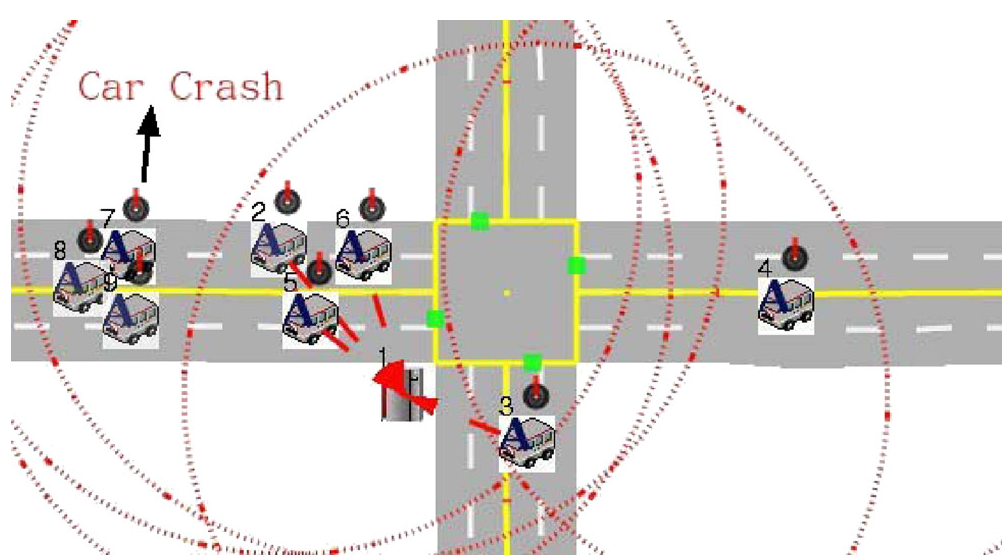 Figure 1: A scenario where a malicious intermediate node (Node 3) can cause a wrong decision to cascade to trailing vehicles (Node 4).
Methodology: The Weighted Distance Decay
To solve this, the authors propose a Hop-Count Weighted Voting mechanism. Every message carries a hop-count from the original event.
The decision metric for a vehicle is calculated as:
Where is a weight factor. If , a relay's opinion is only half as important as a witness's. If , the system completely ignores "hearsay" and only listens to direct observers.
Experimental Results
Using the NCTUns simulator with 35 vehicles at a road intersection, the researchers tested varying values of .
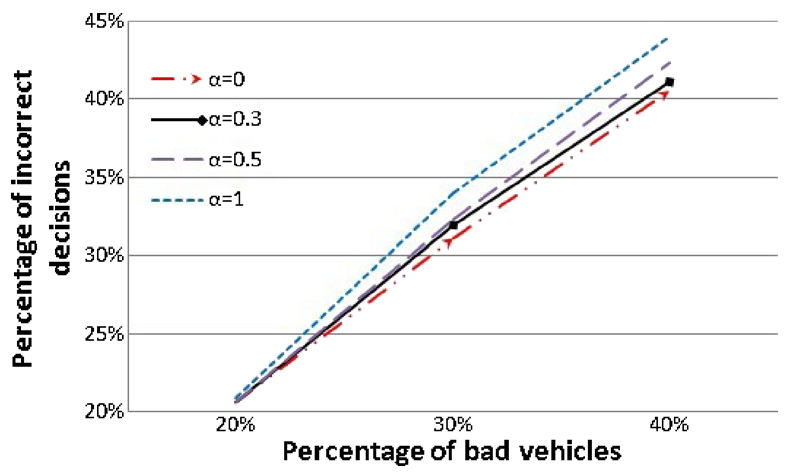 Figure 2: Voting correctness peaks as approaches zero.
Key Findings:
- Lower is Better: The performance significantly improves as the weight of intermediate nodes decreases.
- The Firsthand Advantage: Relying solely on the original observers (Mechanism 1) outperformed any combination of relay-based voting.
- Resilience: The weighted scheme successfully prevented a single malicious relay from tricking the followers.
Critical Insight & Conclusion
This work highlights a counter-intuitive truth in network security: more information is not always better. In ephemeral networks like VANETs, "crowd wisdom" can quickly turn into "crowd manipulation." By introducing a physical-logical constraint (distance-based weight), the authors provide a lightweight but mathematically sound defense against collaborative attacks.
Future Outlook: The next step for this research is addressing Transmission Delay. In real-world high-speed scenarios, waiting for enough votes to achieve "correctness" might result in a decision that arrives after the accident has already occurred.