
Deciphering the Digital Pulse: What Actually Keeps Social Network Users Alive?
Social network user lifetime
This paper presents a pioneering study on the "lifetime" of Online Social Network (OSN) users by analyzing data from the Buzznet platform. It differentiates between active lifetime (participation) and passive lifetime (consumption/voyeurism), identifying social graph properties and interaction patterns that predict user retention and churn.
TL;DR
Why do some social media users stay for years while others vanish after 24 hours? This study analyzes the "User Lifetime" on the Buzznet platform, revealing that popularity (in-degree) and receiving messages during a "critical early window" are the strongest predictors of retention. Interestingly, following celebrities actually correlates with shorter lifetimes compared to interacting with "normal" peers.
Context: Beyond the Social Graph
In the mid-to-late 2000s, the academic focus reflected the explosive growth of OSNs, yet churn remained a silent killer—40% of Twitter accounts were inactive even then. This paper shifts the perspective from static snapshots of who-knows-whom to a temporal analysis of Active vs. Passive Lifetime.
The "Voyeur" Problem: Active vs. Passive Existence
One of the study's most profound insights is the distinction between what a user does and what a user sees.
- Active Lifetime: The span between account creation and the last sent message/photo.
- Passive Lifetime: The span until the user truly stops logging in.
The authors confirm the "90-9-1 rule" intuition: users are mostly voyeurs. However, they found that Active Lifetime is a surprisingly good proxy for Total Lifetime for 70% of users. If they stop posting, they usually stop looking shortly thereafter.
Methodology: Testing the Social Life-Support System
The researchers executed a BFS-based crawl of Buzznet's Largest Connected Component (LCC), capturing 750,000 users and 9 million edges. They tested several hypotheses regarding what extends a user's "life."
1. The Popularity Paradox
Does having more friends make you stay longer?
- The Finding: Yes, but only up to a point. For the "99%" of users, the correlation between In-Degree and Lifetime is a staggering 0.94.
- The Twist: For "Celebrities" (top 0.01%), the relationship breaks down. Influence doesn't necessarily equate to platform loyalty in the same linear fashion.
2. The Danger of "Pure Fans"
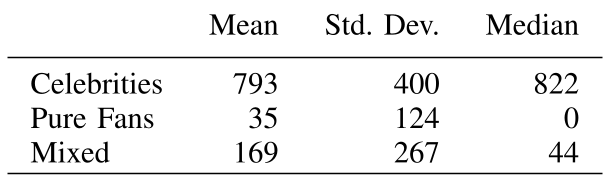
The study categorized users into Celebrities, Mixed Users, and Pure Fans (those who only follow celebrities).
- Insight: Pure Fans have the shortest lifetimes. Social networks built solely on a "follow the star" model are inherently brittle compared to those fostering "Mixed" peer-to-peer connections.
The "Critical Period" of Engagement
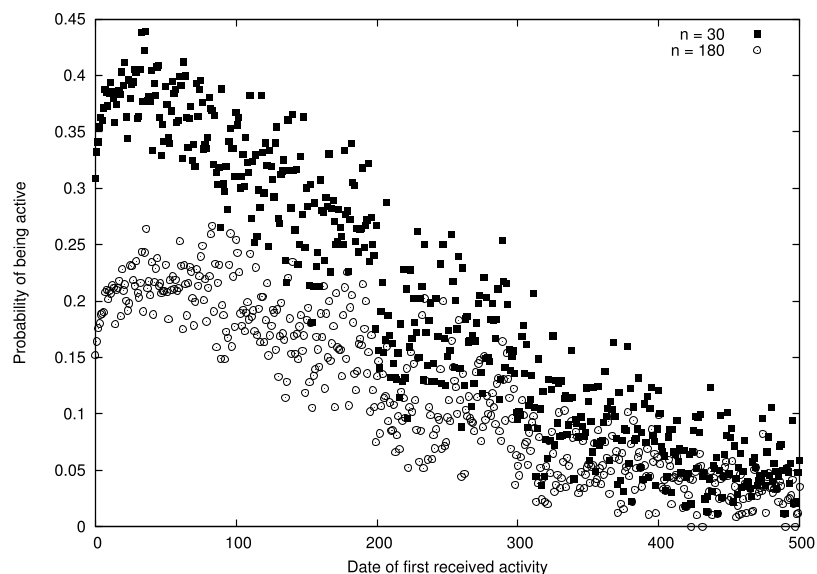
The data suggests a "Golden Window" for new users. If a user receives their first interaction (a comment or note) shortly after joining, their probability of staying active 180 days later skyrockets. If that first interaction is delayed by just 30 days, their "survival probability" drops significantly.
Critical Analysis & Recommendations
The paper concludes with actionable intelligence for OSN architects:
- Don't just chase Celebrities: Luring stars is a marketing win but a retention loss if users don't find "normal" friends.
- Gamify the "First Reply": The system should practically force-feed interactions to new users to get them past the critical churn window.
- Encourage Feedback Loops: Because receiving activity (Hypothesis 5) is 0.58 correlated with longevity, a "Dead" user is often just someone who hasn't been spoken to recently.
Limitations
The study is focused on Buzznet, which lacks the algorithmic "For You" feeds that define modern TikTok or Meta platforms. In today's landscape, an algorithm might artificially extend "Passive Lifetime" even if social interaction (the paper's core focus) is zero.
Final Takeaway
Social networks are biological in nature: they require metabolic input (interactions) to stay alive. This paper proves that the most vital nutrient for a user's digital life isn't the content they post, but the response they receive from a peer.