
RACI: Reimagining Academic Collaboration through Social Intelligence
Platform to supports learning based on Social Network, Web Intelligence and CSCL
This paper introduces RACI (Red Académica Colaborativa Institucional), a collaborative learning platform that integrates Social Network dynamics, Web Intelligence, and Computer-Supported Collaborative Learning (CSCL). Targeted at the academic community of BUAP, it leverages tag-based organization and shared workspaces to foster autonomous, group-based knowledge acquisition.
TL;DR
The paper introduces RACI, an innovative academic platform designed to move beyond the "passive" nature of traditional LMS (Learning Management Systems). By merging the viral engagement of Social Networks, the automated filtering of Web Intelligence, and the pedagogical foundations of CSCL, RACI creates a student-led ecosystem where knowledge is organized via collaborative tagging (folksonomies) rather than rigid administrative hierarchies.
Problem & Motivation: The "Passive" LMS Trap
Despite the ubiquity of platforms like Moodle and Blackboard, the authors argue that these tools often feel like digital filing cabinets rather than vibrant communities.
- The Disconnect: Theoretical pedagogical models (CSCL) are often poorly implemented in software, leading to "passive" participation where students only interact when prompted by an assignment.
- The Fragmentation: Because current tools don't adapt to student behavior, users frequently "flee" to external social networks to discuss academic problems, losing the structured context of the curriculum.
The authors' Insight is simple but powerful: If we treat an academic course as a dynamic social network where data is "intelligence-driven" and interaction is "autonomous," we can foster a more natural "learning-by-sharing" environment.
Methodology: The Three Pillars of RACI
The RACI architecture is built upon three distinct technical domains:
- Social Network (Community Nodes): In RACI, nodes are agents (students/professors) and edges represent academic relationships. Unlike traditional systems, students are given the autonomy to create groups and manage information, mirroring the psychological comfort of platforms like Facebook.
- Web Intelligence (The Filtering Layer): To prevent information overload, RACI utilizes "Aggregated Content" and "Reference Structures." It employs Folksonomies—a collaborative classification system where users tag content. Intelligent algorithms can then surface relevant excerpts or documents based on what a user is currently typing or researching.
- CSCL (The Pedagogical Goal): The platform implements "Learning-by-Interacting" through a suite of integrated tools including messaging, file sharing, blogs, and forums, all organized around group-specific interests.
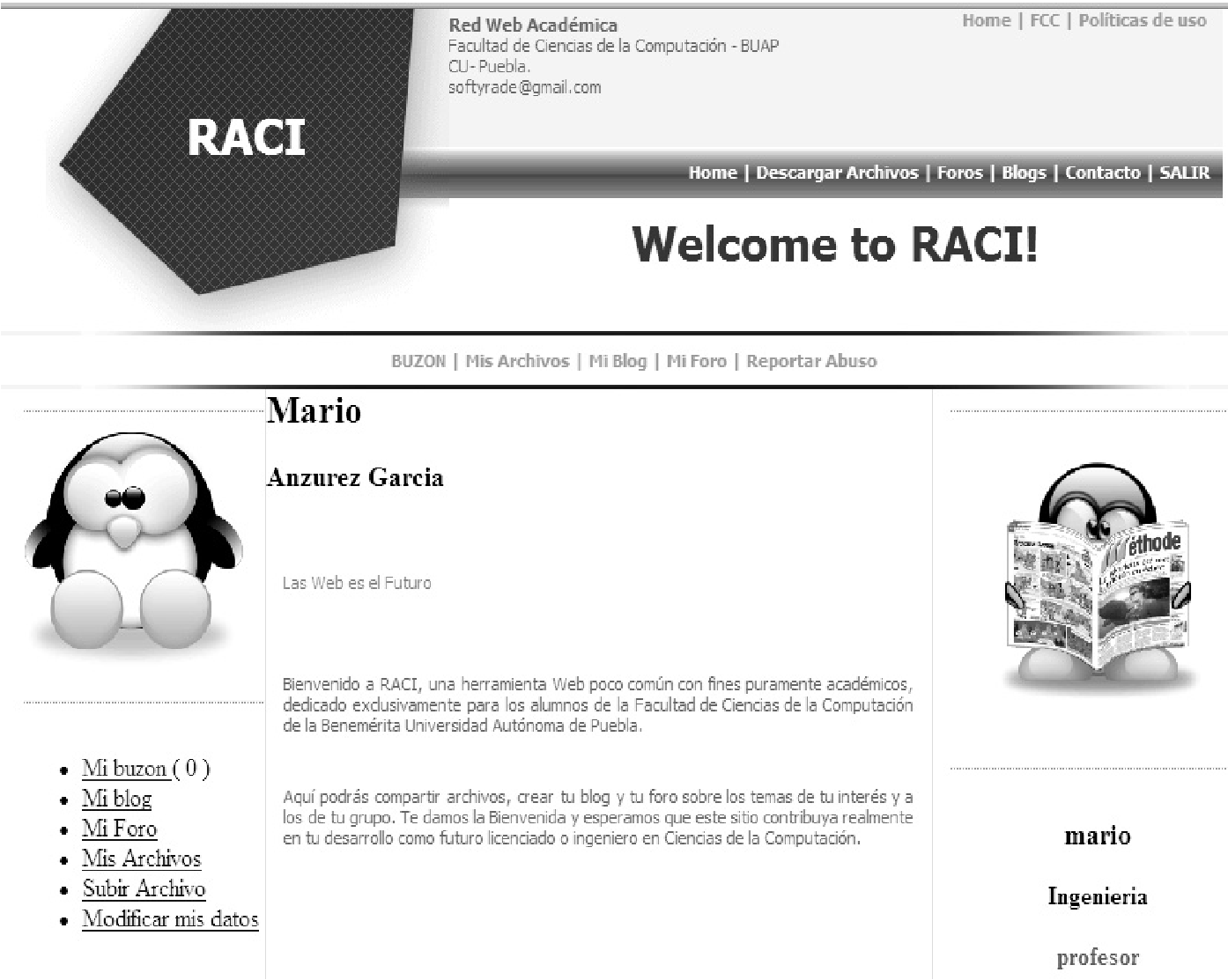 Figure 1: The RACI interface, demonstrating the integration of social tools (Blogs/Forums) with academic resource management.
Experiments & Results: Outperforming the Giants
Tested at the Facultad de Ciencias de la Computación (FCC) at BUAP, RACI was implemented across three groups ranging from 12 to 45 students.
- User Preference: Students who were already experienced with Moodle, WebCT, and Dokeos reported that RACI was significantly "easier to use."
- The Efficiency of Tags: By limiting the "user base" and "tag diversity" within specific interest groups (Zones), the platform successfully filtered out noise, allowing students to navigate reduced but highly relevant sets of resources.
- Autonomous Growth: The qualitative results indicated a shift from instructor-led learning to an "autodidactic" mode, where the initiative for knowledge exchange shifted to the students.
Critical Analysis & Conclusion
Takeaway
RACI proves that Academic Social Networks are not just for socializing; they are structured data environments. By decentralizing control and using Web Intelligence to manage the resulting data "messiness," we can create a more resilient learning ecosystem.
Limitations
- Scalability of Algorithms: While the paper mentions Web Intelligence, the specific complexity and performance metrics of the underlying algorithms used for document retrieval in a real-time sidebar are not fully quantified.
- Security/Privacy: As the authors admit, transitioning to a social-style network introduces privacy risks that traditional, closed-silo LMS systems handle more robustly.
Future Work
The next frontier for RACI involves Interoperability. The team plans to implement Web Services to allow RACI to talk to other institutional databases, potentially creating a "Global Academic Social Graph" that spans beyond a single university department.