
Socializing the Semantic Web: Leveraging Social Networks for Multi-Agent Ontology Negotiation
Social Networked Multi-agent Negotiation in Ontology Alignment
2012-12-01
Summary
Problem
Method
Results
Takeaways
Abstract
The paper proposes a decentralized, scalable multi-agent negotiation process for ontology alignment by integrating Social Network Analysis (SNA) with the Three-Layered Argumentation Framework (TLAF). It leverages underlying social network structures to manage agent communication, expert finding, and reputation management in heterogeneous data environments.
## TL;DR
Merging ontologies at scale is a notorious bottleneck for the Semantic Web. This paper introduces a **decentralized multi-agent framework** that uses **Social Network Analysis (SNA)** to coordinate negotiations. By treating agents as actors in a social graph, the system achieves scalability, identifies experts through network topology, and uses argumentation to reach consensus in a way that mirrors human social cooperation.
## Problem & Motivation: The Scalability Trap
As the Semantic Web expands, we are drowning in a sea of ontologies and micro-formats. Integration is difficult because of a "lack of consensus" between model builders. While Multi-Agent Systems (MAS) are a natural fit for this decentralized problem, they often break down when the number of agents reaches the thousands.
The authors argue that we are ignoring a crucial asset: **Social Awareness**. Humans cooperate effectively because of social structures—trust, expertise, and community ties. Yet, most agents negotiate in a vacuum, unaware of the "social world" that could guide their interactions.
## Methodology: A Three-Layered Approach
The authors propose a structured, layered model to organize agent behavior:
### 1. The Social Network Layer (The Foundation)
This layer abstracts the physical Peer-to-Peer (P2P) network. It extracts metadata from existing social sources (Facebook, LinkedIn) to build agent profiles.
* **Prominence**: Uses metrics like *betweenness centrality* to identify which agents are "hubs" of information.
* **Communities**: Uses clustering to group agents into loosely connected cohorts, managed by "brokers."
### 2. The Negotiation Layer (The Logic)
Instead of a rigid master-slave protocol, the paper employs the **Three-Layered Argumentation Framework (TLAF)**.
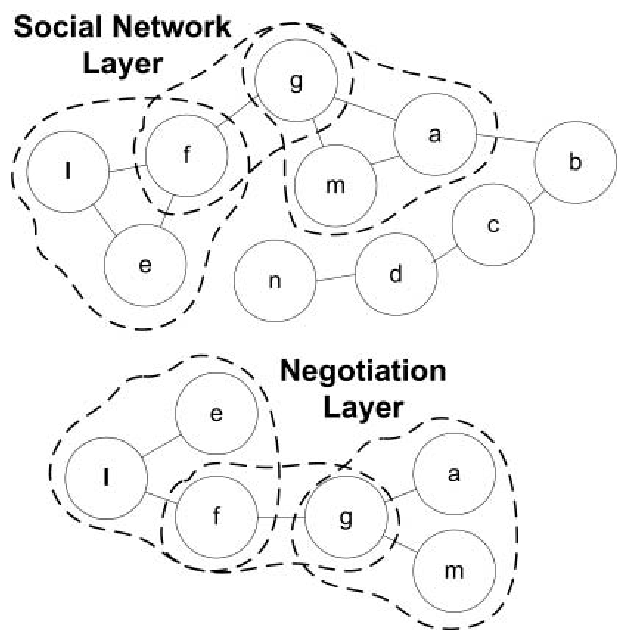
In this layer:
* Agents don't just "bid"; they **argue**.
* Arguments are weighted by the agent's **Reputation** and **Expertise**, which are calculated dynamically based on past interactions and their position in the social graph.
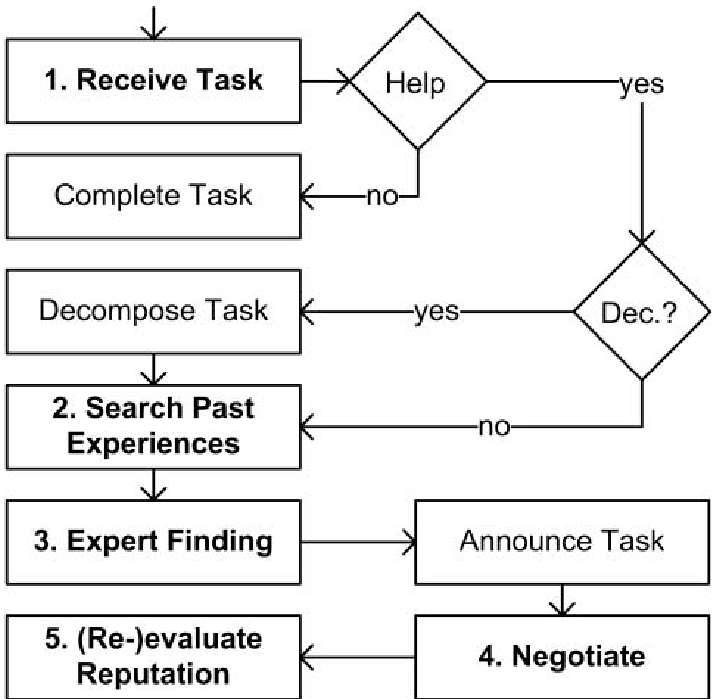
### 3. The Individual Agent Process
The workflow for an agent is iterative:
1. **Receive Task**: Decide whether to solve it alone or ask for help.
2. **Expert Finding**: Query the neighborhood to find agents with high "NodeRanking" (authority flooding).
3. **Negotiation**: Exchange arguments via the TLAF meta-model.
4. **Reputation Update**: Adjust neighbor trust scores based on whether their arguments aligned with the final group consensus.
## Experiments & Insights: The Power of SNA
The paper highlights several "Social Logic" insights that improve performance:
* **Homophily**: Agents tend to relate to similar individuals, which can be exploited to form specialized clusters for specific ontology domains (e.g., medical vs. financial).
* **Brokers vs. Outliers**: By identifying brokers, the system can bridge different ontology communities without overwhelming the entire network with gossip traffic.
* **Conflict as Data**: Reputation is not just a binary score; it's calculated by analyzing "tensions" and "balance" within a subset of agents. If an agent consistently contradicts the consensus, its relevance weight decreases.
## Critical Analysis & Conclusion
The core contribution of this work is the realization that **topology is information**. By utilizing the "Small World" nature of social networks, we can transform a global integration nightmare into a series of coordinated, manageable local negotiations.
**Takeaway**: Future AI systems shouldn't just be "smart" in isolation; they must be "socially intelligent" to navigate the decentralized data ecosystems of the future.
**Limitations**: The paper relies on the availability of social data and assumes that agents can accurately map their human counterpart's expertise. Real-world implementation would require robust privacy-preserving measures (like PeerSoN) to ensure agent metadata isn't exploited.
**Future Work**: The authors plan to test this against large-scale datasets to see how different network topologies (e.g., Scale-free vs. Random) affect the speed of ontology convergence.