
Smarter Product Design: Bridging Social Networking and Complex Human Behavior Modeling
Social Networking Applications: Smarter Product Design for Complex Human Behaviour Modeling
This paper proposes a Social Networking Systems Engineering (SNSE) framework designed to model complex human behavior for the development of "smarter products." It integrates soft computing techniques—such as fuzzy logic and neural networks—within traditional systems engineering lifecycles to enhance collaborative design and personalized user interaction.
TL;DR
This paper explores the convergence of Social Networking, Systems Engineering, and Soft Computing to redefine how we design "smarter" products. By treating social interaction as a data source and a collaborative tool, the authors propose a framework that better accounts for the unpredictable nature of human behavior, ensuring products are context-aware, proactive, and self-organizing.
Background: The Shift to "Smartness"
In the modern tech ecosystem, "smartness" is no longer just about automation; it’s about anticipation. The paper positions smart products as entities capable of predicting business errors and adapting to human inhabitants to improve their experience. This requires a shift from rigid, "hard" computing to "soft" computing methodologies that tolerate the messy, imprecise reality of human social dynamics.
The Pain Point: The "Human" Gap in Systems Engineering
Traditional Systems Engineering (SE) is a top-down, hierarchical decomposition of requirements. While effective for mechanical or software reliability, it struggle with:
- Human Uncertainty: Traditional ML assumes logic that doesn't account for cultural or behavioral variability.
- Complexity Opaque: Issues in human-system interaction often go undetected because they are too "obscure" or "inter-related" for standard audit trails.
- Passive Learning: Educational and design environments often treat users as passive observers rather than engaged collaborators.
Methodology: Social Networking meets Soft Computing
The authors propose a Social Networking Systems Engineering approach. The core intuition is to leverage the "Digital Native" preference for interactive, social environments to fuel the design process.
1. The Soft Computing Layer
To handle human imprecision, the framework suggests:
- Fuzzy Logic: To mimic human decision-making and infer user goals.
- Neural Networks: To represent common characteristics and define complex "user stereotypes."
- Neuro-Fuzzy Systems: To capture and tune expert knowledge for better behavioral assumptions.
2. The Architectural Interaction
The paper emphasizes two critical interaction types:
- p2u (Product to User): Focused on simplicity and natural interfaces.
- p2p (Product to Product): Focused on self-organization through semantic web services, allowing products to form autonomous networks.
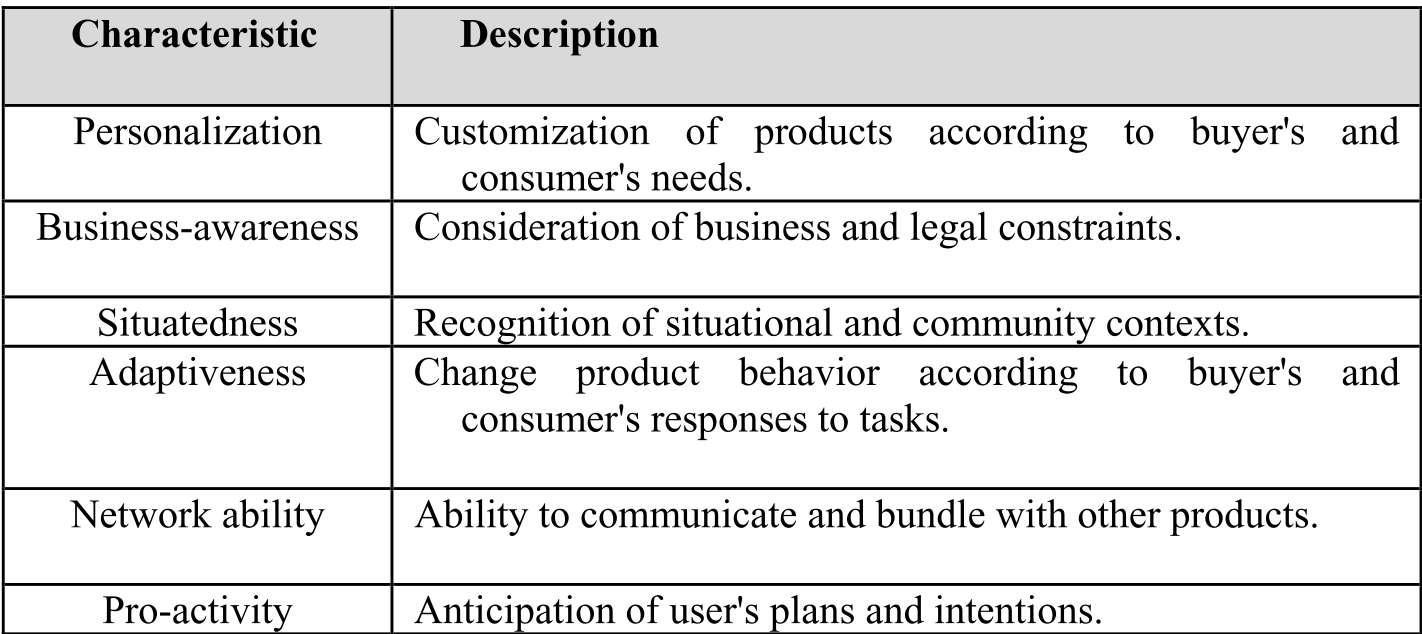 The table above outlines the six pillars of smart products, highlighting 'Pro-activity' and 'Situatedness' as key differentiators from traditional electronics.
3. Collaborative Design via Social Tools
By using blogging paradigms and "wiki-style" collaboration, design groups can move from siloed engineering to a transparent, "peer-reviewed" developmental model. This facilitates "knowledge retention" and mirrors the way digital natives naturally process information.
Human Systems Integration (HSI) and DOORS
A key takeaway is the use of requirement management tools like Rational DOORS. This application allows designers to link specific human behavior requirements to sub-requirements, ensuring that "human considerations" remain prominent throughout the total system lifecycle.
 Figure 1: Using DOORS to track and link complex requirements in a hierarchical order, facilitating traceability for human factors.
Critical Insights & Conclusion
The value of this research lies in its interdisciplinary bridge. It suggests that the future of UI/UX and product design isn't found in better hardware, but in better behavioral modeling.
Limitations: While the framework is conceptually robust, the paper relies heavily on qualitative synthesis. Future implementations would benefit from large-scale data mining of social media interactions to validate the "Soft Computing" models in real-time.
Final Takeaway: Social networks aren't just for socializing—they are the ultimate laboratory for understanding the "human" requirement in the next generation of smart service systems.