
Tag!t: Mining Video Semantics through the Lens of Social Interaction
Using Social Networking and Collections to Enable Video Semantics Acquisition
The paper introduces Tag!t, a social networking application integrated with Facebook that harvests video semantics through collaborative tagging and user interaction monitoring. By leveraging social group dynamics and public APIs (YouTube, Flickr), it enables the acquisition of temporal and collection-based metadata to enhance video search and repurposing.
TL;DR
Researchers from the University of Wollongong and RMIT have developed Tag!t, a system that transforms passive video viewing into a rich semantic data stream. By embedding video tools within social networks like Facebook, they capture not just what a video is about, but when specific emotions occur and how different social circles (e.g., engineers vs. the general public) interpret the same content differently.
The "Tagging Gap": Why Search Engines Still Struggle with Video
Most video search today relies on "Object Tagging"—a few keywords like #cat or #funny applied to an entire 10-minute file. This approach is shallow. It ignores the temporal dimension (where exactly does the cat appear?) and the subjective dimension (one person’s "funny" is another’s "annoying").
The authors argue that the missing link is Social Context. We don't just watch videos in a vacuum; we watch them within tribes. Tag!t aims to capture the "wisdom of the crowd" by observing how social groups interact with media in real-time.
Methodology: The Four Pillars of Video Semantics
The Tag!t system extracts metadata through four distinct channels:
- Collection Semantics: Analyzing how users group videos into playlists (e.g., putting a clip into a folder named "Stop Motion" provides high-level classification).
- Temporal Tagging: Providing a "one-click" interface for users to drop "emotitags" (emotions) or object tags at specific timestamps.
- User Behavioral Semantics: Implicitly tracking when users pause, skip, or re-watch segments. A "skip" is a strong semantic signal for "boring" or "irrelevant."
- Linked Content: Tracking what users search for while watching a specific scene (e.g., searching for "Original Nintendo" during a "Human Tetris" video).
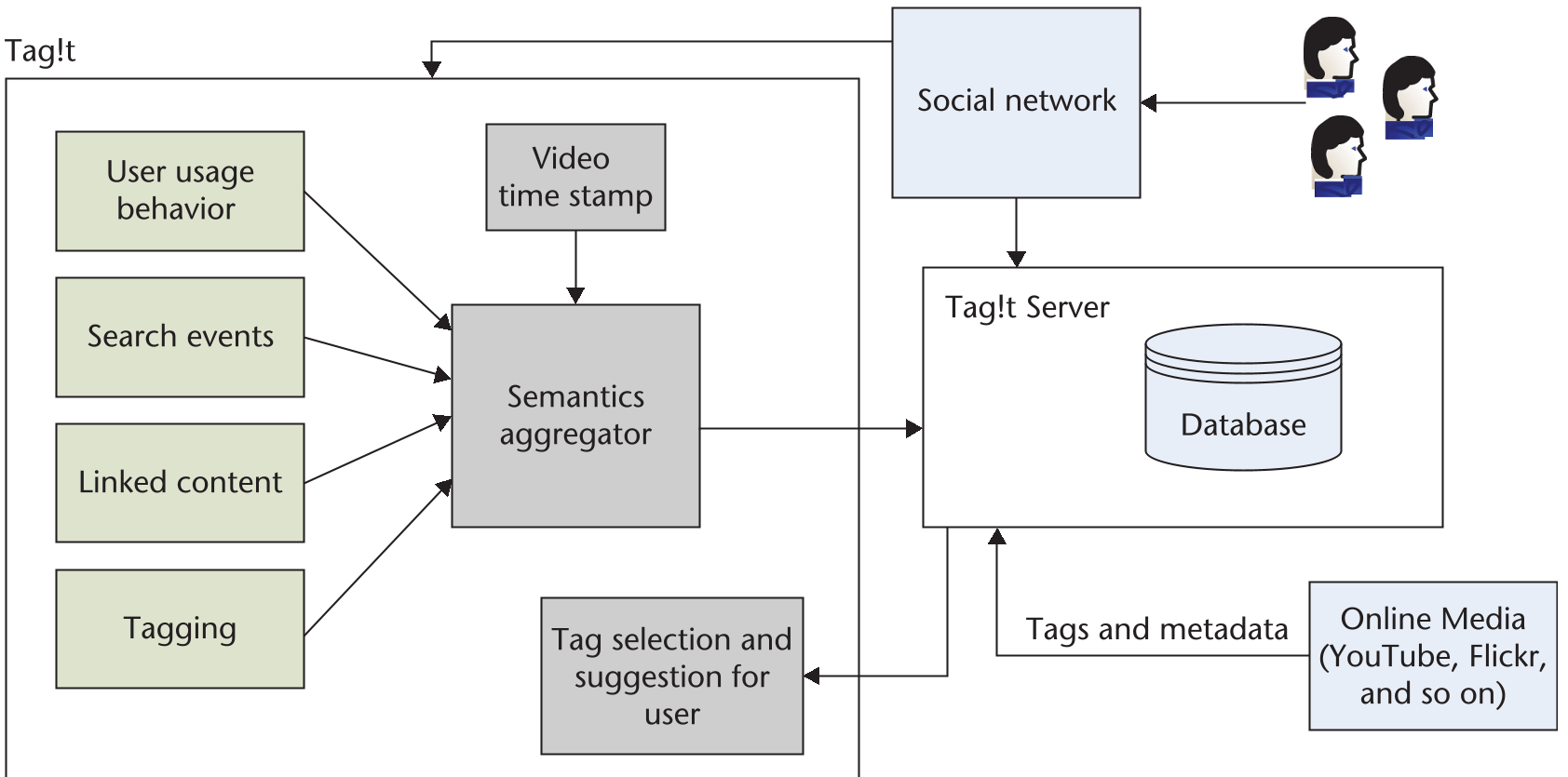 Figure 1: The Tag!t architecture integrates public APIs from YouTube and Flickr with a Facebook-based front end.
Turning Tagging into a Sport
A major hurdle in metadata acquisition is user motivation. Why would a user bother to tag a video? The authors implemented a Competition Mode. Users compete with friends to see whose tags align most closely in time. This "gamification" encourages users to be precise and frequent with their annotations, effectively generating a high-density "ground truth" for the video's timeline.
Experimental Insights: Tribes Think Alike
The study compared "Technical" and "Non-Technical" groups. When watching a comedy clip about physics, the technical group’s tags formed tight clusters around the specific scientific puns, whereas the non-technical group had a much more dispersed tagging pattern.
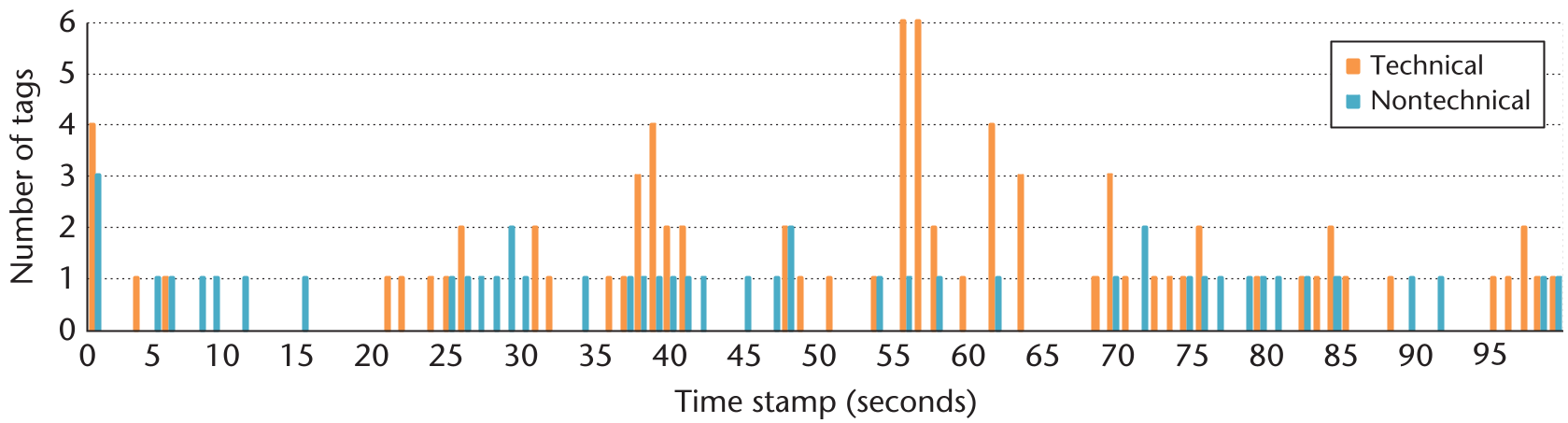 Figure 2: Heatmap showing how Technical vs. Non-Technical users hover around different semantic triggers within the same timeframe.
Key Findings:
- Incentive matters: Competition mode creates higher data density.
- Context matters: The "hidden" vs. "visible" tags experiment showed that users are primarily motivated by the video content itself, not just "copying" others.
- Group Identity: Technical users are more prolific taggers (averaging 27% more tags) and use more specific terminology.
Critical Analysis & Future Outlook
While Tag!t successfully demonstrates how to collect data, the next frontier is Automation. The authors suggest that this harvested "social consensus" can be used to train better machine learning models that understand human emotion in video—not as a global average, but as specialized interpretations based on a viewer's social profile.
The Takeaway: The future of video metadata isn't just AI "looking" at pixels; it's AI "listening" to the social conversations and behavioral signals that surround those pixels. By bridging the gap between social networking and media analysis, we can build search engines that truly understand the nuance of human experience.