
Tag!t: Mining Video Semantics from the Social Graph
Using Social Networking and Collections to Enable Video Semantics Acquisition
The paper introduces Tag!t, a social-networking application designed to acquire rich video semantics by leveraging implicit and explicit user interactions. It integrates video content from services like YouTube with social platforms like Facebook to generate temporal tags, collection metadata, and linked content.
TL;DR
The paper presents Tag!t, a Facebook-integrated application that tackles the "semantic gap" in video retrieval. By combining social group data with temporal tagging and behavioral monitoring, the system transforms passive video watching into a metadata-generating engine, achieving high semantic consensus through social interaction.
The "Tagging" Dilemma: Why Authors Aren't Enough
In the early era of user-generated content (UGC), metadata was primarily a "bottom-up" process: the uploader would provide 5-10 keywords. This approach fails for two reasons:
- Subjectivity: One man's "funny" is another man's "annoying."
- Temporal Blindness: A tag for a 10-minute video describes the object, not the specific events occurring at minute 3:00 vs. minute 7:00.
Individual users often lack the motivation to perform granular temporal tagging. The authors suggest that the solution lies not in smarter AI alone, but in social-networking context.
Methodology: The Four Pillars of Semantics
The Tag!t system extracts metadata through four distinct avenues:
- Collection Semantics: Analyzing how users group videos into playlists (e.g., a "Stop Motion" folder provides high-level genre confirmation).
- Temporal Tagging: Allowing "emotitags" (one-click emotional reactions) anchored to specific timestamps.
- User Behavioral Semantics: Monitoring "seek," "pause," and "skip" events. If a social group consistently skips a segment, that segment is semantically "boring" for that demographic.
- Linked Content Semantics: When a user links a Flickr photo or another YouTube video to a specific scene, the tags from those external objects are imported to enrich the original video's profile.
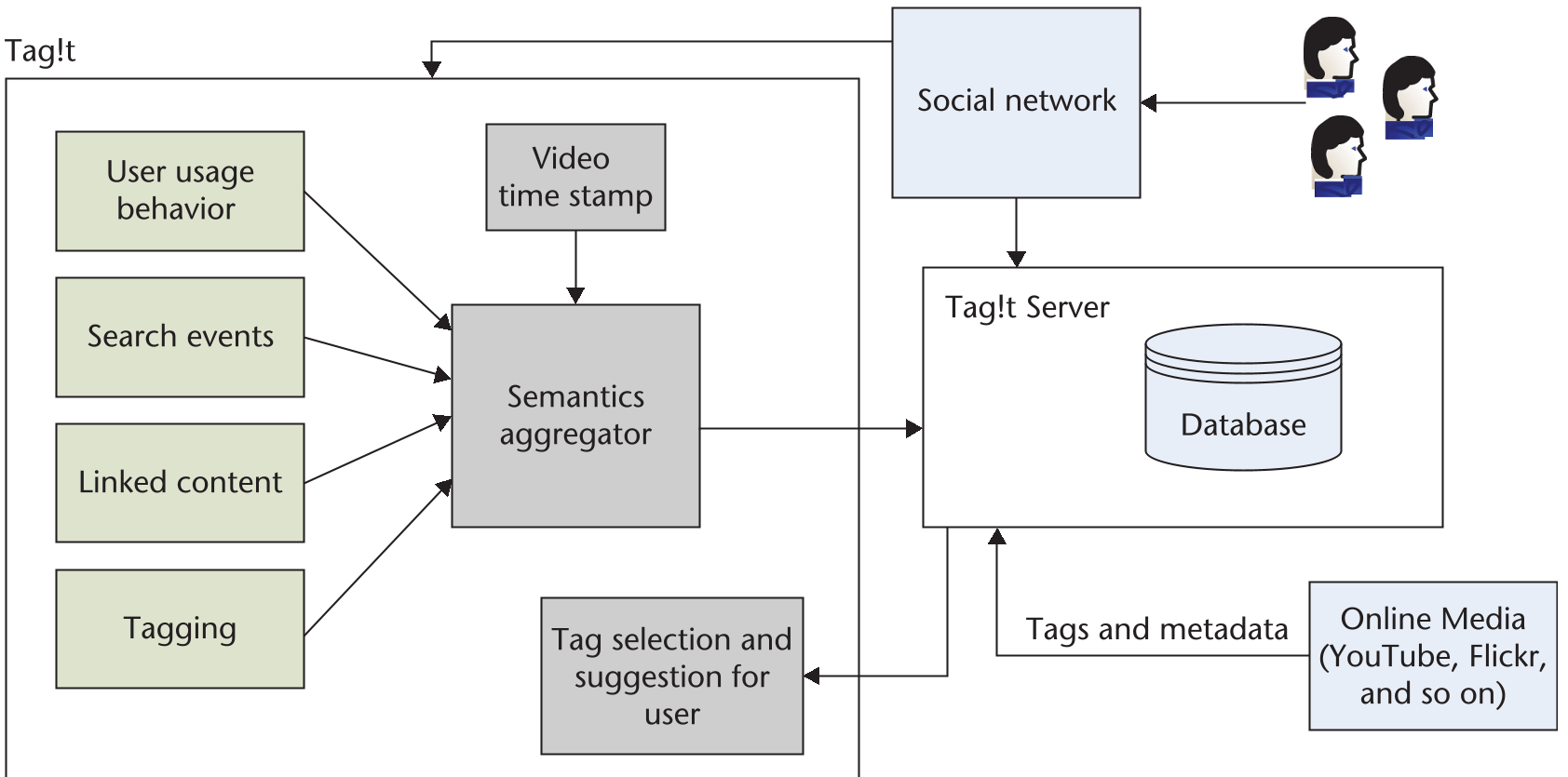 Figure 1: The Tag!t System Architecture, showing the flow from social networking APIs to the Semantics Aggregator.
The Role of Social Consensus
The core "Insight" of this work is that social groups normalize language. While tags in the wild are messy (synonyms, polysemy), within a closed group of "Technical Users" or "Friends," a consensus emerges. The authors used Continuous Media Markup Language (CMML) to deliver these dynamic, group-filtered tags to users in real-time.
Experimental Insights: Technical vs. Casual Users
The evaluation revealed a fascinating divide in how different demographics interact with media.
- Clustering: Tags were not randomly distributed; they clustered tightly around specific "events" or jokes in the video, proving that temporal tagging effectively captures content semantics.
- Demographic Deviation: Technical users were more proactive taggers. Non-technical users required more intuitive interfaces or external "prompts" (forced tagging via CMML) to contribute.
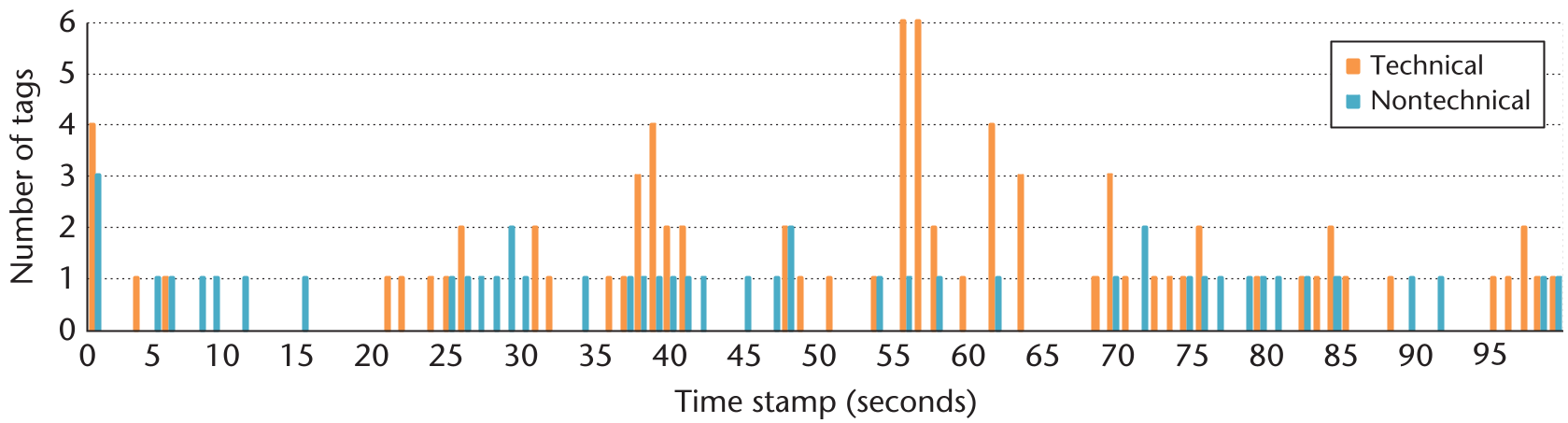 Figure 2: Comparison of tag distribution between groups, showing clear temporal alignment with video highlights.
Conclusion and Future Outlook
Tag!t demonstrates that the social network is not just a place to share media, but a laboratory to understand it. By treating "skipping" a video as a semantic signal and leveraging the "competition" motive among friends, we can generate a depth of metadata that traditional algorithms still struggle to reach.
Future Directions: The authors point toward using these social ontologies to automatically "repurpose" video—essentially creating AI-generated highlights (mashups) based purely on where the "crowd" laughed or skipped.