
Social Media as a Connection Crutch: The Hidden Cost of Virtual Interaction
A proposed study examining the effects of social networking use on face-to-face communication
This research-in-progress paper proposes an empirical study investigating the impact of social networking sites (specifically Facebook) on the face-to-face (FTF) communication habits and social connectedness of college freshmen. The authors propose a moderated model to test if high social media usage negatively correlates with real-world social interaction and psychological wellbeing.
TL;DR
This research proposal from the SIGMIS-CPR conference investigates whether the meteoric rise of Facebook (which reached 500 million users by 2010) comes at the expense of our physical social lives. Focusing on college freshmen, the authors argue that social networking may act as a dysfunctional surrogate for face-to-face (FTF) interaction, particularly for introverts who use the digital medium to escape the complexities of real-world communication.
Background & Motivation: The Paradox of Connection
In the early 2010s, the "social networking movement" was viewed as a revolutionary tool for staying connected. However, the authors identify a growing concern: is technological connection leading to human disconnection? Unlike general internet use—which might involve solitary activities like reading news—Facebook was designed to mimic community.
The authors' central research intuition is that this mimicry is deceptive. Human beings are biologically wired for "The Human Moment"—a state of physiological and psychological benefit that can only be triggered by physical presence. By substituting these moments with digital "pokes" and status updates, we may be starving ourselves of essential social nutrients.
Methodology: The Moderated Displacement Model
The study proposes a survey-based approach focusing on college freshmen, a demographic at a critical "junction point" where they must form entirely new social circles.
Core Hypotheses
- H1: Displacement. High social media use leads to less time spent in FTF interaction and lower feelings of social connectedness.
- H2: Motivation Matters. This negative relationship is stronger for those who use Facebook specifically for "personal connection" rather than functional tasks (like photo storage).
- H3: The Introversion Anchor. Introverts are more likely to use social media as a "shield," exacerbating the loss of FTF skills and connections.
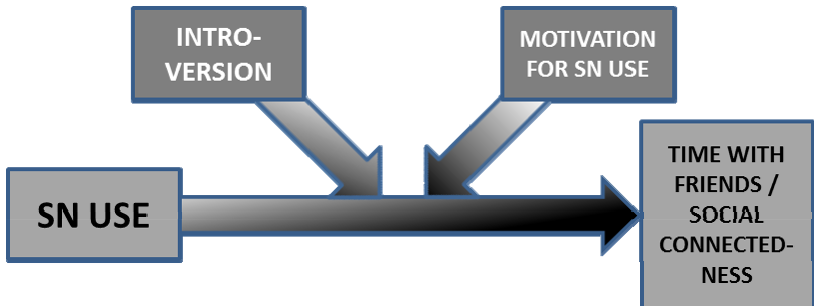 Figure 1: The proposed conceptual framework illustrating how usage, motivation, and personality interact to influence social outcomes.
Deep Dive: The Introvert’s Dilemma
One of the most compelling insights in this paper is the analysis of Introversion vs. Extroversion. The authors hypothesize that:
- Safety in Detachment: Social networking sites (SNS) allow introverts to "think before they speak," avoiding the high-pressure, high-bandwidth cues of FTF talk (body language, tone, eye contact).
- The "Crutch" Effect: Over time, this reliance on digital detachment prevents introverts from developing the skills needed for real-world intimacy. While digital interactions are often more candid or "open" (due to the lack of social risk), they remain shallow, failing to provide the physiological rewards of a physical presence.
Critical Analysis & Future Outlook
While this was a "work in progress" at the time of publication, its value lies in its early identification of Social Media Addiction and the specific psychological mechanisms of displacement.
Limitations
- Self-Report Bias: Relying on students to estimate their own "minutes spent" on Facebook is notoriously inaccurate compared to modern digital telemetry.
- Technological Shift: In 2011, Facebook was the dominant platform; today’s short-form video algorithms (TikTok) and "ephemeral" messaging (Snapchat) would likely influence these dynamics differently.
Conclusion
The study serves as a warning: if we treat social media as an adequate replacement for physical interaction, we risk a "socially disconnected" society. For those in developmental transitions—like students—the "comfort" of the screen might actually be a barrier to long-term social health.